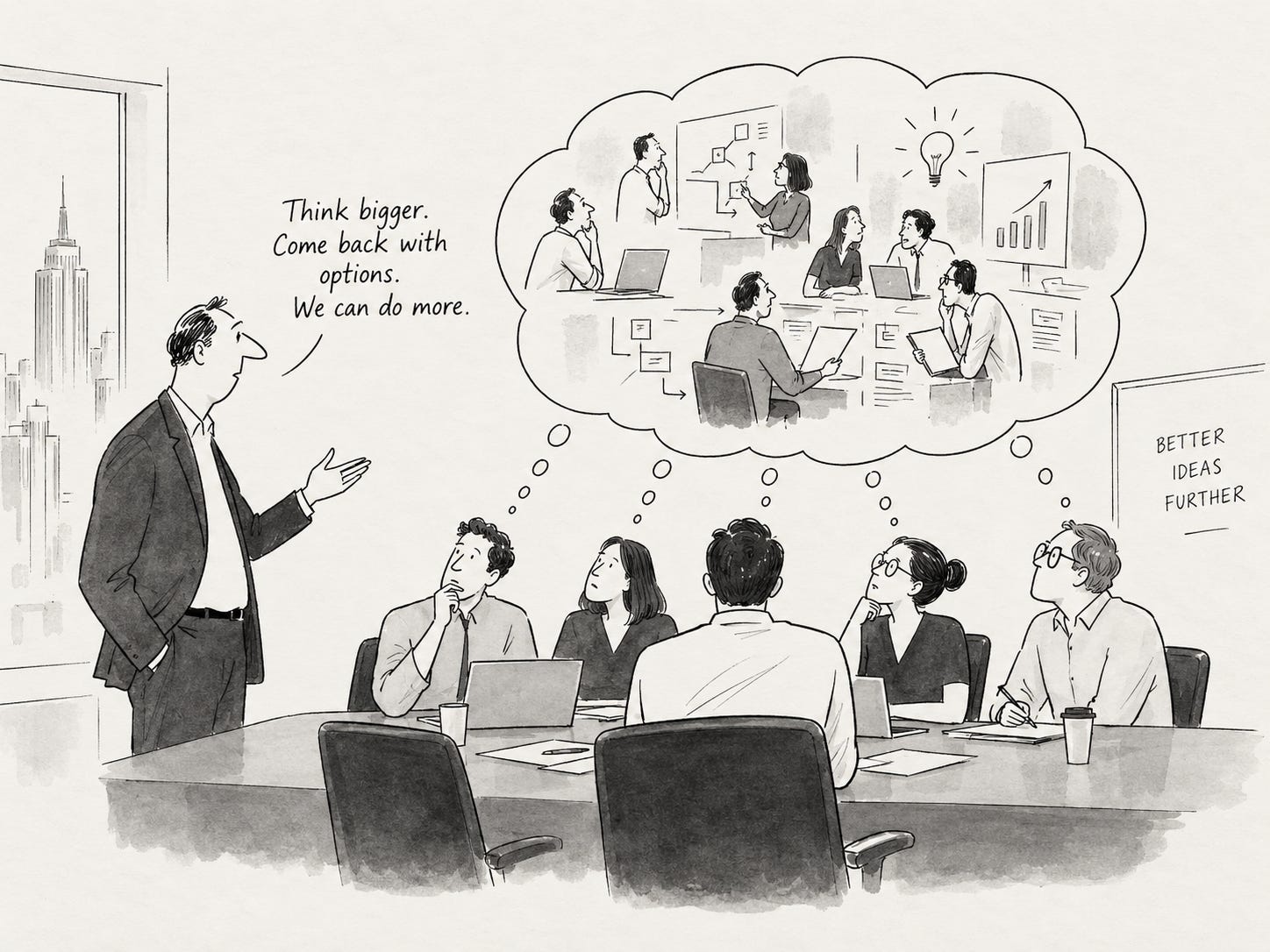
I have worked with leaders who can explain an idea so clearly that by the end of a conversation almost everyone in the room understands exactly what needs to happen.
The objective is clear. The logic is clear. The priorities are clear. The leader has anticipated most of the obvious questions, resolved the contradictions and translated the whole thing into something executable.
I tend to be one of these people.
Over the years, I have put considerable effort into creating clarity for the people I work with. I like reducing a complicated problem until its underlying structure becomes visible. If I have spent days thinking about something, my instinct is to transfer as much of that thinking as possible to the people who now have to work on it.
It seems almost self-evidently useful. If I can save ten people from having to reconstruct something I have already figured out, why wouldn’t I?
At the same time, I have had the privilege of working across several organizations and alongside very different kinds of leaders. Many became close friends, which gave me an unusual view of how they actually thought. I knew when an idea was still half-formed, when they were searching for the language to describe something, and when what sounded like a deliberately sparse instruction was simply the best articulation they had available at the time.
Some of them were remarkably ambiguous leaders.
They often had a strong intuition about where they wanted to go but could not always convert that intuition into language another person could immediately act on. Some were impatient. Some were sufficiently revered or feared that people were reluctant to return repeatedly for clarification.
And yet their teams would produce excellent work.
This used to irk me.
I would sit in a meeting seeing five ambiguities in what had just been communicated and assume the team would disappear down five different paths. Then the work would return remarkably coherent. Sometimes the team appeared to have created more clarity than had existed in the original instruction.
Eventually I started experimenting with this myself. With some teams I continued providing considerable context and reasoning. With others I created basic systems around objectives, constraints and standards, then stepped back. My early attempts were crude, but the pattern was interesting. Teams given more unresolved territory sometimes investigated more, argued more and returned with things I had not anticipated.
None of this makes ambiguity inherently desirable. Research on role ambiguity generally finds it associated with poorer performance. Clear objectives matter enormously.
Something more specific seemed to be happening.
It had to do with where the cognition occurred.
Takeaway: The amount of clarity in an organization may matter less than who had to perform the thinking required to create it.
THE COGNITIVE WATERFALL
Imagine a leader has a difficult problem and a team of six capable people.
The leader thinks deeply about it. She defines the problem, considers the alternatives, identifies the constraints, decides what matters, constructs a solution and explains her reasoning beautifully.
The six people receive an unusually clear brief.
They execute it.
The organization has benefited from excellent cognition, but most of that cognition occurred in one brain.
Now imagine another leader.
He has a strong idea of where he wants to go. He may recognize the right answer instantly when he sees it. But part of the model is tacit. He struggles to convert it into language.
“This isn’t quite it.”
“We’re thinking about this too narrowly.”
“There’s something bigger here.”
“Come back with another way of looking at it.”
There is information inside those statements. The transmission is simply incomplete. Six people now leave the meeting trying to resolve what remains.
One interprets the commercial problem. Another examines competitors. Someone remembers what the leader rejected three months earlier. Another challenges the premise. They produce several interpretations, discard some, combine others and discover contradictions nobody had noticed.
By the time they return, they may have constructed a clearer model than the one originally communicated.
The first organization received clarity. The second had to manufacture it.
That manufacturing process is easy to mistake for wasted motion because some of it undoubtedly is. Yet it also changes who has engaged cognitively with the problem.
Takeaway: Clarity is an output of cognition. When leaders deliver it fully formed, teams receive the output. When teams must construct some of it themselves, the cognitive work becomes distributed.
WHEN THINKING MOVES DOWN THE ORGANIZATION
We normally talk about delegation as the movement of work.
A leader decides what needs to happen and delegates execution.
Cognition can move too.
Once a sufficiently difficult problem moves from one brain into six brains, the computational architecture changes. There are six different histories, six sets of pattern recognition, six ways of decomposing the problem and six opportunities to notice something the others missed.
Six people obviously do not produce six times the intelligence. Coordination has costs. Groups conform, duplicate work, politicize and sometimes reinforce bad ideas.
Still, six people executing somebody else’s completed reasoning are doing something fundamentally different from six people constructing part of the reasoning themselves.
The problem has become parallel.
Different people can search different parts of the possibility space. Their partial answers collide. Weak interpretations disappear. Strong ones combine. Occasionally someone discovers that the original framing itself was wrong.
This is where ambiguity can produce an unexpected secondary effect. The organization is not merely trying to complete a task. It is exercising its capacity to interpret.
Takeaway: Delegating execution distributes labour. Leaving meaningful reasoning unresolved can distribute cognition.
THE BOSS BECOMES AN INVERSE PROBLEM
In mathematics and science, an inverse problem begins with observations and asks what underlying system could have produced them.
You observe the effects and infer the hidden cause.
Some organizations do something remarkably similar with their leaders.
The leader does not fully articulate the model. The organization gradually reconstructs it from observations.
He hated this presentation.
He loved that proposal.
He keeps asking about scale.
He gets irritated when people bring him activity rather than outcomes.
He rejected the cheaper option even though he constantly talks about cost.
Taken individually, the reactions can appear arbitrary. Taken over time, they become data.
The team is effectively estimating a hidden function:
Observed leader reactions → inferred leader model
Eventually people begin predicting the leader.
“I don’t think she’ll buy this.”
“He is going to ask why this can’t be ten times bigger.”
“Before we show him this, we need to solve the economics.”
The leader’s behaviour has become training data.
This can be unhealthy, as we will get to later. But cognitively it is fascinating. The organization has constructed a model that the leader never successfully wrote down.
And the construction itself required observation, abstraction, memory and inference.
Takeaway: An ambiguous but internally coherent leader can force an organization to infer a model rather than simply receive one. Repeated inference can itself become organizational capability.
CLARIFICATION HAS A PRICE
There is another mechanism involved.
When a leader is endlessly patient, accessible and willing to clarify every uncertainty, another question is cheap.
When a leader is impatient, intimidating, extraordinarily busy or sufficiently revered that nobody wants to waste her time, clarification becomes expensive.
Whenever something becomes expensive, people economize on it.
Before asking the boss, they ask each other.
They search old documents. They inspect previous decisions. They construct hypotheses. They rehearse their reasoning. They eliminate questions they believe they should be able to answer themselves.
The social cost of asking creates a kind of clarification tax.
That tax can become destructive. People may hide mistakes or avoid raising information the leader desperately needs to hear. Research on psychological safety gives us good reason to worry about precisely this. Fear can suppress information rather than improve reasoning.
But before reaching that threshold, a more peculiar effect may occur. Some questions that would have travelled upward are instead resolved sideways.
The organizational network starts doing work that the hierarchy otherwise would have done.
The important boundary is whether people stop asking unnecessary questions or become afraid to ask necessary ones.
Takeaway: Making upward clarification costly can redirect problem-solving sideways through the organization. Beyond some threshold, the same mechanism suppresses information and becomes dangerous.
WE LEARN FROM WHAT WE HAVE TO GENERATE
There is a useful clue from cognitive psychology.
Researchers have known for decades about the generation effect. People tend to remember information better when they have generated it themselves than when equivalent information is simply presented to them.
The effect has been demonstrated across many experimental conditions. An organization is obviously much more complicated than a laboratory memory experiment, so it would be careless to treat this as proof that ambiguous leadership improves companies.
The underlying distinction is nevertheless useful. Receiving an answer and constructing an answer are different cognitive activities. When the leader supplies the interpretation, the team needs to understand it.
When part of the interpretation remains unresolved, the team has to generate it.
Generation requires more effort. It may also create greater ownership and a richer mental model of the problem.
More importantly, the output is no longer merely the solution. The people who produced the solution have also changed. They have practiced solving that class of problem.
Takeaway: Cognitive work has two outputs: the answer produced today and the judgment developed while producing it.
CLARITY CAN CENTRALIZE COGNITION
This creates an odd problem for exceptionally clear leaders.
Suppose someone is unusually good at taking messy problems and making them understandable.
People bring complicated things upward. The leader sees the structure, removes irrelevant variables, resolves contradictions and sends clarity back down.
Once, this is helpful.
Repeated hundreds of times, the organization begins learning where clarity comes from.
A difficult problem appears. Instead of six people wrestling with it, they escalate it. The leader solves it. They execute.
The better the leader becomes at doing this, the more rational escalation becomes.
Why spend six hours debating something the CEO can clarify in twenty minutes?
At the level of the individual task, the arrangement is wonderfully efficient.
Over time, however, cognition begins accumulating at the top.
There is a feedback loop.
The hardest problems keep reaching the leader, so the leader gets more practice solving hard problems. The people below get less practice because those same problems keep being resolved for them. The leader’s judgment improves faster. Escalating problems therefore becomes even more rational.
Eventually everyone observes that the leader is simply much better at these decisions.
She probably is.
The system has been training her.
This is where systems become useful. A leader can encode objectives, constraints, standards and decision principles without encoding the entire solution. The system constrains the search space while leaving people inside it responsible for searching.
That is a very different use of clarity.
It provides enough architecture to prevent unnecessary chaos while preserving some cognitive work downstream.
Takeaway: Repeatedly supplying answers can create a feedback loop in which judgment concentrates around the person already best at exercising it. Systems can interrupt that loop when they constrain reasoning without replacing it.
THE IMMEDIATE EFFICIENCY TRAP
Now imagine the opposite case.
A team spends three hours resolving something the leader could have solved in twenty minutes.
Measured at the task level, this is terrible economics.
Two hours and forty minutes have apparently been wasted.
But suppose five people participated in solving it. They encountered the structure of the problem. They argued about possible explanations. They made predictions. Some were wrong. They corrected one another and eventually arrived somewhere.
The project paid an efficiency cost.
The organization acquired cognition.
The next time a similar problem appears, five people possess slightly more relevant judgment than they did before.
This introduces a time horizon into the problem.
Organizations naturally measure execution today: speed, rework, missed deadlines, errors and output.
The development of distributed judgment is harder to see.
A leader can therefore save ten people from two hours of confusion today while quietly removing two hours of cognitive training from the organization.
Occasionally, the efficiency gain almost certainly dominates.
Repeated continuously for years, the calculation becomes less obvious.
Takeaway: What looks inefficient at the level of one task can be capability investment at the level of the organization. The return only becomes visible across repeated problems.
THE COGNITIVE COMPOUNDING PROBLEM
This may explain why some teams surrounding ambiguous leaders become surprisingly capable.
Every incomplete instruction creates a small interpretive problem.
Every problem requires judgment.
Every judgment creates experience.
Every successful resolution becomes available for the next problem.
And because several people are often involved, the cognition moves sideways as well as downward.
Over enough repetitions, small differences can compound.
If one leader performs ten difficult acts of reasoning, the organization gets ten solutions.
If ten people participate meaningfully in those acts of reasoning, the organization gets the solutions plus a larger population that has practiced producing them.
The ambiguous leader may therefore appear strangely effective despite being locally inefficient.
The leader has accidentally imposed a cognitive training regime on the organization.
This does not absolve poor communication. Some ambiguity contains nothing useful to discover. If the leader’s internal model is incoherent, employees can spend enormous amounts of intelligence reconstructing something that never existed.
The mechanism requires an important condition: somewhere behind the imperfect communication there must be a reasonably coherent standard, objective or model against which the team’s interpretations eventually receive feedback.
Otherwise cognition is merely being consumed.
Takeaway: Ambiguity can compound organizational judgment only when repeated interpretation eventually encounters coherent feedback. Without that feedback, ambiguity produces waste rather than learning.
SYSTEMS MAY BE THE AFTERMATH
This makes famous companies surprisingly difficult evidence for leadership clarity.
We often look at a highly systematized organization and infer a highly systematic leader. That inference is unsafe. Organizations create systems too.
A company repeatedly misunderstands the founder, so somebody creates a briefing template.
Decisions bottleneck at the top, so somebody establishes decision rights. Priorities move quickly, so a planning cadence emerges.
The founder asks variations of the same five questions in every review, and eventually someone turns those questions into a framework everyone uses before entering the room.
Notice what the subordinate has done.
They observed repeated behaviour, inferred the underlying pattern, abstracted it and converted it into something other people can use.
Even the creation of the system can therefore be an act of distributed cognition.
Years later, outsiders encounter an elegant operating system and attribute it to the founder’s management philosophy.
Perhaps some of it was. Other parts may be organizational scar tissue. The system records problems that people repeatedly had to solve.
This makes companies such as Amazon, Apple, Intel and other founder-shaped organizations difficult to place neatly on a spectrum of leader clarity. Their mature systems are products of leadership, subordinates, accumulated experience and adaptations to earlier failures.
The company we observe twenty years later conceals much of that provenance.
Takeaway: Organizational systems cannot automatically be treated as evidence of leader clarity. Some systems transmit the leader’s cognition; others are adaptations created by employees to compensate for its incomplete transmission.
THE SURVIVORSHIP PROBLEM
There is another serious complication.
Suppose an extraordinarily demanding and ambiguous founder employs 100 people. Over several years, 70 leave. Twenty fail. Ten become astonishingly good at anticipating the founder and resolving incomplete instructions. Years later, outsiders meet those ten and conclude that the leader develops extraordinary people.
Perhaps.
Or perhaps we are looking at survivors.
Ambiguous leadership can simultaneously train some people, select for people already good at ambiguity and drive everyone else away. Those mechanisms produce similar observations from the outside.
Talent therefore matters enormously. So does accumulated context, feedback frequency and whether people can disagree safely.
A brilliant but poorly articulated leader and an incoherent poorly articulated leader can feel remarkably similar during the first meeting.
Over time, the difference becomes enormous.
The capable team may also precede the leader’s ambiguity rather than result from it. Highly talented people are simply better equipped to fill missing information.
Any claim that ambiguity creates excellent teams therefore has to survive this selection problem.
Takeaway: High-performing teams around ambiguous leaders may reflect development, selection or both. Observing the survivors cannot tell us which mechanism produced them.
WHEN THE ORGANIZATION LEARNS THE WRONG THING
A team can become extraordinarily sophisticated at predicting the boss while becoming progressively worse at predicting reality.
If enough organizational cognition is devoted to asking what the leader will think, the leader can gradually replace the customer, market, physics or evidence as the system’s ultimate source of truth.
People optimize presentations rather than problems.
Bad news gets translated into acceptable language.
Experiments become attempts to validate anticipated preferences.
The organization may become excellent at solving the inverse problem of its leader.
It has simply solved the wrong inverse problem.
This is where fear becomes particularly dangerous. Ambiguity combined with an inability to challenge the leader can turn distributed cognition into distributed obedience.
Six brains are still working very hard.
They are working on satisfying one brain.
Healthy ambiguity therefore requires an external correction mechanism. Reality must retain veto power. Customers, measurements, experiments, economics and observable outcomes need to be capable of proving both leader and team wrong.
Takeaway: Distributed cognition creates organizational intelligence only when the object being learned remains reality. If predicting the leader becomes the objective, the same mechanism produces sophisticated conformity.
THE STRANGE ECONOMICS OF CLARITY
This began for me as an irritating observation about leaders who seemed less clear than they should have been.
The more I think about it, the more it resembles an allocation problem.
Cognition is a resource.
A leader can perform a large share of it centrally and distribute the resulting clarity. This is fast, particularly when the leader is very good.
The organization can also leave meaningful portions of difficult problems unresolved and allow cognition to occur across many people. This introduces redundancy, disagreement and occasionally waste. It also gives more people repeated exposure to difficult judgment.
Systems can sit between those extremes. They can carry accumulated knowledge, establish constraints and prevent the organization from rediscovering everything from scratch while still leaving consequential reasoning to the people doing the work.
The trade-off changes with time.
Centralized clarity can improve today’s execution. Distributed cognition can build the organization’s ability to solve tomorrow’s problems without returning to the same person for answers.
Neither mechanism is free. Too much centralized cognition produces dependence. Too much ambiguity produces waste. Fear can corrupt the entire process. Weak teams may simply drown in uncertainty. High-stakes problems sometimes leave little room for learning through interpretation.
But there is a cost that rarely appears when we celebrate exceptionally clear leadership.
Every time a leader resolves an ambiguity for the team, the immediate problem becomes easier. The team also loses one opportunity to practice making that judgment itself.
Once or twice, this hardly matters. Across hundreds of decisions, it determines who accumulates experience solving difficult problems.
If the answer is repeatedly the leader, the gap between the leader’s judgment and everyone else’s should widen. More decisions then flow upward because the leader really has become better at making them. The organization can eventually find itself dependent on the very person whose clarity helped make it efficient.
If more of those decisions are worked through by capable people throughout the organization, progress may initially be slower and messier. But judgment has more places to accumulate.
That seems to be the strange economics of clarity.
The fastest way to get an answer today may sometimes be the slower way to build an organization that can answer without you tomorrow.