Sand (formerly Sand Technologies) invited me to Miami on a project. Three days at their Physical AI Evolve Summit. The highlight was the founder Fred Swaniker’s synthesis of how cities relate to data. Dark cities have none. Noisy cities drown in inactionable data. Intelligent cities turn data into actionable insights that drive change. The theme distilled to three words: Sense, Analyze, Act.
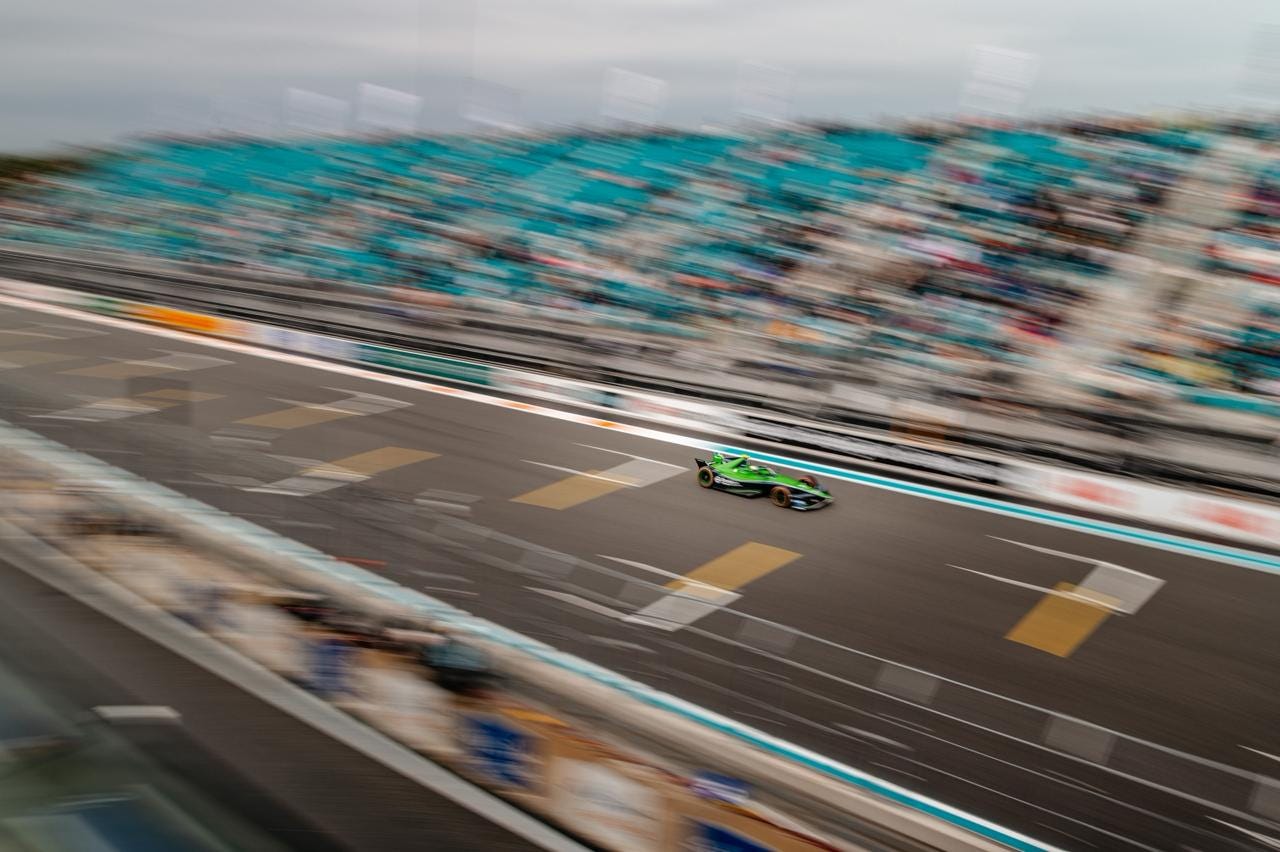
On the last day, we went to Formula E. Sand is an official partner of Envision Racing, providing AI solutions that CTO Sylvain Filippi has called a game changer for the team.

I thought I knew what fast looked like. I’d seen the F1 movie. Brad Pitt at 320 kilometers per hour, the camera shaking, the soundtrack telling you this is intense.
Then I stood trackside and watched the real thing. Nothing prepares you. The cars pass so quickly your brain processes them after they’re already gone.
But what caught my attention wasn’t the acceleration. It was what happened every time they slowed down.
In Formula E, teams don’t just compete on who can go fastest. They compete on who loses the least when forced to slow down.
Traditional brakes fight motion with friction. Friction generates heat. Heat escapes into the air. The energy released during deceleration simply vanishes. Regenerative braking reverses the motor instead, turning that deceleration into stored electricity. What would have been lost becomes available for the next acceleration.
Think of the difference between a bouncy ball and a lump of clay. Drop both from the same height. The clay hits the ground and stays there. All that falling energy converts to a dull thud and some heat. The bouncy ball returns most of that energy, springing back almost to where it started. Regenerative braking turns a race car into the bouncy ball.
Energy comes in two basic flavors. Potential energy is stored and waiting, like a boulder at the top of a hill. Kinetic energy is energy in motion, the boulder rolling downhill. A moving car is a vessel of kinetic energy. Braking empties that vessel. The question is where the contents go.
In Formula E, up to 40 percent of the total energy used in a race comes from regenerative braking. Drivers don’t just start with a full battery. They rebuild it, corner by corner, throughout the race.
The Physics Of Leadership...and Energy
Standing there watching the Envision car recover power from every corner, I found myself thinking about leadership. About what happens when momentum stalls. About where all that energy goes when a team, a project, a career is forced to slow down.
Most leadership operates like friction braking. When setbacks occur, when projects stall, when teams encounter resistance, the kinetic energy of forward motion converts entirely into organizational heat. Frustration. Blame. Political maneuvering. Stress that dissipates into hallways and Slack channels, warming nothing useful, powering nothing forward.
A product launch fails. The post-mortem happens. Lessons are “documented” in a shared folder no one will open again. The team moves on, depleted. They lost speed, and they gained nothing in return.
Engineering Recovery
Regenerative braking isn’t passive. The Envision team tunes it constantly. Too little regen and you’re leaving energy on the track. Too much and the car becomes unstable under braking.
The driver has a paddle on the steering wheel that adjusts regen intensity in real time. Approaching a fast sweeper where you want the car stable? Dial it down. Entering a heavy braking zone? Dial it up. The skill is knowing when to maximize recovery without destabilizing the vehicle.
Leadership recovery works the same way. Push for lessons too early, while a team is still processing a failure, and you create whiplash. Wait too long and the energy dissipates as heat. The skill is calibration.
So What
Think about your last significant setback. A project that failed. A deal that fell through. A reorganization that disrupted your momentum.
What did you actually recover from it? Not what you told yourself you learned. What tangible capability exists today that wouldn’t exist without that failure?
If you struggle to answer, you’re running friction brakes.
The shift requires recognizing deceleration as an energy opportunity rather than a pure loss. It requires timing awareness. And it requires capture mechanisms that actually store what you recover. A lessons-learned document no one reads is a battery with a hole in it.
The race ended. The cars returned to their garages. After each event, the Envision crew downloads 2 to 3 terabytes of data. Enough to store 500 hours of HD video. A single race generates more recorded information than most people consume in a year. They comb through it all, studying each braking zone, each regen adjustment, each fraction of a percentage point that might give them an edge next week. They aren’t lamenting the corners where they had to slow down. They’re optimizing what they recovered from them.
You will slow down. The question is whether you’ve engineered yourself to capture anything when you do.
Cool Facts - Formula E vs Formula 1
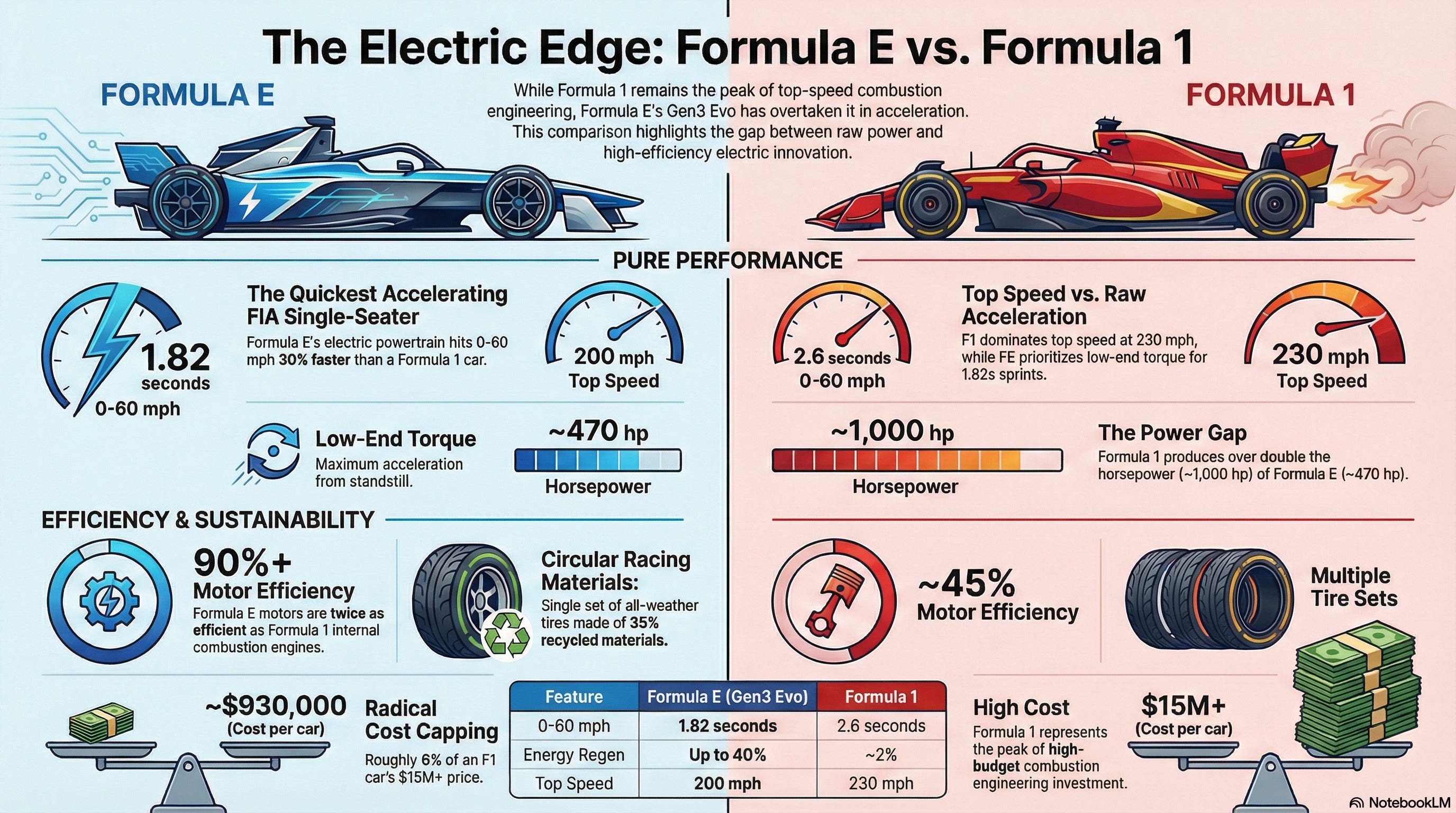
The Gen3 Evo Formula E car accelerates from 0 to 100 km/h in 1.86 seconds. That’s 30 percent faster than a current Formula 1 car. The quickest accelerating FIA single-seater on the planet isn’t powered by a combustion engine. It’s electric.
Formula 1 still wins on top speed. F1 cars reach around 370 km/h. Formula E maxes out at 322 km/h. And F1 produces roughly 1,000 horsepower compared to Formula E’s 470. But efficiency tells a different story. Formula E motors run at over 90 percent efficiency. Combustion engines manage around 40 percent.
Formula 1 teams burn through multiple sets per race, with pit crews changing them in under 2.5 seconds. Formula E uses one set of all-weather Hankook tires for the entire race. No changes. Those tires are made from 35 percent recycled and sustainable materials.
Formula 1’s hybrid system recovers about 2 percent of energy through regenerative braking. Formula E recovers up to 40 percent. One sport optimizes for raw speed. The other optimizes for what it keeps.