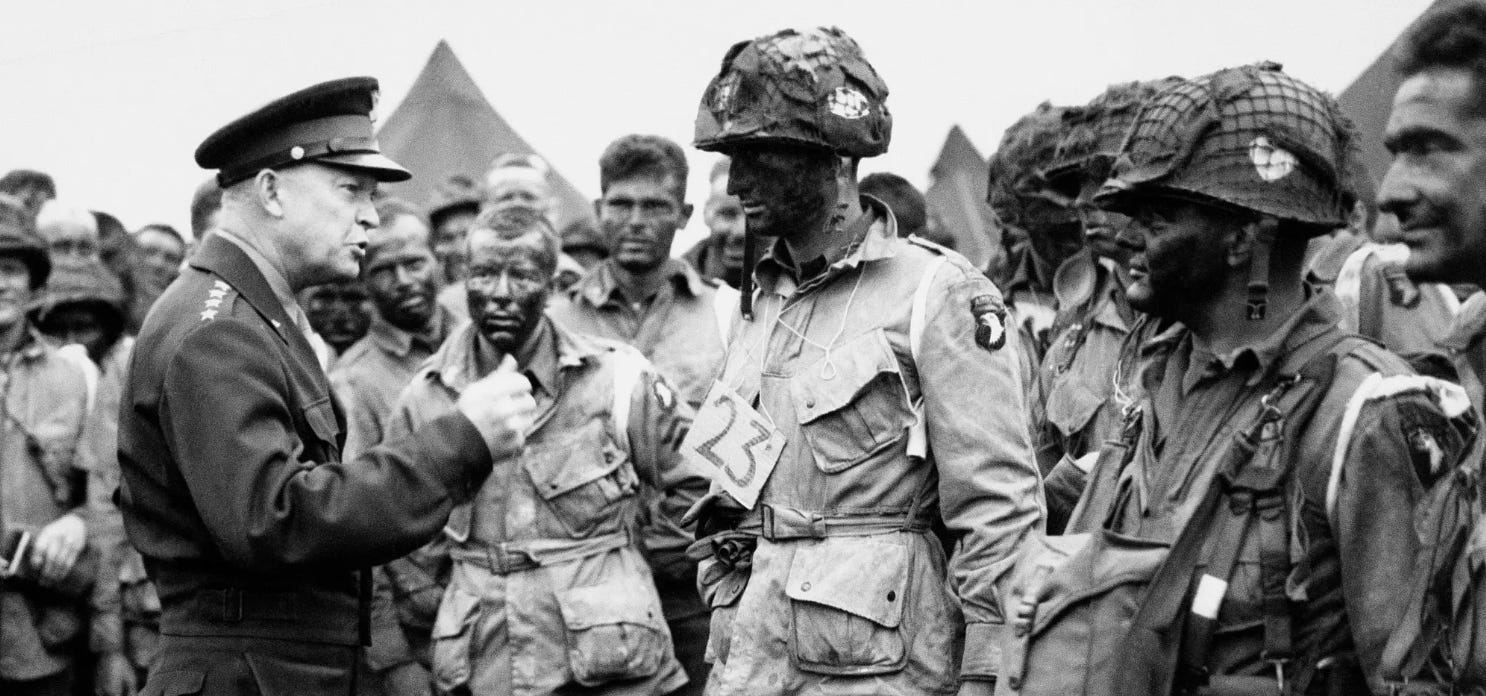
Try a quick experiment. Read these findings from one of the largest studies ever conducted on human behavior, a survey of over 600,000 American soldiers during World War II:
Men from rural backgrounds were usually in better spirits during their Army life than soldiers from city backgrounds. Makes sense. Rural men in the 1940s were accustomed to harsher conditions, more physical labor, longer hours. City boys, softer by comparison, struggled to cope.
Better educated soldiers showed more psychological distress than less educated soldiers. Of course. The intellectual mind ruminates. It overthinks. The less educated man just gets on with it.
Southern soldiers handled the tropical climate of the South Pacific better than Northern soldiers. Obviously. Southerners grew up in heat. Northerners didn’t.
You probably nodded along. You might have even thought, “Why did they need 600,000 interviews to tell us what anyone could have guessed?”
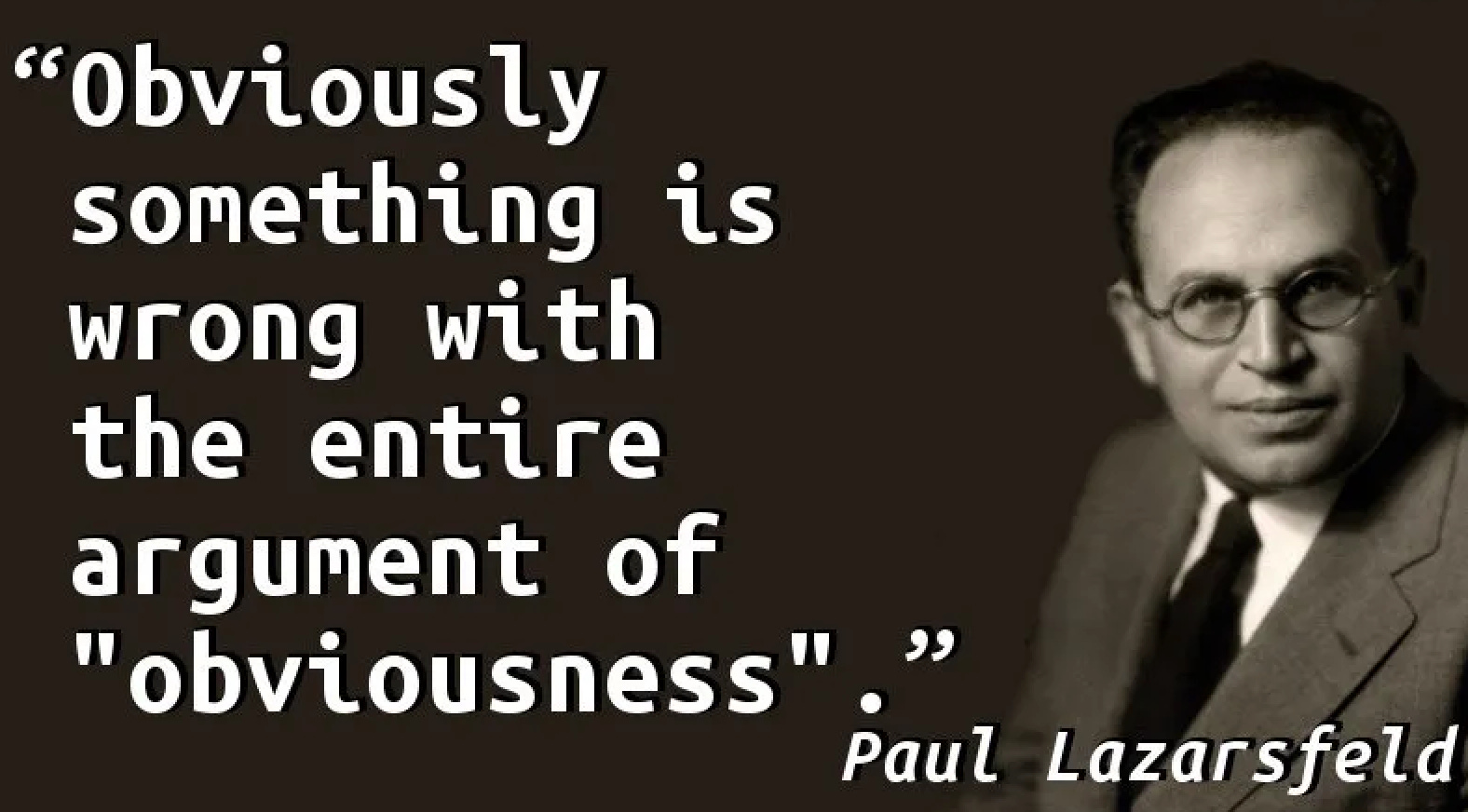
The sociologist Paul Lazarsfeld asked the same question in 1949 when he reviewed these results. Then he revealed the trick. Every single one of those findings was the exact opposite of what the study actually found. It was city soldiers who were happier. Less educated men showed more psychological symptoms. Southerners had no climate advantage over Northerners.
And if you’d been told the real results first, you would have nodded along just as comfortably. City men are used to working in crowded conditions, corporate hierarchies, strict schedules and social etiquette. Of course they adapted better. That’s obvious.
When every answer and its opposite both feel obvious, Lazarsfeld pointed out, something is fundamentally wrong with the entire argument of “obviousness.
A Word That Explains Everything and Predicts Nothing
Common sense might be the most confidently used and least examined concept in human conversation. Everyone claims to have it. Everyone accuses others of lacking it. Nobody defines it.
The American anthropologist Clifford Geertz tried. He described it as an “ancient tangle of received practices, accepted beliefs, habitual judgments, and untaught emotions.” That’s generous. A less generous description would be: a large pile of contradictory rules that get selectively applied after the fact.
Consider the proverbs we were raised on.
“Birds of a feather flock together.” But also: “Opposites attract.”
“Absence makes the heart grow fonder.” But also: “Out of sight, out of mind.”
“Many hands make light work.” But also: “Too many cooks spoil the broth.”
“He who hesitates is lost.” But also: “Fools rush in where angels fear to tread.”
“You’re never too old to learn.” But also: “You can’t teach an old dog new tricks.”
Each proverb sounds like wisdom. Each one feels true. And each one has an equally true, directly contradictory twin. This creates a system with a remarkable property: no matter what happens, there is a proverb ready to explain it. Something went well because of patience? “Good things come to those who wait.” Something went well because of speed? “The early bird gets the worm.” The proverb library has full coverage.
Full coverage of explanations. Zero coverage of predictions.
Common sense, in practice, operates like the doctor in a small town who told every pregnant patient the sex of their baby. To the mother, he’d say “girl.” In her medical chart, he’d write “boy.” If she had a girl, she marveled at his gift. If she had a boy and questioned him, he pointed to the chart. He was never wrong. He was also never useful. He just covered every possibility and took credit for whichever one happened.
That is what common sense does. It doesn’t forecast. It narrates.
Five Seconds After You Hear It
There is something even stranger about common sense than its contradictions. It reveals itself in the moment an answer is revealed.
Before you learn something, it feels uncertain, complex, possibly unknowable. The second you hear the answer, it feels like something you should have known all along. Five seconds separate complete ignorance from smug familiarity. Your brain crosses that gap so smoothly that you barely notice you were on the other side.
Psychologist Baruch Fischhoff named this phenomenon in 1975. He called it “creeping determinism,” though it’s better known now as hindsight bias, or the “knew-it-all-along” effect. In his original experiments, he gave people descriptions of real historical events with four possible outcomes. Some participants were told which outcome actually happened. Others were not. Then everyone was asked to estimate how likely each outcome was.
The participants who knew the answer consistently rated the actual outcome as more probable than those who didn’t know. They couldn’t unknow what they knew. But they also couldn’t recognize that knowing it had changed how they saw the problem.
This happens because the brain doesn’t store ignorance. It stores knowledge. When new information arrives, the brain integrates it immediately and rewrites the memory of what you thought before. Not deliberately. Not dishonestly. Automatically.
Think of it like writing in a notebook with pages that dissolve. You write your prediction on page one. The answer arrives and gets written on page two. Page one dissolves. Now when someone asks what you predicted, you read page two and assume it was always there.
We can express the relationship simply:
Confidence That You “Knew It” = Outcome Knowledge × (1 ÷ Memory of Prior Uncertainty)
Read this as: the more clearly you understand what happened, and the less you remember not knowing, the more convinced you become that you always saw it coming. As outcome knowledge goes up, confidence rises. As memory of your prior confusion fades toward zero, confidence approaches infinity. At the extreme, you become absolutely certain you predicted something you never could have.
Fischhoff’s student experiments confirmed this. Before Nixon’s trips to Beijing and Moscow, students estimated the probability of various diplomatic outcomes. After the trips, they were asked to recall their original predictions. Their recalled estimates were consistently biased toward whatever actually happened. They didn’t just feel like they knew it all along. They genuinely remembered predicting it.
A later study by Dietrich and Olson replicated this during the Clarence Thomas Supreme Court confirmation. Before the Senate vote, 58% of college students predicted Thomas would be confirmed. After he was confirmed, 78% claimed they had predicted it.
Twenty percent of people acquired a memory of a prediction they never made.
Why The Brain Deletes Uncertainty
None of this is a character flaw. It’s a design choice, and an old one.
The brain did not evolve to maintain an accurate record of what it once didn’t know. That would be computationally expensive and practically useless from a survival standpoint. What the brain evolved to do is update quickly, integrate new information into existing models, and move on. Dwelling on your prior confusion has no survival value. Knowing the answer does.
Researchers at the University of Washington tracked hindsight bias across the entire human lifespan, from age 3 to age 95. Every age group demonstrated it. Three-year-olds showed it. Ninety-five-year-olds showed it. It never went away. Preschoolers and elderly adults showed the most bias, but even college students in their cognitive prime couldn’t escape it.
Some researchers have argued this is actually a by-product of an otherwise adaptive system. Hoffrage, Hertwig, and Gigerenzer proposed that our brains are designed to acquire knowledge, not preserve ignorance. The system that lets you rapidly absorb new information is the same system that makes it impossible to remember what you didn’t know five minutes ago.
This is why common sense feels so real. It isn’t that you have a deep well of reliable folk wisdom. It’s that every piece of information, once learned, immediately feels like something you obviously knew. The brain keeps dissolving the evidence of its own prior cluelessness.
The Illusion Machine
Daniel Kahneman described a related mechanism he called cognitive ease. The brain continuously monitors how smoothly information is being processed. When something is easy to process, it feels true, familiar, and safe. When it’s hard to process, it feels suspicious, foreign, and risky.
Statements that are repeated feel more true than novel statements, even when they’re false. Ideas presented in clear fonts feel more intelligent than identical ideas in hard-to-read fonts. Concepts you’ve encountered before, even briefly, feel like things you’ve always known.
This is how common sense maintains its illusion. Every piece of folk wisdom you’ve been exposed to, every proverb you’ve heard, every truism someone repeated at a dinner table, sits in your associative memory waiting to feel true the moment it becomes relevant. You didn’t evaluate it. You absorbed it. And absorption feels identical to knowing.
Kahneman’s research demonstrated that the brain links cognitive ease to what he called illusions of truth. If a claim is easy to process, it registers as true. If it aligns with something already in memory, it registers as something you’ve always believed. The brain doesn’t fact-check incoming information against some internal library. It checks whether the information flows smoothly. Smooth processing gets a stamp of approval. That stamp says “true” and also “obvious.”
This is why someone can hear a completely new insight, absorb it in three seconds, and then argue they already knew it. They’re not lying. From their brain’s perspective, the information was processed so easily that it couldn’t possibly be new. Anything that feels this familiar must have been there all along.
Common Sense As Rearview Mirror
Duncan Watts, a physicist turned sociologist at Microsoft Research, spent years studying why common sense fails. His conclusion was blunt: common sense is a phenomenal tool for navigating everyday social situations, like knowing when to hold a door or how to read a room, and a terrible tool for understanding how the world actually works.
The reason cuts back to the same mechanism. Common sense operates retroactively. It explains. It justifies. It rationalizes. What it does not do is predict. And because hindsight bias erases the boundary between prediction and explanation, we can’t tell the difference.
Watts identified three specific ways common sense breaks down. First, we imagine other people’s motivations to be like our own. If we were in their situation, we assume we’d make the same choices, which is almost always wrong because we aren’t in their situation, and context drives behavior far more than character does. Second, we assume groups behave like scaled-up individuals. If one person acts a certain way, we assume ten thousand people will act that way ten thousand times over, ignoring that collective dynamics are nonlinear and often wildly unpredictable. Third, we suffer from the hindsight bias that makes every historical outcome look inevitable, as though the Mona Lisa was always going to be the world’s most famous painting and Facebook was always going to beat MySpace.
Common sense mistakes narrative coherence for causal explanation. A good story about why something happened feels like an explanation. It’s usually just a story.
What To Do With Something That Was Never There
If common sense was never a reliable guide to begin with, what were we losing when we complained about its disappearance?
Probably nothing.
What people usually mean when they say “common sense is dying” is that other people aren’t reaching the same conclusions they are. And since hindsight bias guarantees that your own conclusions feel obvious, anyone who disagrees must be lacking some basic capacity. The problem isn’t that common sense has declined. The problem is that it was always an illusion, and the illusion is getting harder to maintain as the world becomes more complex and more visible.
In a small community where everyone shares the same proverbs, the same experiences, and the same reference points, common sense feels universal. Everyone “just knows” the right thing to do. But what they actually share is a common set of biases and a limited range of outcomes against which to test them.
Offices are supposed to be these small communities. They aren’t.
Walk into any company and you’ll find that “common sense” means completely different things depending on which floor you’re on. To the sales team, it’s common sense that you discount to close the deal. To the finance team, it’s common sense that you protect the margin. To marketing, it’s common sense that brand equity matters more than either. Each group is operating from a different set of proverbs, and each one thinks the other groups are missing something basic.
When a VP says “this should be common sense” in a meeting, they’re not describing a shared understanding. They’re ending a conversation. The phrase operates as a mute button. It says: the correct answer is obvious, I already see it, and if you don’t see it too, the problem is you. It converts one person’s bias into a group’s marching orders without requiring evidence, debate, or even a complete sentence.
This is why “common sense” shows up most aggressively in two office moments. The first is before a decision, where it’s used to skip analysis. “We don’t need to test this, it’s common sense.” The second is after a failure, where it’s used to assign blame. “You should have known. It was common sense.” In both cases, the phrase does the same work: it makes uncertainty disappear. Before the decision, it removes the discomfort of not knowing. After the failure, it removes the discomfort of admitting nobody knew.
The person who invokes common sense loudest in a room is rarely the person who understands the problem best. They’re usually the person most uncomfortable with ambiguity. And because hindsight bias guarantees that every outcome feels predictable after the fact, the “common sense” crowd is never short of evidence that they were right all along.
The real question has never been “where did common sense go?” It’s whether it was ever a tool for understanding anything at all, or just a comfortable label for the feeling of not being confused.
Common sense isn’t disappearing. Our ability to sustain the illusion that it was ever reliable is what’s disappearing. The world got too complex, too visible, and too fast for retroactive narration to pass as wisdom.
Common sense was never a compass. It was a rearview mirror dressed up as a windshield.
It told you where you’d been. It made you feel like you could see where you were going. And every time you crashed, it calmly explained that you should have seen it coming.
You couldn’t have. Nobody can. That’s what the science keeps showing us, from Lazarsfeld’s soldiers to Fischhoff’s historians to Kahneman’s cognitive illusions to Watts’ network studies.
The only honest relationship with common sense is to appreciate it for what it does well, navigating daily social interactions where the stakes are low and the patterns are familiar, and to stop trusting it for everything else.
We never lost common sense. We just started noticing it was never there.
If this resonated, consider subscribing. I write about the science underneath the things we think we already know.