In 1891, the Société des Gens de Lettres commissioned Auguste Rodin to sculpt a monument to Balzac, dead for forty years and already France’s most celebrated novelist. The society expected a dignified likeness in a frock coat, delivered in eighteen months. Rodin took seven years. He tracked down Balzac’s old tailor and had a suit made to the dead man’s measurements. He traveled to the Touraine region where Balzac was born, studying the faces of locals for inherited features. He read the novels, collected daguerreotypes, the early silver-plate photographs of Balzac's own lifetime, and produced more than fifty studies: Balzac nude, Balzac fat, Balzac as an athlete, Balzac as a monk. The society sent increasingly desperate letters. Rodin kept pressing clay.
What he finally exhibited in 1898 scandalized Paris. A nine-foot figure wrapped in a dressing gown, the body dissolved into a single rough upward surge, the head thrown back, all detail sacrificed to the impression of a mind at the moment of creation. Critics called it a snowman, a sack of coal, a monolith. The society refused the work and commissioned a safe replacement from another sculptor. Rodin returned their money, hauled the plaster to his home in Meudon, and placed it in his garden, where it stayed until his death. He never saw it cast. In 1939, twenty-two years after he died, the bronze was finally erected in Paris, and it is now widely considered the beginning of modern sculpture. Rodin called it the sum of his whole life.
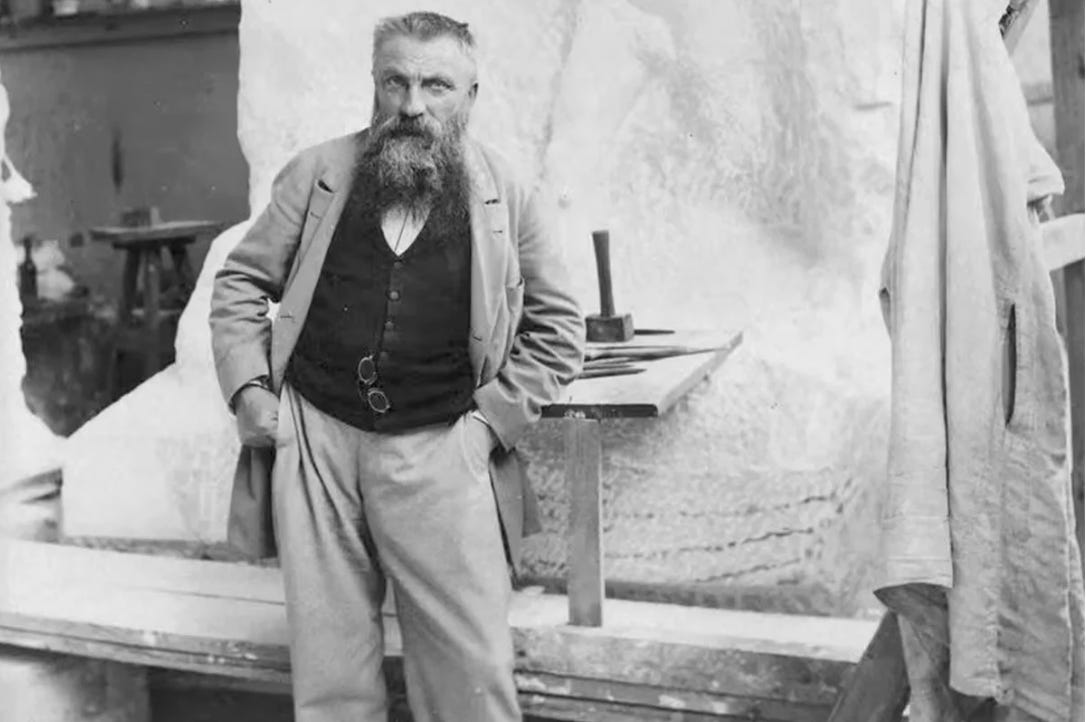
Why am I telling you about a French sculptor? Years ago, out of pure curiosity, I took a classical realism class in Florence. I expected to be flattened by the local giants, Michelangelo a few streets away, Leonardo in every museum. What actually struck me, studying technique in the city built by the Renaissance, was Rodin. The Florentine masters aimed at perfection and achieved it, and their perfection is complete, sealed, almost unapproachable. Rodin’s figures felt like they were still being made. You could see the thumbprints. The work recorded its own process, thousands of small decisions left visible in the surface, and that turned out to be the more instructive thing to study.
It took me until this decade to understand why that stayed with me.
The Man Who Never Struck Once
The Balzac was not an aberration. It was the method at full scale, and the method ran through everything Rodin did.
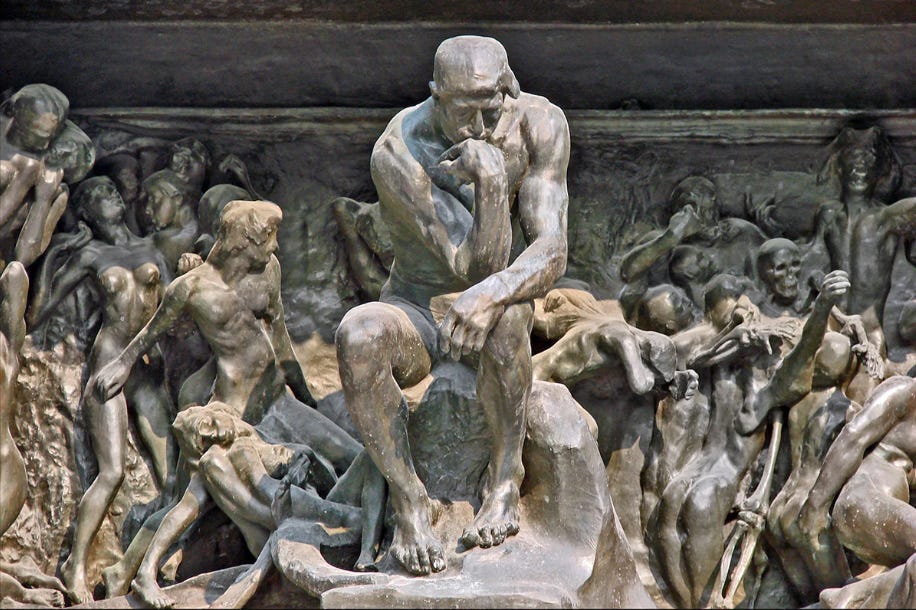
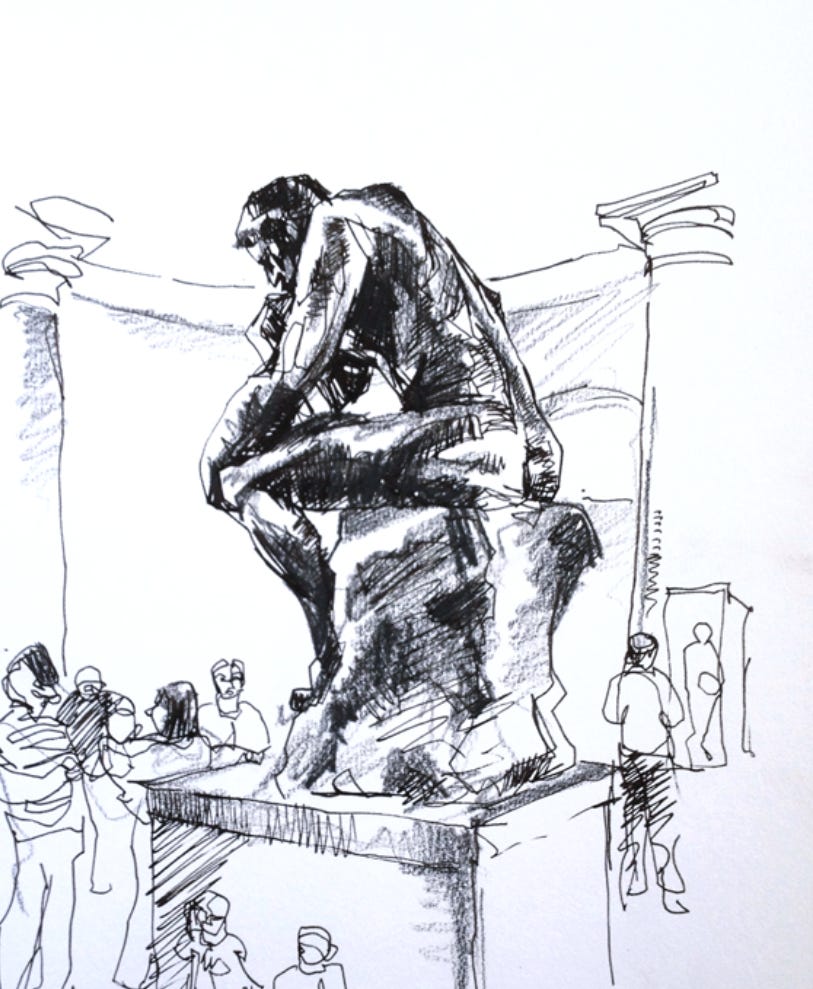
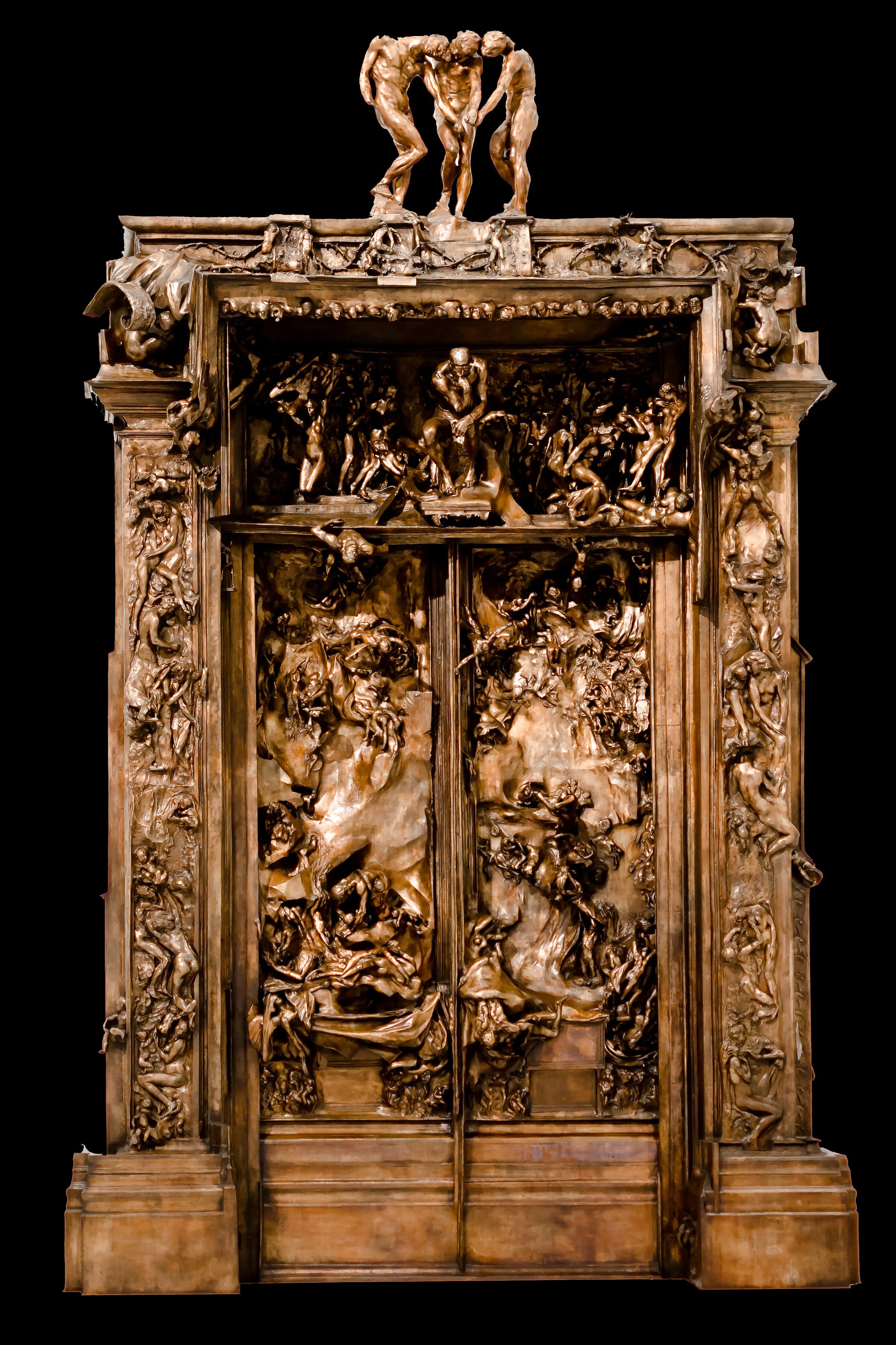
He kept drawers full of body parts. Plaster hands, feet, arms, torsos, hundreds of them, cast from his own clay studies and filed away like a lexicon. He called them his abattis, the French word for giblets. When a new figure demanded a gesture, he did not always model it fresh. He went to the drawers, found a hand made years earlier, and grafted it onto the new work. The Gates of Hell, which he worked on for thirty-seven years and never declared finished, became a quarry for this method. The Thinker began as a small figure perched above its doors before Rodin enlarged it into the most recognized sculpture on earth.
His studio practice was just as unusual as his storage system. Academic sculptors of his era posed a model in a fixed position and copied it. Rodin paid models to wander the studio freely, talking, stretching, sitting, while he made rapid clay sketches of whatever their bodies did on their own. Thousands of small studies, most never meant for exhibition. When The Age of Bronze appeared in 1877, it was so anatomically alive that critics accused him of casting directly from the model’s body. He had to produce photographs of the model to prove the figure came from his hands.
Rodin never attempted the single perfect strike. He worked in clay, an additive material, pressing on small amounts, stepping back, pressing again, sometimes across decades. The masterpiece was never one decision. It was the compound interest of thousands of small, deliberate ones.
Most people use artificial intelligence with the opposite instinct. Every session is a fresh block of marble and one swing of the chisel.
You Have a Reputation With the Machine
Think about what a reputation does for you among people. A colleague of ten years reads your two-line email and knows exactly what you want, how firm to be, which of your standards apply. A new hire needs a briefing document for the same task. The difference is not intelligence. The difference is accumulated context, built through hundreds of small interactions in which you revealed how you think, what you reject, and why.
Reputation is stored specification. It is every instruction you will never have to give again, banked in someone else’s head.
Modern AI tools now hold reputations too. Persistent memory, project spaces, custom instructions, and long context windows mean the model no longer meets you as a stranger each morning. Whether you intend it or not, you are building a reputation with the machine, and the quality of everything it produces for you increasingly depends on the quality of that reputation.
Most usage goes wrong in two mirrored ways.
The first failure is the prompt obsessive. An entire cottage industry now sells prompt engineering, templates promising the exact incantation that unlocks the machine. The obsessive spends twenty minutes polishing a single instruction, treating the model like a genie that grants wishes only when the wording is flawless. This is the new hire’s briefing document, rewritten from scratch for every task, forever. All the effort goes into specification and none into reputation, so the specification tax never goes down.
The second failure is invisible but more common. Call it the fragmented user. Ten exchanges here, five there, scattered across tools and threads, each one careless, each one abandoned. A question about a contract in one window, a draft in another, a half-explained request in a third, corrections given as “no, redo it” with no reasons attached. This person is having hundreds of interactions and building nothing, the way someone who makes small talk with a different stranger every day for a decade ends the decade with no friends. Volume without deposit. The model has met them a thousand times and knows them not at all.
Both failures share one root. Both treat each interaction as a transaction that ends when the output arrives. Neither notices that the interaction itself is an asset, and that the asset compounds.
Working in Clay
I want to propose a different practice. Call it Conversational Sculpting: the deliberate use of everyday exchanges to build the model’s reputation of you, so that over time it holds an increasingly faithful working replica of your reasoning, your taste, and your standards.
Each time you explain why you rejected a draft, you press clay. Each time you show the model the difference between what it produced and what you wanted, you press clay. Each time you name a framework you use, describe a decision and the reasoning behind it, or correct a habit it keeps repeating, you press clay. None of these presses matters much on its own. Rodin’s individual sketches did not matter much either. What matters is that they land on the same figure.
That last condition is the one the fragmented user violates. Rodin’s abattis worked because the drawers were in one studio. Abattis (pronounced ah-bah-TEE) is the French word for giblets, the leftover parts of a butchered bird: the neck, gizzard, heart, liver, feet. When you buy a whole chicken in France and get the little bag of organs, that bag is the abattis.
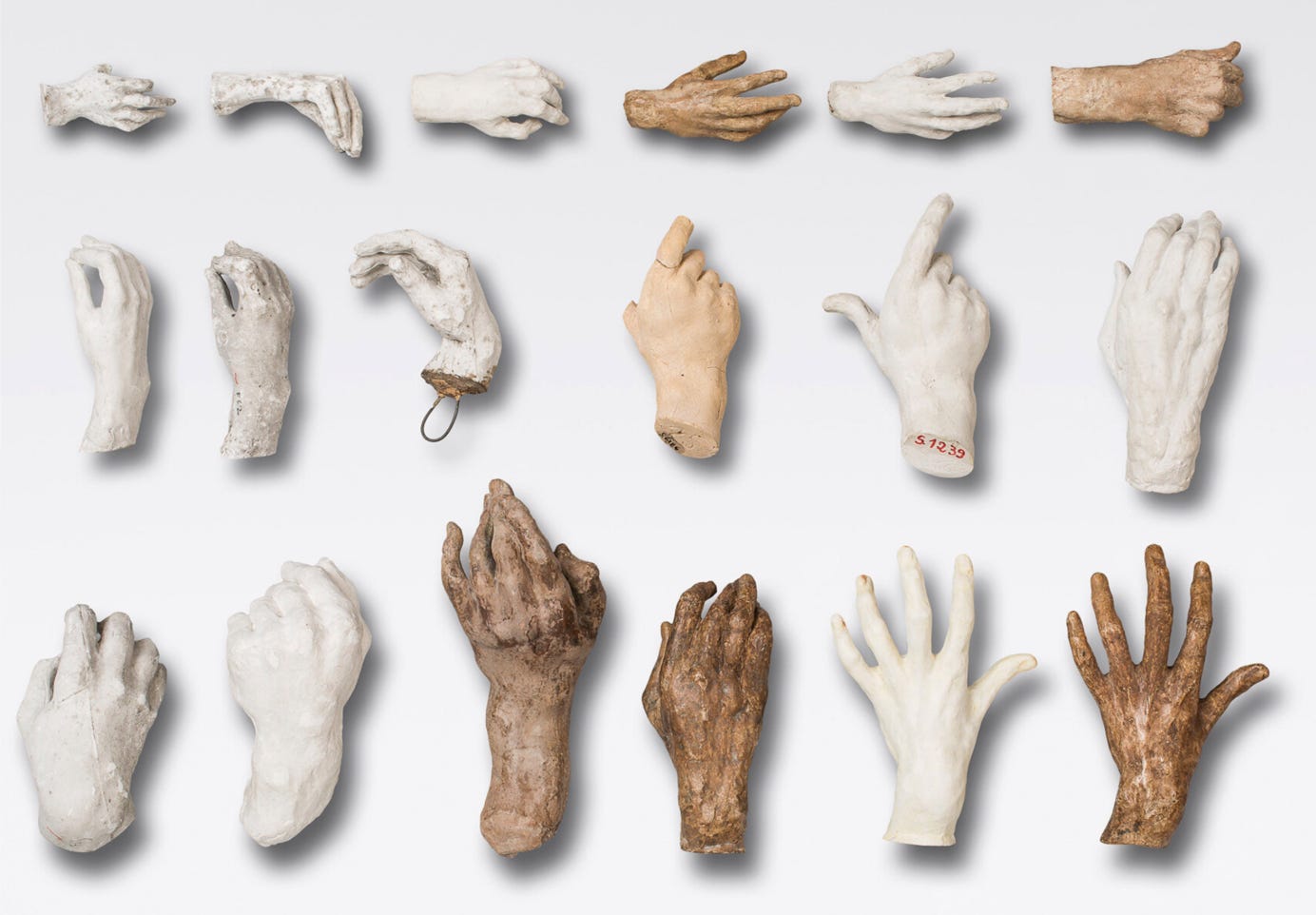
Rodin borrowed the word as studio slang for his collection of spare plaster body parts. He and his assistants cast hundreds of hands, feet, arms, and torsos from his clay studies and kept them filed in drawers and boxes around the studio. Since these were literally disembodied limbs and organs of figures, the butcher-shop term stuck, and it was typical of his dark humor to call his own life’s work giblets. A hand filed in Paris cannot be grafted onto a torso in Marseille. Scatter your interactions across disconnected tools and threads and you are sculpting a hundred figures one thumbprint each, which is to say sculpting nothing. Consolidation is not a convenience. It is the difference between a body of work and a pile of gestures.
The payoff arrives in a specific form: your prompts get shorter while your outputs get better. Once the reputation is rich enough, an incomplete instruction works, because the missing half is already banked. “Draft the reply, usual approach, firmer this time” becomes a sufficient prompt. The colleague of ten years needs a nudge. The stranger needed three paragraphs.
How Reputation Grows
Two things govern how fast the reputation builds: how often you show up, and how deliberate you are when you do. The second multiplies the first. Think of two gym members with identical attendance. One drifts between machines while scrolling a phone. The other runs a program. Same number of visits, and after a year the difference is visible from across the street. Careless volume does not compound. Deliberate volume does.
The fragmented user has a further problem. Their visits never even count, because each scattered thread is a different gym. High activity, zero accumulation.
This reframes the core formula of many of my articles that I reinforce often:
Value ∝ (Existing Demand × Relevance) / Friction.
Every deliberate conversation raises the relevance of every future output, because the model tailors its answers to a person it increasingly resembles, and lowers the friction of every future request, because you stop paying the specification tax. Prompt engineering optimizes one transaction. Reputation optimizes the ratio itself, permanently, for every transaction that follows.
The accumulated asset deserves a name. Brand equity builds like sediment, invisible day to day and decisive over years, and the same holds here. I like to call it - Context Equity. Context Equity is the stored, compounding understanding a model holds about how you think, and it behaves like any equity: slow to build, valuable to hold, costly to abandon, and impossible to fake in a hurry. Switching tools after two years of sculpting means walking away from the drawers of plaster hands.
Takeaway: you are building a reputation with the machine either way. The only choice is whether you build it deliberately in one place or accidentally in fragments, and the fragments round to zero.
Keeping Your Own Fingerprints
An objection deserves a direct answer. If the machine learns to write and reason like you, does it not eventually replace the you it learned from?
The risk runs the other way. Left untrained, these models pull every user toward the same generic median voice, the phenomenon I have previously called AI-Gregation. The person with no reputation gets the average of the internet, fluent and interchangeable. The person who sculpts gets a tool trained on their variance, the specific deviations from the median that make a voice worth reading and a judgment worth trusting. Rodin’s assistants carved his marbles and his foundries cast his bronzes, yet no one mistakes a Rodin for anything else, because the clay originals held his hands’ decisions. The tool amplified authorship precisely because the authorship was pressed into the material first.
The discipline this demands is honesty in the modeling sessions. Feed the model your polished conclusions only, and it learns a costume. Feed it your reasoning, including the rejected options and the reasons for rejecting them, and it learns the mind underneath. Rodin sketched models in motion because the fixed pose was a lie about how bodies work. Your finished outputs are fixed poses. Your thinking in motion is the true subject.
Takeaway: the reputation reflects whatever you deposit. Deposit conclusions and the model learns to imitate your surface. Deposit reasoning and it learns to extend your depth.
The Daily Practice
The method reduces to a handful of habits, none of which requires templates or courses.
Explain your why, not just your what. When you ask for a draft, include the reasoning behind the request in a sentence or two. The request produces one output. The reasoning improves a thousand future ones.
Correct with specificity. “Make it better” presses no clay. “This opening announces its point before making it, and I never do that” presses a great deal. Every precise correction is a thumbprint the model keeps.
Name your frameworks. If you think in ratios, say so. If you evaluate decisions by their reversibility, say so. Named concepts become handles the model can grab later without re-explanation.
Consolidate ruthlessly. This is the habit the fragmented user needs most. One studio, one figure, one set of drawers. Ten conversations in one project space compound. Ten conversations scattered across five apps evaporate.
Review the reputation occasionally. Ask the model to describe how you think, then correct the description. Rodin circled his figures daily, viewing them from angles he had not modeled from. The errors you find are the next session’s work.
Takeaway: stop optimizing prompts and stop scattering exchanges. Both are transaction thinking. A reputation is built one deliberate deposit at a time, in one place.
Thirty-Seven Years of Doors
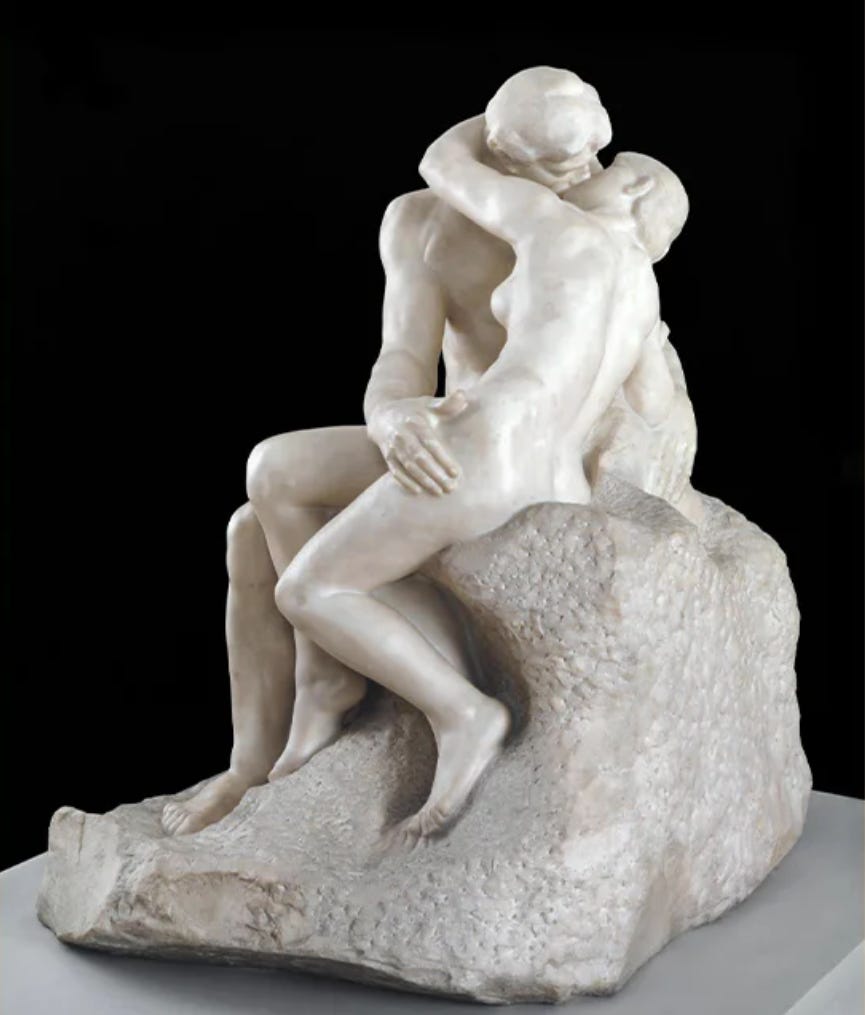
Rodin never delivered The Gates of Hell. The museum that commissioned them in 1880 was never built, and the doors stood in his studio until his death in 1917, perpetually reworked, endlessly quarried. By any project management standard, an unfinished failure. By every other standard, the most productive object in the history of sculpture, because the accumulated work inside it kept yielding masterpieces for decades. The Thinker, The Kiss, and dozens of other figures walked out of those doors.
The Balzac tells the same story from the other end. Seven years of studies the world called wasted, a monument the client rejected, and a method vindicated so completely that the rejection is now the famous part. The fifty discarded Balzacs were not failures. They were deposits, and the final figure was the withdrawal.
Your accumulated conversations can work the same way. Not a series of disposable transactions but a single ongoing work, pressed and repressed, that keeps yielding. The prompt obsessives are commissioning statues from strangers. The fragmented users are leaving thumbprints on a hundred abandoned figures. The sculptors are building something that knows their hands, and every year the gap between them widens.
What We Can Learn from Rodin
Rodin’s full production system deserves a closer look, because it maps onto modern knowledge work with almost unreasonable precision.
He was a modeler, not a carver. His days were spent shaping wet clay with his hands and a few simple tools, chasing movement and emotion at the speed of thought. He considered the clay model the true, living artwork, because it held his direct touch and his immediate inspiration. Everything downstream was translation.
Once a clay figure was finished, his workshop made a plaster cast of it, preserving the form before the clay dried and cracked. Then came the part that surprises people. Rodin rarely carved marble or cast bronze himself. He employed highly skilled assistants, stonecutters, and foundry experts to turn his plasters into stone and metal. Camille Claudel carved hands and feet in his studio. The Rudier foundry cast his bronzes for decades. Rodin supervised everything closely, approved or rejected the results, and signed the finished pieces. The signature meant the judgment was his, not that every chisel stroke was.
Notice the division of labor. The clay stayed in his hands, always. The clay was where the thinking happened, where a figure could be wrong forty-nine times before it was right, where the thumbprints landed. The scaling of that thinking into durable, repeatable, distributable form was delegated to skilled hands he directed and reviewed. He never delegated the clay. He never hoarded the foundry.
Now translate. Whether you work with Claude, GPT, or Gemini, the same three-stage system applies.
Your clay is your thinking: the framing of the problem, the judgment call, the taste that says this version and not that one, the reasoning you deposit into the conversation. This is the true, living artwork, and it must stay in your hands. The moment you outsource the clay, asking the machine to decide what you think, you have stopped being the sculptor and become a customer of someone else’s figures.
Your plaster is your preserved reasoning: the frameworks you have named, the corrections you have explained, the standards you have articulated, all of it held in the model’s memory of you. Plaster is what lets a form outlive the session that made it. This is Context Equity in physical form, the mold from which future work can be pulled without remaking the original.
Your bronze and marble are the outputs the machine produces at scale: the drafts, the analyses, the code, the fifty variations you could never produce alone in an afternoon. This is exactly what the foundry was for. Delegating it is not cheating, any more than Rodin was cheating when Rudier poured his bronzes. The Age of Bronze scandal cut the other way; he was accused of too little intervention and had to prove his hands were in the work. The proof was the process, and the process was documented in clay.
What remains, and cannot be delegated, is the signature. Rodin inspected every cast before his name went on it, and rejected the ones that failed his eye. Publishing machine output you have not judged is signing a bronze you never looked at. The signature is the final act of ownership, and it is the one stage where no assistant, human or artificial, can substitute.
This extends past AI into work itself. Every role has clay, plaster, and bronze. The clay is the irreducible thinking only you can do. The plaster is the systems, documents, and trained understanding that preserve your thinking so it can be reused without you repeating it. The bronze is execution at scale, the part that skilled hands, junior colleagues, or machines can produce under your direction. Careers stall in two ways that mirror the two failed AI users: some people spend their lives in the foundry, executing at scale while never developing clay of their own, and some hoard every stage, insisting on carving their own marble, which caps their output at the speed of their own hands. The masters keep their hands in the clay, build their plaster deliberately, and run a foundry they trust but always inspect.
Takeaway: keep the thinking, preserve the reasoning, delegate the scale, and never sign what you have not judged.
Rodin was rejected from art school three times. What he had instead was decades of daily, deliberate, unglamorous work in clay, all of it in one studio, backed by a foundry he directed and a signature he never lent cheaply. The tools available to you are more responsive than clay ever was. What remains is how deliberately you press, where you keep the drawers, and whether you look before you sign.
One last thing. If you find yourself in Paris, the Musée Rodin is a must, set in the Hôtel Biron where he lived and worked, with The Thinker, The Gates of Hell, and the Balzac studies scattered through the house and gardens. If you are in New York, walk into the Met and head to the B. Gerald Cantor Sculpture Gallery, Gallery 800, where nearly fifty of his marbles, bronzes, and plasters hold the room, The Age of Bronze among them. And if travel is not in the cards, YouTube has a full documentary, Auguste Rodin: Modeler and Sculptor, that brings you into the studio for free. However you get there, spend an hour with the man. It might surprise you.
If this changed how you think about the tools you use every day, subscribe to STRATEX by Naz, where science, business, and behavior meet.