
I have worked on many projects over the years that surface as strategy documents in long, complex slide designs, and I put them together at what most people around me describe as “insane speed.” There have been weeks with four or five projects running at once, each producing decks of thirty to a hundred pages with complete analysis, strategy, and proper design. How did this speed come about?
It was purchased years ago. Over the last two decades, I have built an enormous number of corporate slides, paid and unpaid. For long stretches I was reworking or building about six a week that belonged to no project and no client, for no financial benefit at all. There were pitch decks we lost that I would reopen weeks later, after the outcome no longer mattered, just to rebuild them better. I loved the craft, I learned from every rebuild, and I practiced it relentlessly. Along the way I would learn about sesame, steel, national agendas, climate change, fast moving consumer goods ranging from shavers to tampons, cars, technology, fintech, sports, media, health. The range was so broad that it compounded something psychologists call associative fluency: the speed and ease with which a mind connects ideas from unrelated domains. Every industry I absorbed became raw material for the next one, so in later projects I could borrow and reassemble thinking across categories, and a framing first built for climate change would resurface, reshaped, to inspire work in the diaper category. Nobody sees the span of work that was happening underneath, the years that facilitate the speed of today. They only see the afternoon it now takes.
None of it required discipline. Nobody assigned me those practice decks. No willpower was spent. The work pulled me in on its own, and that pull is the subject of this article, because we have been telling ourselves a misleading story about persistence for twenty years.
We treat grit as a character trait, something a person either carries or lacks, like height. Angela Duckworth’s research made the word famous, and the corporate world promptly turned it into a hiring filter and a poster. But look at how grit is actually measured and something odd appears. Duckworth’s own Grit Scale has two halves. One half measures perseverance of effort. The other half measures consistency of interest, whether your enthusiasms hold steady or scatter every few months. Half of grit, by the researcher’s own definition, is not toughness at all. It is sustained interest. It is fit.
When someone abandons the gym in February, we say they lacked willpower. When the same person spends four hours dissecting a chess opening or perfecting a sourdough starter, willpower is suddenly abundant. The person did not change between activities. The fit did. Grit is not a fuel tank you carry from pursuit to pursuit. It behaves more like a chemical reaction between a specific person and a specific activity, and it only ignites when the right two meet. The kid grinding through piano lessons with the enthusiasm of a hostage and the kid who won’t put the guitar down do not differ in discipline. They differ in match.
Takeaway: Before you diagnose anyone, including yourself, as lacking grit, check the fit. Persistence problems are usually matching problems in disguise.
How fit is found
If grit sits downstream of fit, the practical question is how to find fit, and the answer is not introspection. You cannot think your way to knowing whether you would love the cello. The brain values what it has directly experienced far more than what it has merely been told about, so fit reveals itself through contact, not contemplation.
The sequence runs in one direction. Discovery first: broad, cheap, low-stakes exposure to many things. Then interest: one of them produces a pull the others don’t, a reluctance to stop. Then practice: the pull converts into hours. Only then, at the end of the chain, does grit become visible. Grit is the last link, not the first. Demanding grit from someone still in the discovery phase is demanding fruit from a seed.
Benjamin Bloom documented this sequence in the 1980s when his team at the University of Chicago studied 120 world-class performers, among them concert pianists, Olympic swimmers, and research mathematicians. Almost none began with rigor. The first phase was play. Early teachers were chosen for warmth rather than credentials, and the point of the lessons was fun. Heavy training arrived only after interest had taken root. The romance preceded the work, and the work was only bearable because the romance came first.
Average hours make you average
Suppose the fit is real, the pull has arrived, and practice has begun. A second trap waits, and it is pure arithmetic.

The Indian bassist Mohini Dey put it plainly: “If you put in average hours you become average. I put in an extraordinary amount of hours to be where I am today.” I first came across her on YouTube when she was seventeen, and even then you could hear that this kid had already banked an extraordinary amount of practice. The hours were audible. I have followed her career ever since, and she remains, hands down, one of the most technical and yet deeply musical players I have ever heard, a combination that almost never coexists in one musician. MusicRadar ranks her among the top ten bassists of this century, and the ranking undersells the experience of actually watching her play. Raised in Mumbai by a session bassist father, she was on the instrument before she turned four and grew up inside a regimen that consumed most of her waking day. By nine she was working professionally. If mind-bending musical calibre is your thing, find her on Instagram and enjoy the virtuosity. Her story is the whole argument of this section compressed into one career.
A fair question interrupts here: did Mohini ever get to discover anything? Her father put a bass in her hands before she could form the word for it. The sequence I described, discovery before interest before practice, seems to have been skipped entirely, and her case looks at first like an argument for imposition rather than fit. Perhaps. Outliers exist, and forced starts occasionally produce greatness. But consider what she was likely working with. Her father was a session bassist, her mother a Hindustani classical singer, and whatever cocktail of aptitudes shapes a musician, she plausibly inherited a strong pour of it. The imposition may have simply collapsed the discovery phase, delivering her early to an instrument she was already built to love. Thousands of other children have been pushed onto instruments with equal force, and most of them produced resentment, not virtuosity. The push explains how she started. Only fit explains why she never stopped.
Dey is describing distributions, and distributions are indifferent to your feelings. If the median serious guitarist practices two hours a day, then practicing two hours a day is, by definition, a strategy for reaching the median. The word average describes both the input and the destination. Extraordinary output requires input from the far end of the practice distribution, because that is where your future peers already live.

Michael Phelps turned this into a schedule. His coach Bob Bowman had him train every single day, Sundays and birthdays included, while rival swimmers took the traditional day off. Phelps himself did the math: fifty-two Sundays a year meant fifty-two extra days of training annually. Across the five years leading into an Olympic cycle, that is roughly 260 additional days in the water, most of a full year of training his competitors simply never accumulated. When he touched the wall a fingertip ahead, that fingertip had been built on Sunday mornings.

Music offers the same testimony on repeat. Charlie Parker, humiliated at a Kansas City jam session as a teenager, spent the following three to four years practicing eleven to fifteen hours a day, by his own account. What emerged changed jazz permanently. John Coltrane ran exercises between sets, worked through theory books at home, and by several accounts fell asleep with the horn still on his chest. The cellist Mstislav Rostropovich, handed the score of Shostakovich’s first cello concerto, went home and practiced ten hours that day, ten the next, eight the day after, and had it memorized in four days.
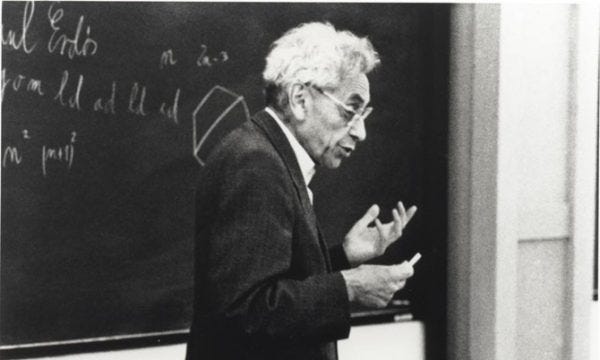
Science keeps the same hours. The mathematician Paul Erdős worked on problems nineteen hours a day for decades, sleeping little and owning almost nothing, and left behind roughly 1,500 published papers, more than any mathematician in history. Marie Curie processed tonnes of pitchblende by hand in a leaking shed, stirring boiling vats with an iron rod for years, to isolate a decigram of radium. Newton, during his most productive periods, worked with such absorption that his assistant recorded him forgetting meals entirely, finding the untouched food the next morning. Ramanujan filled notebook after notebook with thousands of results, working through the night on a slate because paper was too expensive, wiping it with his elbow to go faster.
None of these people were grinding against their nature. Parker at fifteen hours a day was not displaying superhuman discipline. He was displaying near-perfect fit, a match so complete that the practice consumed him rather than the reverse. The extraordinary hours were not the cause of the love. They were the evidence of it.
Takeaway: Fit determines whether extraordinary hours are even survivable. Extraordinary hours determine whether you become extraordinary. The first without the second is a hobby. The second without the first is a breakdown in progress.
For those with jobs, families, and full lives
All of this comes easily to a childhood prodigy or a full-time athlete. What about someone with a demanding job, a family, a commute, obligations stacked to the ceiling? Where do the hours come from?
The constraint is real. But before accepting it, run one audit. Open your phone’s screen time report and look at the weekly number without flinching. For most adults it lands somewhere between three and five hours a day, the majority of it scrolling you could not summarize afterward if asked. That is the reservoir. Not all of it is recoverable, and rest is legitimate, but even reclaiming ninety minutes a day yields more than 500 hours a year. Five years of that is a body of practice most people never accumulate in a lifetime. The time exists. It is currently being spent on other people’s content instead of your own craft.
And if, after the audit, you decide the trade is not worth it, that is a legitimate answer too. Accept the average and continue your life without guilt, because average is where nearly everyone lives, and a good life is fully available there. The word extraordinary is doing honest work in this article. It means outside the ordinary, and it cannot mean anything else. Most of humanity, across all of history, has been shaped by a very small number of people who paid a very unusual price. The choice deserves to be made consciously, rather than behind the comfortable claim that the hours were never there.
Takeaway: Audit your screen time before declaring you have no time. Then choose deliberately: reclaim the hours, or accept the average in peace. Both are respectable. Only the unexamined middle is a waste.
If this way of looking at persistence was useful, subscribe for more articles that sit at the intersection of cognitive science, strategy, and how things actually work.