
Stand on Seventh Avenue between 35th and 40th Streets in Manhattan and look up, and the buildings start doing something odd. They rise, pause, step back, rise again, like staircases built for a giant, or like wedding cakes stacked in stone. The same shapes line Eighth Avenue one block west. They are the leftover shape of a law passed in 1916, and part of the story behind that law is an attempt by New York's old money to stop the very people who would later build these towers.
The neighborhood is called the Garment District for the plainest reason a place can be named anything: clothes were made there, in volumes that are hard to believe now. By the late 1920s, the fifteen blocks between Sixth and Ninth Avenues, from 34th Street up to 42nd, held the largest concentration of clothing factories on earth. Roughly three of every four dresses worn by American women came out of these buildings. The industry that filled them was built almost entirely by Jewish immigrants who had arrived a generation earlier with nothing except a skill the Russian empire had forced on them by accident.
The czar trained the workforce
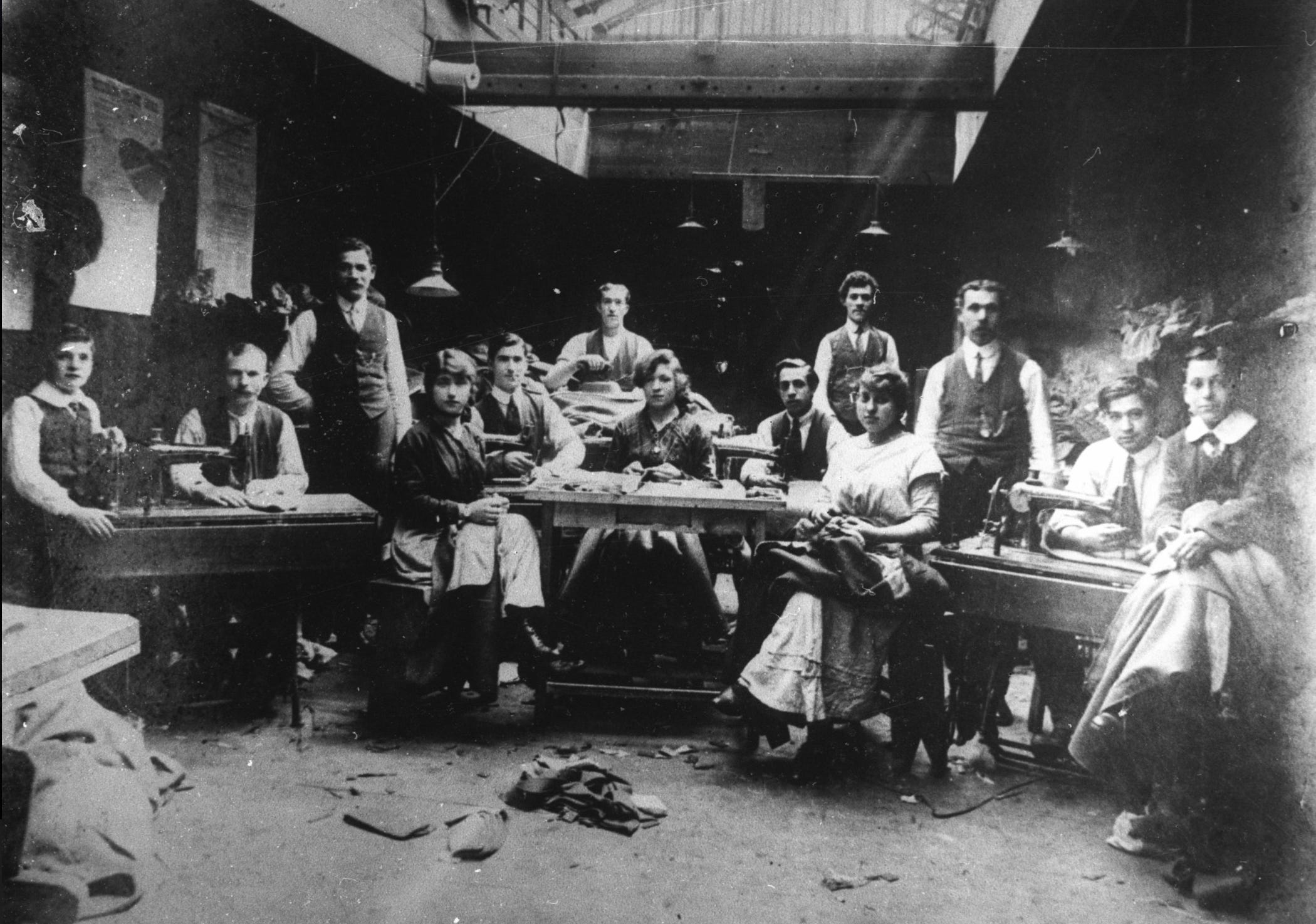
To understand why they could sew, you have to start 4,000 miles away, about 6,400 kilometers. For over a century, the Russian empire required its Jews to live inside a designated western strip of the country called the Pale of Settlement, essentially a giant fenced region beyond which they could not settle. Inside the fence, owning farmland was mostly forbidden. Barred from the land, Jews crowded into small towns and into the trades a town could support: peddling goods door to door, keeping small shops, and above all, tailoring. By the late 1800s, roughly one in six Jewish workers in Russia made clothing for a living. That is more than a quarter of a million people bent over needles because the law had closed nearly every other door.
Then Russia turned violent. Starting in the 1880s came the pogroms, organized mob attacks on Jewish towns, houses burned and people killed while the police looked the other way. Alongside them came the May Laws of 1882, new rules that squeezed Jews out of even more places and occupations. Staying became impossible. Over the next four decades, some two million Jews left for America.
Picture one of them arriving in 1892. Let’s call him Mendel. Twenty-six years old, a tailor from a small town outside Kyiv, wearing every layer of clothing he owns because layers do not count against your luggage. Picture him as you read the rest, because this whole story is his. The steamship has docked in New York harbor, but a docked ship does not touch the shore; a gap of water and empty air still separates the deck from the pier. What bridges it is the gangplank: a narrow, movable wooden ramp thrown from ship to land, bouncing slightly under every step, with the harbor visible below through the gap. It is the last few meters of the old world, and every immigrant in this story crossed one. Mendel walks it carrying his entire productive life on his back: a Singer sewing machine, about 40 pounds of iron, roughly 18 kilograms, the weight of a small child.
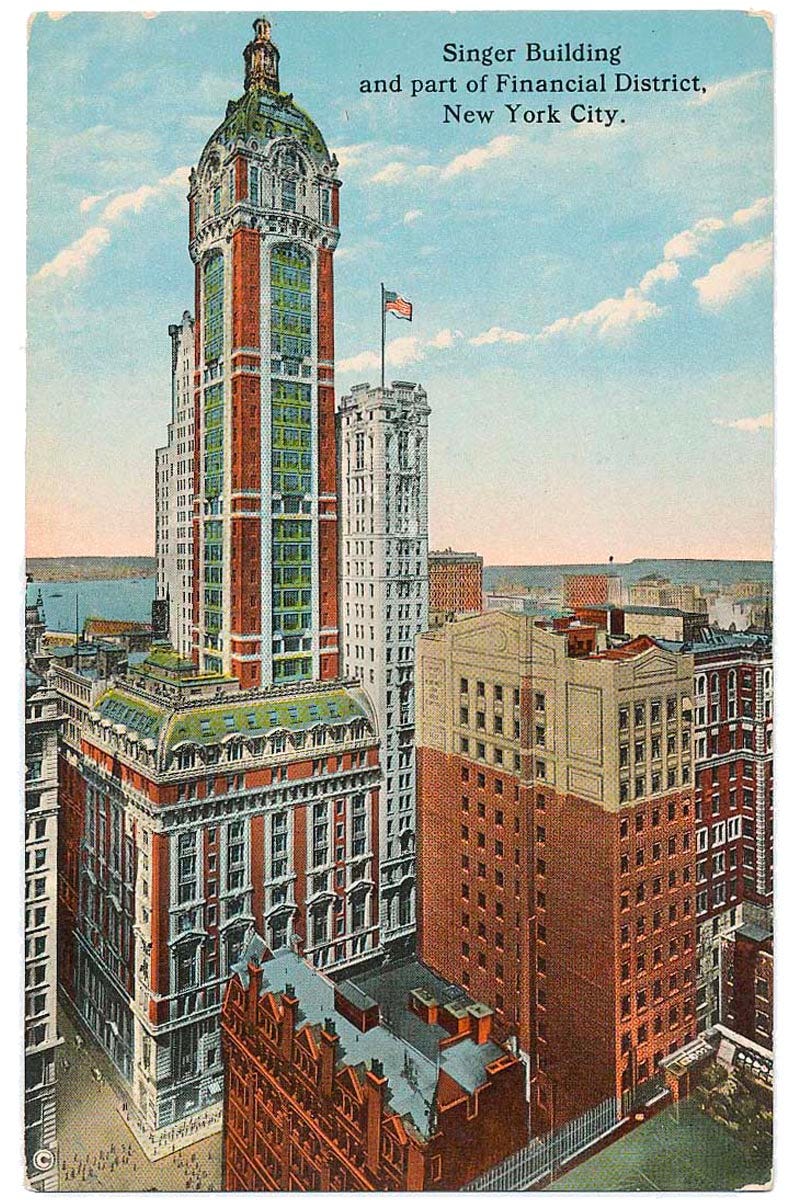
That name misleads modern ears, so let’s settle it early. Singer has nothing to do with singing. It is a brand, named after its founder, Isaac Merritt Singer, the man who turned the sewing machine into a mass product in the 1850s. The company grew so rich that in 1908 it completed the Singer Tower in downtown Manhattan, 612 feet tall, about 187 meters, the tallest building in the world for a single year until a rival passed it in 1909. That tower was demolished in 1968, but its smaller sibling, the Little Singer Building, still stands at 561 Broadway in SoHo, at the corner of Prince Street, its iron-and-glass face worth a detour if you are in the city. Singer’s real invention, though, was not the machine but the payment plan: small installments over time, designed precisely so that people with no savings, people like Mendel, could own one. Immigrant memoirs describe these men again and again, machines strapped to their shoulders like soldiers carrying rifles.
On the far side of the plank, a boom was waiting that fit his skill perfectly. Of all the immigrant groups arriving in America between 1899 and 1910, Jews had the highest share of skilled workers, around two-thirds, and most immigrant skills landed here and found nothing to attach to. Mendel’s did. The Civil War, thirty years earlier, had taught American factories to make uniforms in standard sizes, which invented ready-to-wear clothing, clothes you buy off a rack instead of having made for your body. Department stores were teaching a growing middle class to shop that way. New York had the ports, the fabric, and the customers. The one thing the boom lacked was hundreds of thousands of people who already knew how to sew. The czar, through pure cruelty, had spent a century producing exactly that workforce, and had then shoved it toward the one harbor where the skill was worth more than anywhere else on earth.
Takeaway: Persecution decided what skills Mendel had. Luck decided what those skills were worth on arrival. Neither was chosen, and the combination built an industry.
A factory you could carry
One pier down, an Italian immigrant is crossing his own gangplank with skills just as real: stonework, digging, construction. Those trades served real demand; his countrymen built the subways and much of the city’s stone. But a builder’s work is chained to a site. It stops in winter. It moves with the contract. It runs through a labor boss who controls who gets hired that morning. The worker owns the skill, but someone else owns the only place the skill can be used.
Mendel’s entire factory weighed 40 pounds and worked anywhere. In any tenement, those cramped immigrant apartment buildings of the Lower East Side, in any season, at any hour of the night, the machine ran. Picture the scene the journalist Jacob Riis kept walking into during the 1890s: a kerosene lamp, a kitchen table, Mendel at the machine, his wife finishing seams, children sorting bundles, the whole family working in the same three rooms where they slept and ate. Riis wrote that the homes of the Jewish quarter were also its workshops. You can still stand inside one of those apartments today. The Tenement Museum at 97 Orchard Street has preserved them, furniture, sewing stations and all, and walks visitors through in small groups, thirty-five at most when I visited. I had the pleasure of going, and the entire factory floor of a family business turns out to be smaller than a modern parking spot. It was, in the most literal sense, the first mobile work-from-home setup in American economic life. The job traveled with the worker instead of the worker traveling to the job.
Call this the Portability Premium: the extra upward mobility that flows to a skill whose tools move with the person holding them. You can put it in directional form:
Upward mobility ∝ (Demand for the skill × Portability of its tools) / Friction of starting over
You read this as: how fast a newcomer rises depends on how badly the market wants what he can do, multiplied by how easily his tools travel with him, divided by how costly it is to set up again after every disruption. The stonemason from the next pier had strong demand but almost no portability; every restart meant finding a new site, a new crew, a new boss. Mendel had strong demand and near-total portability; his restart cost him one flight of tenement stairs. Run that difference over thirty years and it compounds into two entirely different family histories.
Portability mattered for a second reason. In the clothing trade, the ladder had no missing rungs. A worker who saved a little became a contractor, taking bundles of piecework home and hiring two neighbors. A good contractor became a middleman buying and selling between factories. A middleman became a manufacturer. A manufacturer eventually owned the building. Every step used the same knowledge and the same relationships as the step below it. Construction offered no such staircase; jumping from laborer to contractor took capital and political connections a newcomer could not get. By 1897, about 60 percent of New York’s Jewish workforce was in the clothing trade, and three-quarters of the industry’s workers were Jewish. By 1910, making clothes employed nearly half of the city’s entire industrial workforce, and the factories were largely owned by men who, like Mendel, had been machine operators fifteen years before.
The old money reached for the law
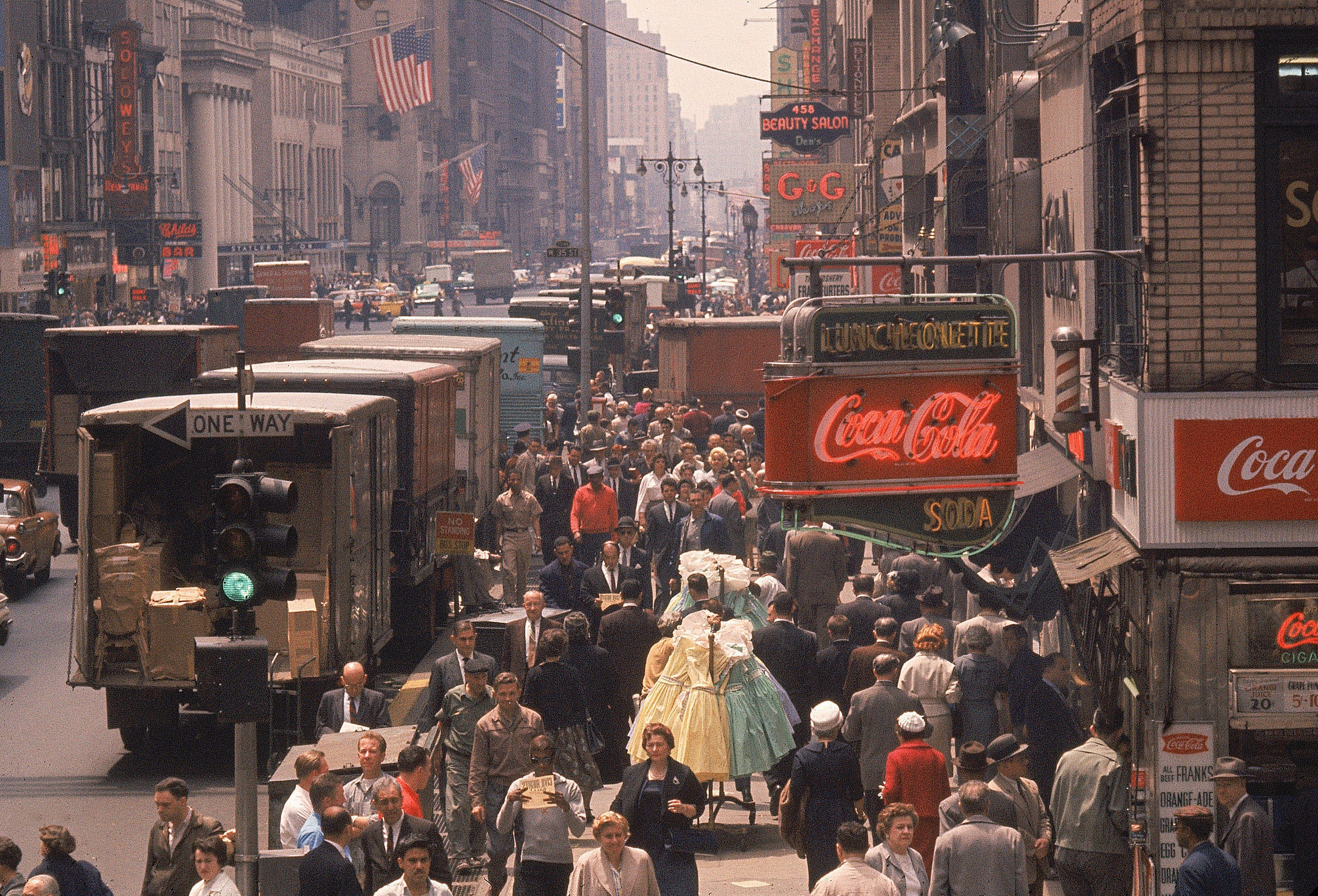
As the industry outgrew the Lower East Side, its factory lofts crept uptown toward Fifth Avenue, following the department stores they supplied. At lunchtime, thousands of garment workers, Mendel’s workers now, because by 1910 he runs a shop of twenty machines, poured onto the same sidewalks where the city’s wealthiest shoppers browsed. The merchants and property owners of the avenue, organized since 1907 as the Fifth Avenue Association and backed by New York’s old Protestant elite, found this unbearable. Their complaints survive in the newspapers of the day, and they are barely disguised: the workers crowded the sidewalks, jostled the customers, lowered the tone. In 1916 the Association ran an open campaign called Save New York, and that July the city passed the first zoning law in American history, the first law telling every block what could be built on it and what could happen inside.
The law did two things at once. It restricted manufacturing around Fifth Avenue, and the pressure worked so completely that within three months, 95 percent of the clothing makers near the avenue had agreed to move. It also required tall buildings to step back as they rose, so sunlight could still reach the street. Those steps produced the wedding-cake outline from the opening of this story. And the district the planners drew for the clothing trade, the blocks west of Seventh Avenue between 34th and 42nd, was described by one historian of the neighborhood in words close to a quarantine: a zone where the industry and its immigrants could be contained, out of sight of the wealthy shoppers.
The maneuver repeats throughout history whenever established players face competitors they cannot outwork. Call it Friction by Statute: when incumbents cannot win on demand or relevance, they use law to raise the denominator instead, piling cost and distance onto the path of whoever is climbing. The Fifth Avenue merchants could not sew faster or sell cheaper than the immigrants displacing them, so they legislated geography.
Takeaway: Zoning arrived in America as a competitive weapon dressed as city planning, and its first large-scale use was moving an immigrant industry away from the people it was making rich.
The quarantine became the capital
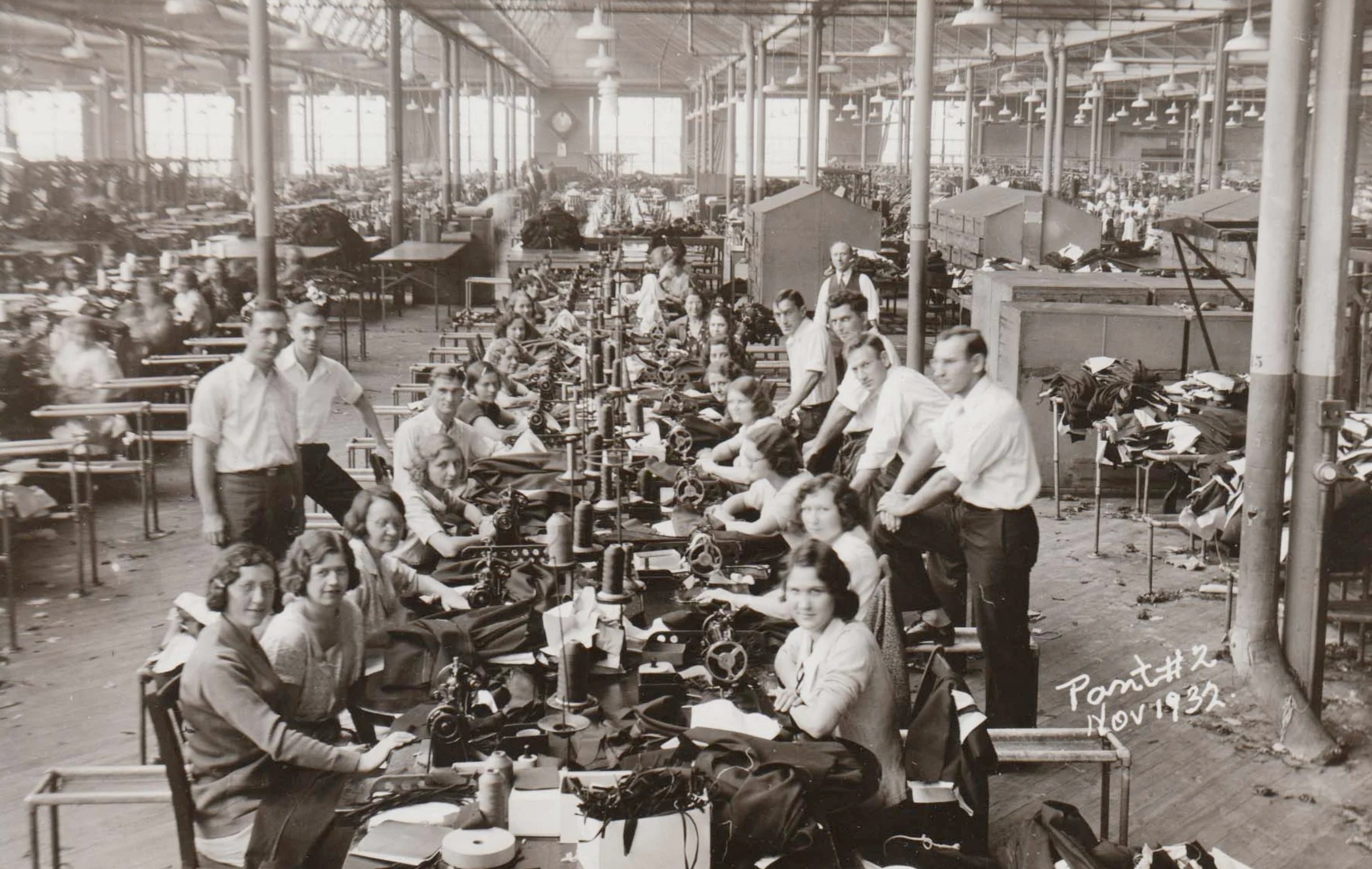
Pushed into their designated zone, the clothing manufacturers did not shrink. They built. Between 1920 and 1928, about 120 high-rise factory towers went up north of 35th Street, financed largely by the manufacturers themselves, men like Mendel now acting as their own property developers. The towers obeyed the setback law, stepping back floor by floor as they rose, which means the wedding-cake skyline of Midtown’s west side was built by the exact community the law’s sponsors wanted pushed out of sight, in the exact shape the law demanded. By 1931 their containment zone was the densest clothing-making district on the planet.
By 1920, Mendel faces a decision about his sons, and like nearly every manufacturer on Seventh Avenue, he makes the same one: they will never touch a sewing machine. He has spent enough years bent over a Singer to know the trade is seasonal, strike-prone, and merciless. What he has instead is tuition money, and a city that offers City College free of charge. So garment wages became school fees, and school fees became diplomas, and a diploma turned out to be the most portable capital of all. A people barred from owning land for centuries had learned to hold wealth only in forms that could move: coins, credit, skill. The Singer weighed 40 pounds. A medical license weighs nothing, cannot be burned in a pogrom, and earns its income in any city with sick people. Run the equation above with a diploma in place of the machine and portability approaches total while the friction of starting over approaches zero. A profession is a factory stored entirely in the head.
City College filled so completely with garment workers’ children that people called it the poor man’s Harvard, and its crowded lunchroom debate corners produced a string of Nobel Prize winners most countries would envy. Jonas Salk, whose vaccine ended polio, was the son of a Lower East Side garment worker who made ladies’ scarves. One generation separated the needle from the laboratory, and the bridge between them was a free classroom.
The fence moved, and the story repeated
The old establishment noticed, and it responded exactly as the Fifth Avenue Association had, only this time the fences were drawn around universities and professions instead of city blocks. In 1922, with Jewish enrollment at Harvard having roughly tripled in twenty years, its president proposed an open cap on Jewish students. When that caused a scandal, the admissions office got the same result indirectly, inventing scores for “character” and “geographic balance” that held the numbers down for thirty years. Medical schools ran similar quotas into the 1940s. The elite law firms simply did not hire Jews, whatever their grades. The big banks kept their partnerships closed.
It was Friction by Statute again, and again it backfired, because it shoved a generation of talent into whatever fields the establishment considered beneath its dignity, and each of those fields became the commanding position of its industry within two generations. Call this the Quarantine Dividend: the payoff that eventually flows to an excluded group precisely because exclusion concentrates its energy in territory the incumbents thought worthless. The Garment District itself was the first payment. The rest arrived on schedule.
In law, the grand old firms kept the polite work of issuing bonds and looked down on hostile takeovers and bankruptcies, corporate street fights where one company seizes another against its will. Jewish lawyers, hired nowhere else, founded their own firms and took the street fights. When the takeover wave hit America in the 1970s and 80s, the despised specialty turned out to be where control of corporate America was actually decided, and the firms built in exile sat at the top of the profession, where they remain.
Remember the fur and cloth and glove trades from earlier in this story? Adolph Zukor, who built Paramount, was a furrier, a maker and seller of fur coats. Marcus Loew, whose company became MGM, was a furrier too. Samuel Goldwyn sold gloves. William Fox, of what is still called Fox, inspected cloth in the garment trade. They moved into nickelodeons, converted storefronts showing short films for the price of a nickel, five cents, which is where the odd name comes from. Respectable people considered moving pictures a cheap amusement for immigrants, which meant the field was empty of serious competition. When Thomas Edison’s patent lawyers tried to squeeze independent filmmakers out of New York, these men packed up and moved production to a quiet farm town in California called Hollywood, far from the reach of Edison’s courts. The cheap amusement became the most powerful culture industry of the twentieth century, and the men from the fur and glove counters owned it. Medicine followed the same course: graduates blocked by quotas trained at Jewish-founded hospitals like Mount Sinai, which built their own excellence until the quotas collapsed under its weight.
Takeaway: Every field this generation rose to lead was a field it had been fenced into, never one it freely chose. Exclusion did the concentrating. Education did the compounding. The causality runs exactly opposite to the conspiracy version, which imagines coordination where the record shows people scattering into whatever territory was left unguarded.
By mid-century the conversion was complete enough to see in any professional directory. The grandsons of Seventh Avenue were disproportionately the doctors, lawyers, professors, and studio chiefs of American life. The sewing machines themselves had passed to the next arrivals, Puerto Rican and later Chinese workers running the same portable engine up the same staircase, because nothing about the machine was ever Jewish. It rewarded whoever held it under conditions of high demand, high portability, and heavy exclusion, and for seventy years that description fit one group of migrants almost perfectly.
Remember Mendel on the gangplank in 1892, 40 pounds of iron on his back, the harbor water visible through the gap below his feet? The wedding-cake towers still stepping back over Seventh Avenue are his monument, built by men the law meant to contain, in the shape the law prescribed. But the truer monument is harder to photograph. It is the distance between that machine crossing the last few meters of wood between ship and shore, and his granddaughter’s diploma, which weighs nothing at all.