
For decades, the strength of the U.S. dollar looked like an almost unqualified advantage. It lowered the cost of capital, made American financial assets desirable across the world, allowed U.S. consumers to buy foreign goods cheaply, and gave American companies enormous flexibility to source production wherever costs were lowest. It reinforced Wall Street, strengthened the Treasury market, and made the dollar the central operating system of global commerce.
All of that remains true. But the same system also created a vulnerability that is becoming harder to ignore. The dollar’s strength made it unusually easy for the United States to consume more than it produced, while allowing productive capability to accumulate elsewhere. That is the paradox now sitting underneath much of America’s renewed obsession with tariffs, industrial policy, supply chains, and domestic manufacturing.
To understand it, start with the flows.
Suppose America imports $500 billion of goods from another country while exporting only $200 billion back. The United States has received $300 billion more in goods than it has sent out. That difference is the trade deficit.
The money moves in the opposite direction. American consumers and companies pay foreign producers $500 billion, while foreign buyers pay American producers $200 billion. The foreign side is therefore left with a net $300 billion in dollars.
Those dollars do not simply disappear. They are typically recycled into U.S. assets. Foreign governments, companies, banks, pension funds, and investors buy U.S. Treasury bonds, equities, corporate debt, real estate, bank deposits, and businesses. So the broad exchange is simple: America receives real goods, while the rest of the world receives financial claims on America.
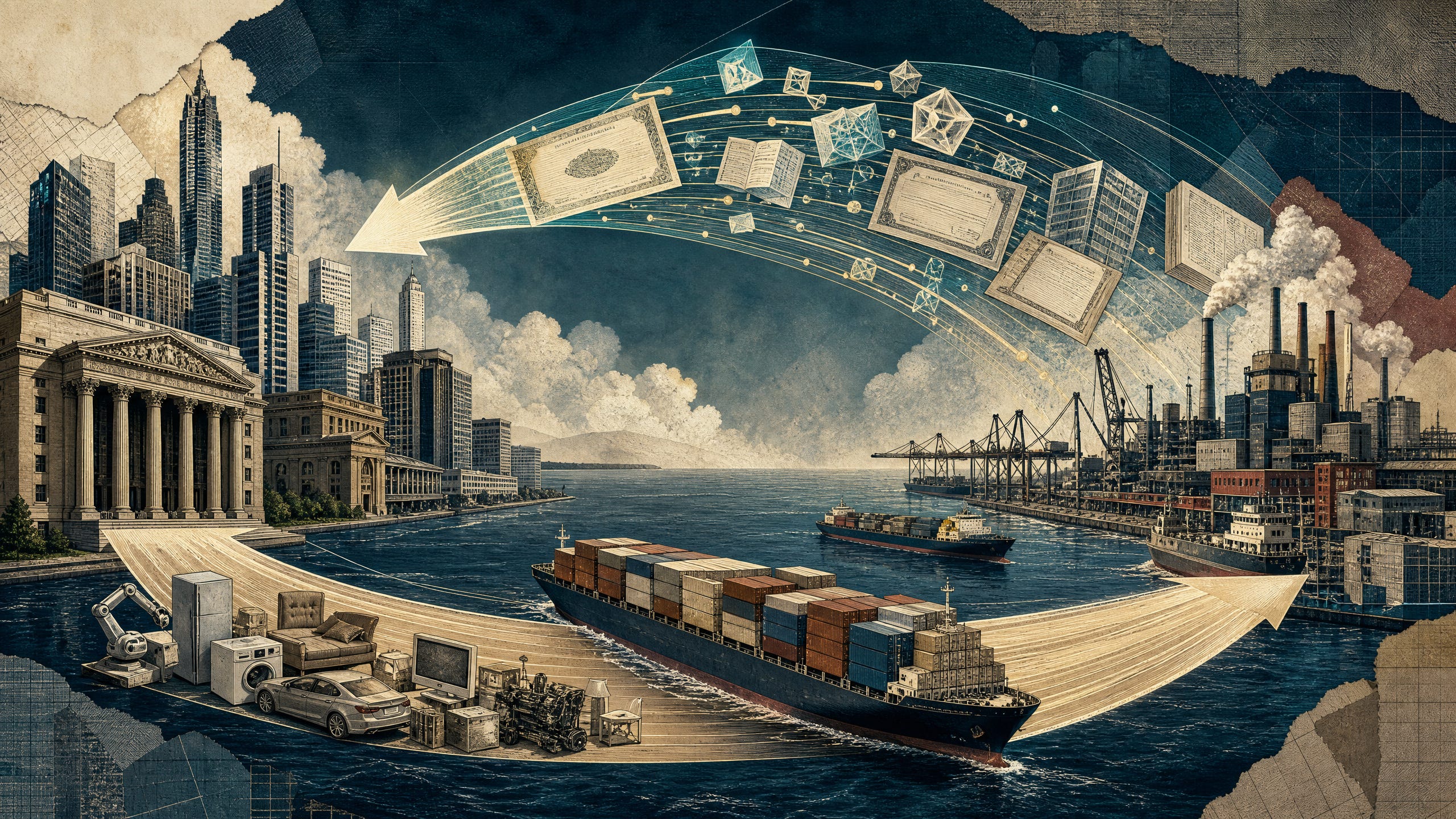
Because the world actively wants those claims, America can sustain this arrangement for much longer than most countries could.
That is where the dollar’s reserve-currency role becomes decisive.
If a smaller country persistently imported far more than it exported, it would eventually run into a currency constraint. It would need foreign exchange to keep paying for imports. Its currency might weaken, imports would become more expensive, consumption would fall, and the imbalance would begin correcting itself.
America is different because America issues the currency everyone else wants.
The world needs dollars for reserves, trade settlement, debt, savings, commodities, and investment. That creates persistent demand for dollar assets, which supports the currency and continually channels capital back into the United States.
The result is a reinforcing loop. The world wants dollars. Capital flows into America. The dollar remains strong. Foreign goods stay relatively cheap for Americans. Imports become attractive. Production shifts toward lower-cost geographies. Foreign countries accumulate dollars. Those dollars return into American financial markets. The system continues.
For American consumers, the benefits were substantial. Goods became cheaper. Corporate margins improved. Capital was plentiful. Financial assets appreciated. For American companies, outsourcing production often made perfect economic sense.
The problem is that production does something money does not.
Production creates capability.
A factory is not merely a building where products are assembled. Around it develops an ecosystem of engineers, suppliers, logistics companies, tooling specialists, technicians, materials expertise, automation systems, process knowledge, research capacity, and managerial experience. That knowledge compounds. The more batteries a country manufactures, the better it becomes at manufacturing batteries. The more ships it builds, the deeper its shipbuilding ecosystem becomes. The more electronics it assembles, the larger the surrounding network of component manufacturers, engineers, and technical labor becomes.
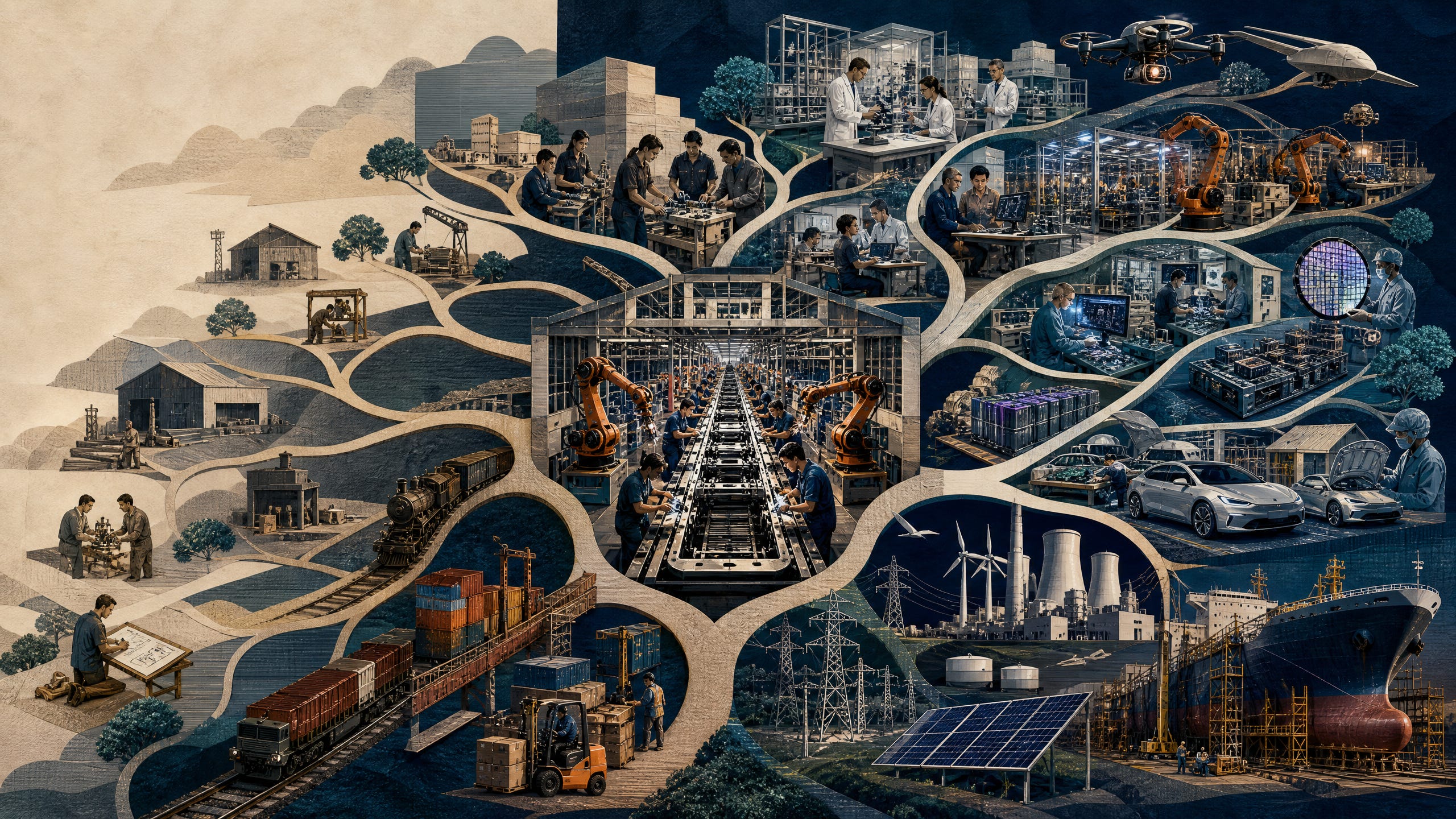
Manufacturing has learning effects. Comparative advantage therefore does not remain fixed. Countries can manufacture their way into competence.
China is the clearest example.
It began as a low-cost manufacturing destination for Western companies. At first, the relationship looked straightforward. American companies controlled the brands, technology, distribution, and customers, while Chinese companies supplied inexpensive labor and manufacturing capacity.
It was an excellent arrangement for American firms.
But twenty or thirty years of production changes the producer. Factories generate expertise. Expertise attracts suppliers. Suppliers lower costs. Lower costs attract more production. Production supports engineering. Engineering leads to better products. Better products create indigenous companies. The contractor begins climbing the value chain.
Eventually, the country that once manufactured products designed elsewhere begins designing its own.
Huawei is not simply an assembler. BYD is not simply a contract manufacturer. CATL is not merely producing cheap batteries. DJI is not assembling foreign drones. These companies emerged from industrial ecosystems that became progressively more capable.
Now imagine you have a business process outsourcing company.
You subcontract most of the actual operations to another firm because its labor costs are dramatically lower. At first, the arrangement is highly profitable. You own the client relationships, the brand, and the contracts. The subcontractor simply executes.
Then twenty years pass.
The subcontractor has now processed millions of transactions. It understands your workflows. It has trained tens of thousands of employees. It has developed better software, built quality systems, learned pricing, understood client requirements, and automated processes you once performed manually.
Meanwhile, your own company has become increasingly focused on finance, contracts, branding, and client acquisition.
Eventually, the subcontractor is no longer merely your supplier. It has become capable of competing with you.
Worse, if it stopped supplying you tomorrow, rebuilding the operational capability internally could take years.
That is the vulnerability.
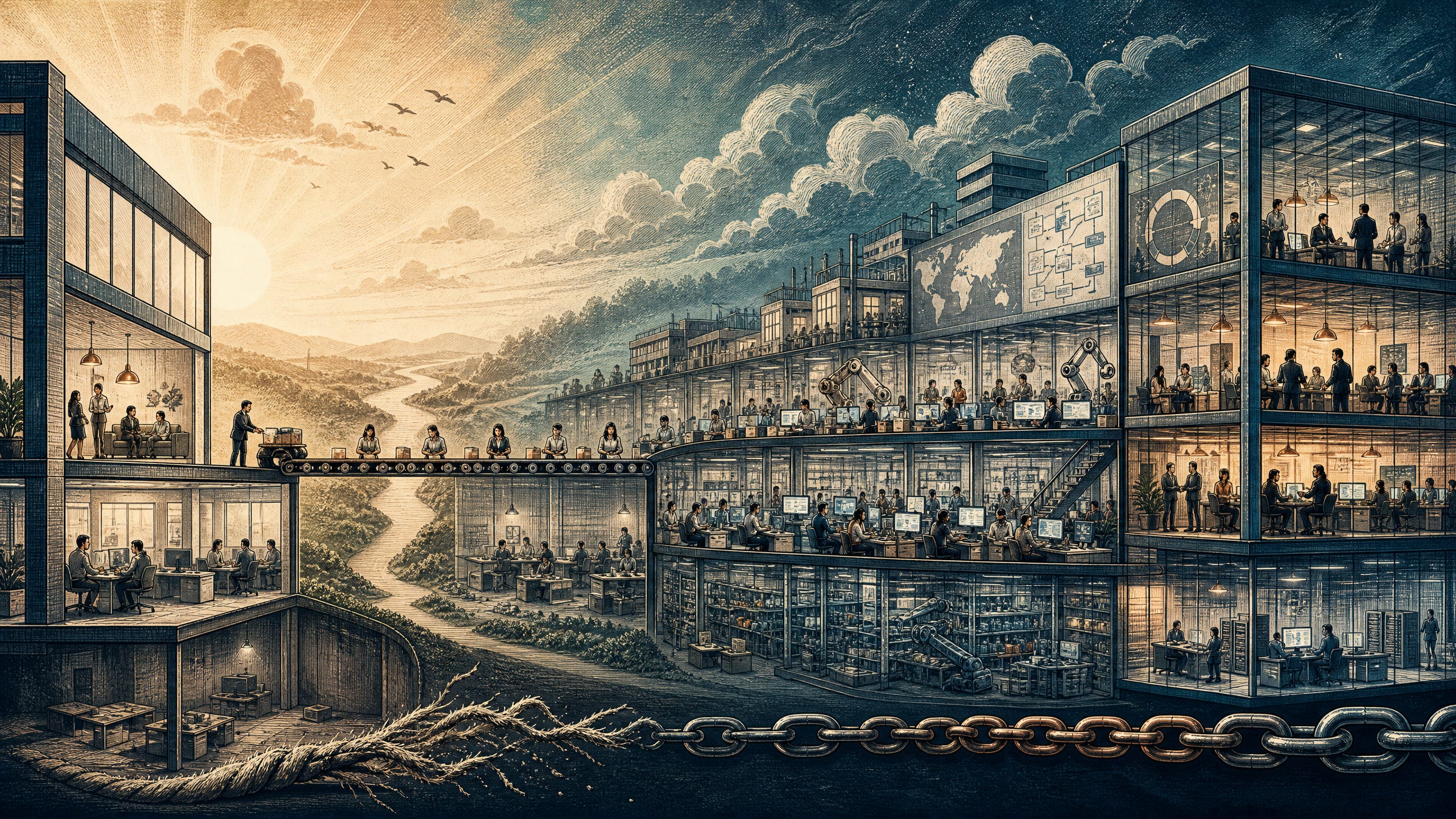
The original outsourcing decision may have been completely rational. The problem was assuming the supplier would remain merely a supplier.
This is the part of globalization that conventional discussions about comparative advantage often understate. Capability accumulates where activity occurs. Countries learn by doing. Industrial ecosystems evolve. The geography of production becomes the geography of knowledge, and knowledge creates strategic power.
This is why the dollar’s strength can be understood as an Achilles heel.
The dollar gave the United States an extraordinary ability to finance external deficits without immediately suffering the consequences that another country might face. The world kept demanding dollars. Foreigners kept buying U.S. assets. Capital kept flowing back. The system did not force America to rebalance.
That allowed the arrangement to persist for decades.
America accumulated tremendous financial wealth. Other countries accumulated tremendous productive capability.
One side accumulated claims on assets. The other accumulated factories, suppliers, engineers, and industrial knowledge.
Both forms of wealth matter. But productive capability contains a particular kind of optionality. A battery industry can become an electric vehicle industry. An electronics cluster can become a drone industry. A semiconductor ecosystem can produce entirely new classes of technology. A shipbuilding ecosystem can support both commercial and military production.
Industrial capability creates adjacent possibilities.
Once a country possesses enough nodes in that capability graph, entering neighboring industries becomes progressively easier.
COVID made this vulnerability visible in a way economic theory had not. The United States was still extraordinarily wealthy. Its financial markets were still enormous. The dollar was still dominant. Yet money alone could not instantly manufacture masks, medical equipment, pharmaceuticals, or semiconductor chips when supply chains broke.
America had purchasing power. Someone else had the factories.

That distinction is now central to American industrial policy.
For much of the late twentieth century, the dominant question was simple: where can this product be produced most efficiently?
The emerging question is different: which capabilities can we afford not to possess ourselves?
That shift places resilience beside efficiency. It places strategic capacity beside consumer prices. It treats factories as repositories of knowledge rather than merely cost centers. It recognizes that redundancy, which looks wasteful in a spreadsheet, may be valuable in a crisis.
None of this means globalization was a mistake. Nor does it mean trade deficits are inherently bad. The United States gained enormously from the system. American consumers enjoyed decades of inexpensive goods. American corporations became some of the most profitable firms in history. U.S. financial markets became the destination for global capital. The dollar became deeply embedded in international commerce. Those are immense advantages.
The difficulty is that a system can be beneficial and still contain destabilizing feedback loops.
Dollar dominance creates global demand for dollar assets. That demand pulls capital into the United States. Capital inflows support a strong dollar. A strong dollar makes imports attractive. Imports encourage production to migrate toward lower-cost countries. Production generates learning. Learning generates capability. Capability creates industrial ecosystems. Industrial ecosystems generate technological power. Technological power creates strategic leverage.
Over decades, the country issuing the world’s strongest currency can therefore become increasingly dependent on countries that accumulated the physical capabilities required to manufacture critical goods. That is the paradox.
The dollar helped America become enormously rich. It also reduced the immediate cost of allowing parts of its productive base to move elsewhere. The privilege delayed the correction.
Now the United States is attempting something extraordinarily difficult. It wants to preserve the benefits of dollar dominance while rebuilding industrial capacity. It wants cheap capital without excessive dependence. It wants global financial leadership while reducing trade imbalances. It wants resilient domestic supply chains without dramatically increasing consumer prices.

Tariffs are one attempt to force that adjustment. Whether they are the right instrument is a separate question.
Factories cannot be recreated by tariff schedules alone. Industrial capability takes time. It requires engineers, infrastructure, vocational skills, research, energy, suppliers, capital equipment, logistics, and patient investment. Thirty years of accumulated industrial knowledge cannot simply be purchased back.
But the diagnosis driving the current American shift is increasingly understandable.
The postwar economic system optimized brilliantly for efficiency, consumption, capital mobility, and financial returns. It optimized much less deliberately for the geographic distribution of productive capability.
For decades, that distinction did not appear particularly dangerous. Now it does.
And that may ultimately prove to be the dollar’s great paradox: its strength allowed America to command the output of the world, while also helping create a world in which some of the capacity to produce that output increasingly belonged somewhere else.
Figures quoted in the article
An Illustrative $300 Billion Trade Gap
The article’s simplified bilateral-flow example contrasts goods imports and exports, with the difference identified as a trade deficit.
Unit: US$ billions (illustrative flow example)
Figures quoted in the article
- Goods importedAmount: 500 US$ billions (illustrative flow example)
- Goods exportedAmount: 200 US$ billions (illustrative flow example)
- Trade deficitAmount: 300 US$ billions (illustrative flow example)
Use left and right arrow keys to review the quoted figures.
Suppose America imports $500 billion of goods from another country while exporting only $200 billion back. The United States has received $300 billion more in goods than it has sent out. That difference is the trade deficit.
Limits: Scope/date: this visual uses the article’s hypothetical bilateral trade-flow example, published 29 August 2026; the example has no measured country, observation date, or stated period. All figures are quoted by the author, not live or independently verified financial data. No unit conversions or derived values are used. This is an explanatory illustration, not a financial model or trade recommendation.
Read the original articleFull figures and source notes
| Category | Amount (US$ billions (illustrative flow example)) |
|---|---|
| Goods imported | 500 US$ billions (illustrative flow example) |
| Goods exported | 200 US$ billions (illustrative flow example) |
| Trade deficit | 300 US$ billions (illustrative flow example) |
Quoted source text
Suppose America imports $500 billion of goods from another country while exporting only $200 billion back. The United States has received $300 billion more in goods than it has sent out. That difference is the trade deficit.
American consumers and companies pay foreign producers $500 billion, while foreign buyers pay American producers $200 billion. The foreign side is therefore left with a net $300 billion in dollars.