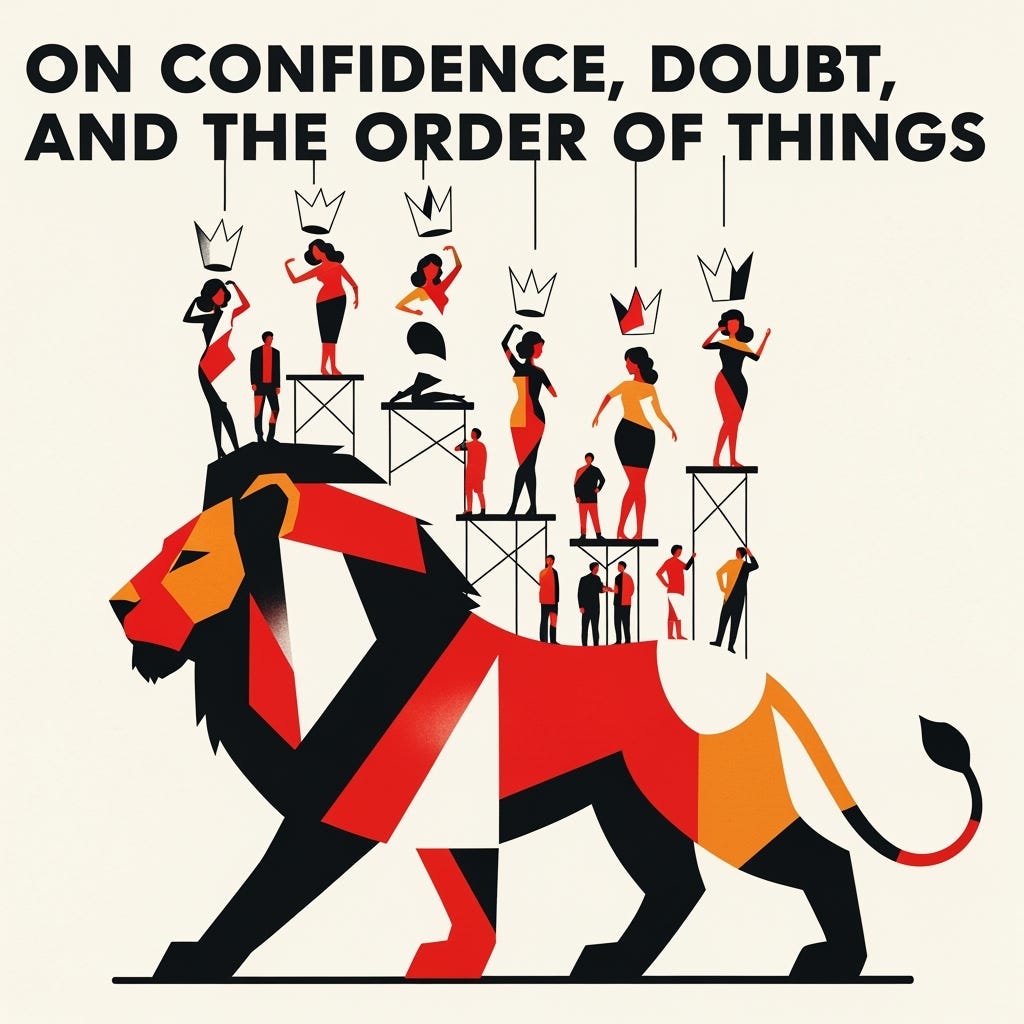
We’ve been sold a myth disguised as inspiration. That self-confidence and self-esteem must come first. That they’re prerequisites to creation, leadership, change. They are not. They are consequences of work. Not facades to plaster on—outcomes from producing, refining, challenging.
Confidence is not a mindset. It’s the neural footprint of doing. You make things, you iterate, you endure scrutiny, you practice the edges—then your brain learns the pattern: I have done this before. I can do it again. Self-esteem isn’t universal. It’s context. You might feel legitimate running a team you know inside and out. You might shrink in unfamiliar rooms. That’s not a failure—that’s evidence of work earned under specific conditions.
Everywhere, the cultural machine urges us otherwise. “Believe first. Feel brave first. Fake it till you make it.” The facade-first approach yields brittle performance. Facades collapse when the work begins. What remains is choreographed fear.
I tell my team: don’t bring self-confidence to the table. Bring self-doubt. That stare-down from peers when I say that? I welcome it. Because doubt is the forcing mechanism. It turns certainty into complacency. Certainty and work don’t co-exist. Doubt sharpens the edge. Doubt forces rehearsal, testing, iteration.
Now I came across this in Sapiens by Yuval Noah Harari. He describes how lions and sharks, top predators, accrued their majestic confidence over millions of years—evolution as steady dominion. Humans didn’t. We vaulted from the underdog to apex in under 100,000 years. No ecosystem checks. No slow adaptation. Harari argues that other predators evolved balance. We didn’t. He casts us as a banana-republic dictator—an insecure, anxious creature wielding power prematurely, one that bred cruelty and calamity.
That passage struck me. It echoes the danger of projecting confidence we haven’t earned. Lions don’t announce their position. They’ve earned it through slow, relentless survival. We try to leap to the top via image and declaration. But we skip the work.
Here’s where the chaos enters: Shortcut Creatures Always Win, my contrarian riff. What if self-confidence is the shortcut? The cultural shortcut to power? The allure is obvious. In the fitness landscape of ideas, sometimes a confident claim beats a cautious paper. Shortcut creatures often rise—brigade generals in T-shirts, founders projecting breakthrough before foundation. They win eyeballs, first funding, narrative share.
But that doesn’t undercut the original point. Understanding the fitness landscape still requires work. Confidence may open doors—but it cannot sustain position. Relay a shortcut with no foundation and it falls apart under pressure. If the fitness landscape changes—or even if it doesn’t—the untested structure crumbles.
So here’s the refined contradiction.
Self-confidence: not an input. A byproduct of rigor.
Self-doubt: not weakness. The hammer that shapes competence.
Shortcut confidence: seductive, often rewarded, but unsustainable.
In the end, whether it’s evolutionary history or the ideas economy, real dominance is earned. Not declared. Don’t begin with confidence or esteem. Begin with work. Build patterns, earn outcomes. Then confidence isn’t a mask—it’s evidence.