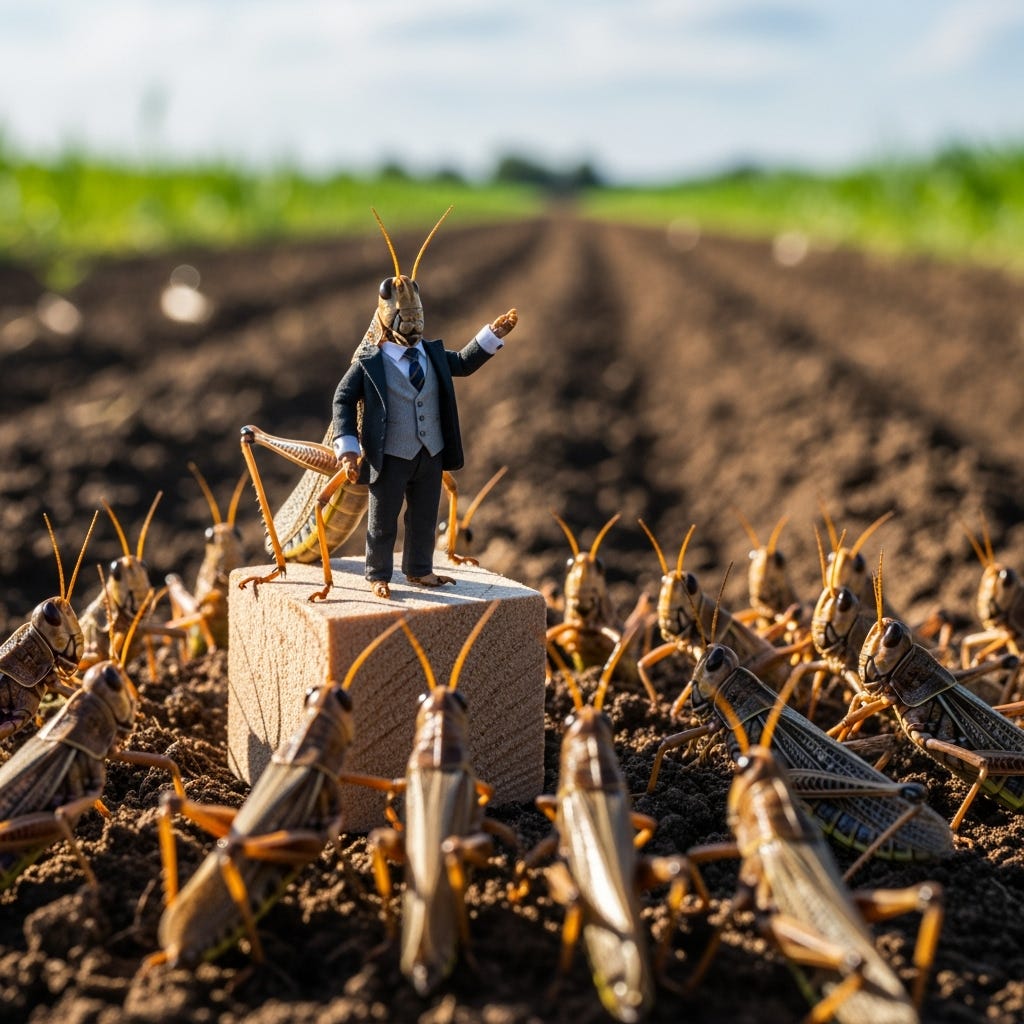
Let me tell you an interesting story. For a long time, scientists were puzzled by why swarms of locusts suddenly emerge. Recent research found that it all comes down to density. When there are fewer than about seventeen locusts per square meter, each insect behaves alone, wandering without pattern. It is almost complete disorder. Each locust is isolated, unaffected by others. But when more locusts gather, around twenty-four to sixty per square meter, their behavior begins to shift. They form small groups, like cliques in a high school. Each mini-swarm moves together, but there is no coordination between groups. Then comes the tipping point. At precisely 73.7 locusts per square meter, something extraordinary happens. The locusts start to march in unison, not as cliques but as a single, coordinated swarm. Out of density comes order. What looked like chaos transforms into one of the most destructive forces in nature.
This story of the locusts offers a useful metaphor for us. Humans too shift from individuals, to cliques, to societies that suddenly move in mass coordination when tipping points are reached. And just like locusts, the mechanisms are not always intuitive. Which brings us back to that exasperated question we all ask: what is wrong with people? Why would he or she or they do that? That makes absolutely no sense!
The Long Arc of Evolution
Our species has existed for around 200,000 years. If we assume an average generation length of twenty-five years, that gives us roughly 8,000 generations. For nearly all of them, survival meant dealing with immediate, tangible cause and effect. A rustle in the grass could signal a predator. A red berry might nourish or kill. Social groups rarely exceeded a few dozen people, so the dynamics of trust and betrayal could be tracked face to face. Pattern recognition, storytelling, and simple logic were enough.
Since the fall of Rome only fifty to sixty generations have passed. In that short span we moved from agrarian villages to global financial markets, from oral storytelling to social media algorithms, from spears to nuclear weapons. Only a few decades ago parents were the ones teaching technology to their children, whether it was how to use a radio, a typewriter, or a television. Now the direction has reversed, with children often teaching their parents how to navigate smartphones, apps, and digital platforms. These developments created a causal world that is abstract, global, and delayed in its effects. Climate change is the classic example: what we emit today transforms the environment decades later. Our instincts are still those of foragers, yet our environment demands probabilistic reasoning, systems thinking, and long time horizons.
Input and Bottleneck
Here lies the paradox. We are simultaneously the input and the bottleneck. Human brains are the raw matter of culture. Out of them came mathematics, science, governance, and technology. But those same brains struggle to use the advanced products of culture.
Culture is not the output of a perfect swarm. Most of the innovations that shape our societies came from rare outliers whose thinking stretched beyond instinct. Euclid gave us geometry. Al-Khwarizmi formalized algebra. Galileo connected observation to mathematical law. Newton discovered universal gravitation and calculus. Ada Lovelace imagined computing. Einstein reconceptualized space and time. Each of these individuals worked at the edge of intuition, producing insights the average human brain could not spontaneously generate. Their discoveries were then codified into books, equations, and institutions so that others could use them.
The swarm does play a role. The majority transmits, preserves, and applies these ideas, even if it cannot originate them. Farmers may not invent the mathematics behind agronomy but they can adopt planting cycles refined by generations of cultural transmission. Traders may not derive the laws of probability but they use prices shaped by those laws. The swarm amplifies what the few create. Outliers are the sparks. The swarm carries the flame.
Why the Mismatch Persists
Cognitive science shows that our reasoning is divided into fast heuristics and slow deliberation. Daniel Kahneman labeled them System 1 and System 2. System 1 is quick, automatic, and intuitive. System 2 is deliberate, effortful, and analytical. The problem is that System 1 dominates because it is metabolically cheaper and was sufficient for survival for thousands of generations. System 2 exists, but it must be trained and cultivated. This is why statistics and probability feel alien even though they are the very tools required to navigate modern complexity.
Neuroscience adds another layer. The prefrontal cortex, critical for abstract reasoning and planning, is relatively recent in evolutionary terms. It is powerful but limited. Working memory can only hold a handful of items at once. When faced with nonlinear systems, cascading feedback loops, or exponential change, our brains default to shortcuts. This is not irrationality but a reflection of architecture designed for simpler environments.
Culture Shapers and Cultural Drift
The tension between the few and the many is structural. The few generate leaps that redefine the possible. The swarm sustains, adapts, and spreads those leaps. But this creates a lag. Outliers move ahead faster than the instincts of the swarm can catch up. Institutions like schools, universities, and legal systems try to bridge the gap, converting rare insights into collective tools. When those institutions are strong, the mismatch narrows. When they falter, the gap widens and confusion multiplies.
This explains why modern life so often feels absurd. Why financial markets, climate change, or public health policies provoke the frustrated question: what is wrong with people? The answer is not that people are broken. The answer is that our wiring is mismatched to our creations. A few minds produce cultural scaffolding that everyone depends on, but most individuals find it alien. Without deliberate training, the swarm falls back on instinctive reasoning.
The Task Ahead
The real question is whether we can bridge the gap. Education, institutions, and cultural scaffolding exist precisely to extend what raw brains cannot do alone. Literacy, numeracy, and scientific reasoning are prosthetics for the mind. But they require maintenance and renewal. When institutions weaken, or when education falters, the mismatch widens and the paradox sharpens. We are both the builders of the library and the confused readers wandering its halls.
The takeaway is clear. We built a world that requires logical and probabilistic reasoning to survive, yet our instincts were forged for a different reality. We are simultaneously the source of culture and the bottleneck that limits its use. Until we recognize and work deliberately against that mismatch, we will keep asking the same exasperated question: what is wrong with people?