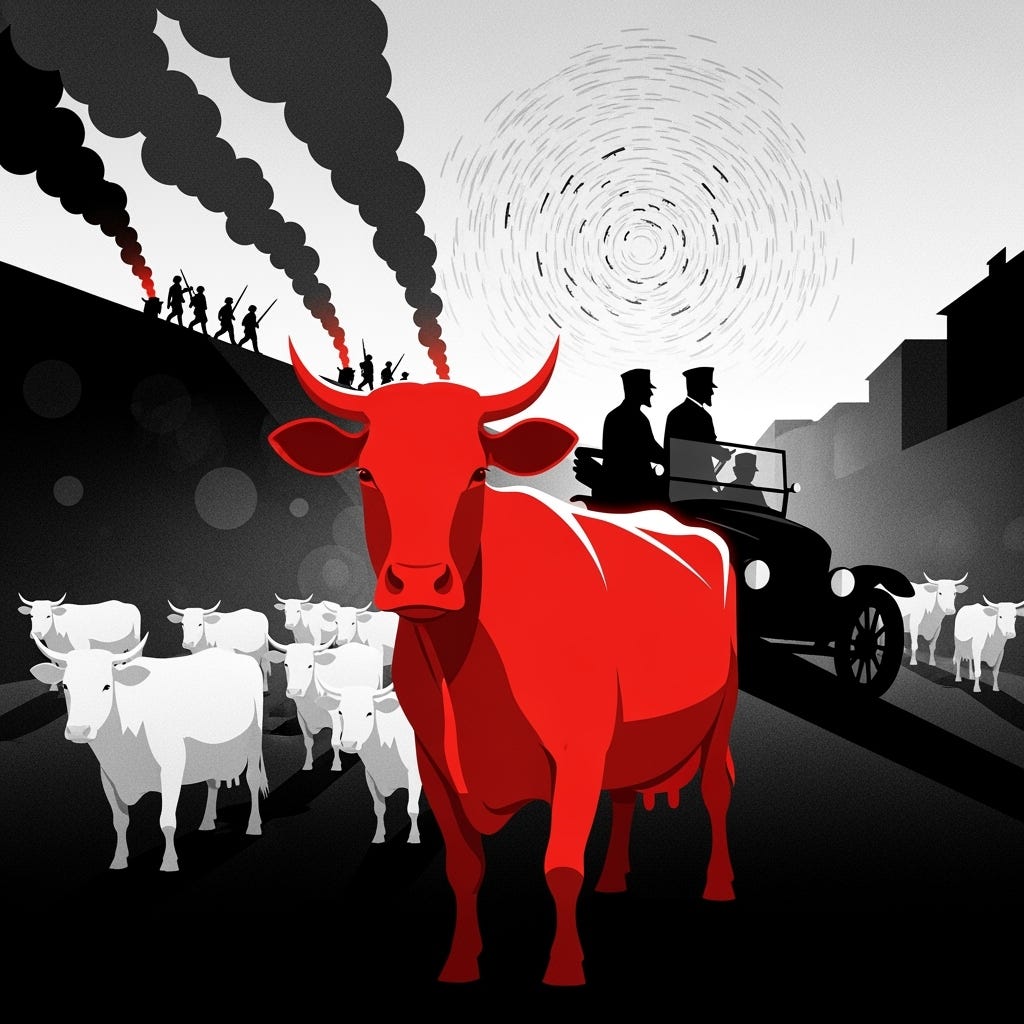
In August 1996, a red cow was born in the Jezreel Valley. Not brown. Not black. Not spotted. A full red cow. What are the odds.
For ordinary cattle breeders, it might have been a curiosity. For the devout, it was combustible. Numbers 19 in the Bible spells it out. Only the ashes of a perfectly unblemished red cow could purify the faithful and make way for the rebuilding of the Temple. And rebuilding the Temple would not be a symbolic act. It would mean tearing down the Dome of the Rock and Al-Aqsa Mosque, Islam’s third holiest site, which sits on the same contested ground. To Jews awaiting restoration, the red cow was destiny. To Muslims, it was desecration. To Christians, especially millennial evangelicals, it was the fast-track to Armageddon. A detail buried in scripture had suddenly become a live fuse in Jerusalem.
And it was not just any moment. This red cow arrived barely three years before the millennium. The world was already steeped in apocalyptic countdowns, Y2K hysteria, and millennial prophecy fever. To some Jews, this was the missing key. To some Christians, it was the opening act of Revelation. To Muslims, it was an existential threat to the sanctity of Al-Aqsa.
One animal. Three faiths. Billions of believers triangulating meaning onto a cow.
Seth Godin once told marketers to find their “purple cow,” the thing so distinctive it forces attention. History one-upped him. This was the red cow. Except this kind of distinctiveness did not sell books or toothpaste. It threatened to redraw Jerusalem.
Under constant scrutiny, every hair of the red cow was inspected like a nuclear trigger. Then one day, a single white hair appeared amidst the red coat. Just one. Enough to disqualify it. The most dangerous cow in the world was suddenly just another cow. The fire fizzled. The apocalypse was postponed.
But the story did not end there. Some Jews began breeding in search of another red cow, trying to manufacture what was once sheer accident. Replicating randomness, as if providence could be coaxed into a pen. Contingency turned into strategy, and strategy into theater.
That urge is not confined to religion. It is how we behave today. The TikTok craze is a modern red cow factory. An algorithm stumbles upon a random video, amplifies it, and suddenly we frame it as a cultural truth. People then scramble to reverse-engineer the accident. They copy the format, mimic the sound, chase the trend. Just as ranchers bred cows in search of an unblemished red, we breed content in search of relevance. And just as with the cow, the framing makes the trivial look prophetic.
We often reach for lines like “everything happens for a reason” or “it was meant to be” when chance turns against us. But when chance bends in our favor, we simply accept it as destiny and move on. The red cow was to some a gift, to others a threat. Who, in that moment, had the monopoly on “meant to be”?
The truth is simpler, and harder to swallow. We are predictive, optimizing creatures who forget that some things just happen. Contingent on ripple effects far too many to account for. As Einstein once said, not everything that can be counted counts, and not everything that counts can be counted.
History reinforces this. Archduke Franz Ferdinand’s death in 1914 was not inevitable. Years earlier, he was nearly killed in a hunting accident when the loader’s gun jammed and misfired. A few degrees of angle and he would have died in the forest, not in Sarajevo.
On the day of his assassination, the sequence was almost comical in its improbability. A bomb was thrown at his motorcade but missed. The Archduke insisted on visiting the hospital to see the injured. His driver then took a wrong turn onto a side street. By sheer chance, there stood Gavrilo Princip, a second assassin who had already abandoned hope after the failed bombing and stopped for a sandwich. He looked up, saw the Archduke, and raised his pistol. Within seconds, Ferdinand and his wife were dead.
That single moment of contingency was then framed as an insult to empire and proof that enemies could no longer be tolerated. Austria struck at Serbia. Russia moved to defend Serbia. Germany mobilized to defend Austria. France and Britain entered in turn. Within weeks, Europe collapsed into the Great War.
One hunting misfire. One wrong turn. One sandwich. One pistol shot. Any of them could have bent differently. Instead, they converged. Millions died, empires dissolved, borders were redrawn, and the twentieth century was set on its course. Contingency lit the spark. Framing built the inferno.
The red cow reminds us that meaning is never in the object. It is in the frame we build around it.
And the way you frame something may be catastrophic to some and beneficial to others. You are a ripple in this world. You may not have control, but you do have influence. For good. For bad. You could be that locust that pivots the swarm ever so slightly. Slightly enough to send it onto a trajectory of destruction. Perhaps that is the terrifying power of framing.