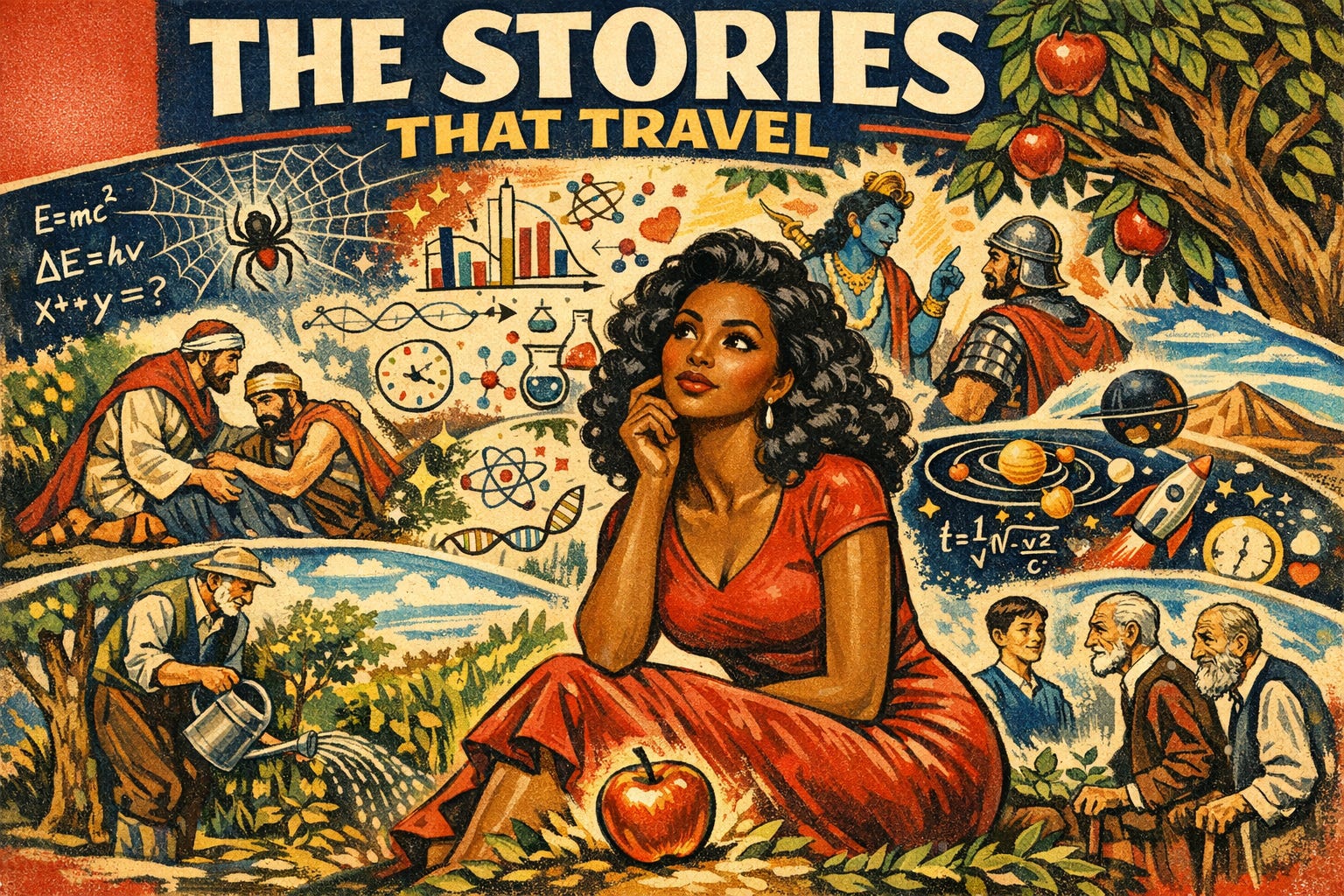
If you grew up Christian, you know the Good Samaritan. A man is beaten and left in the road, the respectable people cross to the far side to avoid him, and a foreigner everyone looked down on stops and pays for his care.
If you grew up Muslim, you know the spider from the Quran. Whoever leans on anything besides God is like a spider trusting its web for shelter, and no house is weaker than the spider’s.
If you grew up Buddhist, you know the mother who carried her dead child to the Buddha and begged him to undo it. He told her to bring back a mustard seed from a single home that death had never visited. She knocked on every door, found none, and understood.
If you grew up Hindu, you know Krishna telling a frightened soldier that the soul leaves a worn body for a new one the way a man changes his clothes.
Four faiths, four stories, each one resting in the memory of hundreds of millions of people who heard it as children and never had to study it again.
Now name the law that keeps the moon from falling on us. Most people cannot, though the same force holds their feet to the floor, pulls the rain back down, and works on everyone alive no matter what they pray to. It is one of the truest things we have ever found, and it lives in far fewer minds than a story about a spider.
The stories travel on the shape they come in. Religion gives you a picture you can hold in one hand. Science gives you a formula you have to pry open first.
Gravity reaches you as a line of symbols, one mass times another, divided by the distance squared. It is more exact than any story could ever be, and that exactness is the trouble, because you cannot feel a formula. It explains the moon perfectly and stirs nobody. This is the thing science is worst at, and it is worst at it nearly everywhere. Ask for evolution and you get a lecture. Ask about the atom and you get jargon. The careful, accurate answer arrives in a language built for precision and nearly useless for memory. Science reached for the most exact tongue available, and the most exact tongue turns out to be the one fewest people speak.
It does not have to go this way, and once in a while it hasn’t. Darwin set out to explain how every living thing connects, and he did not reach for an equation. He gave us a tree. One trunk, branches splitting into branches, every creature a twig on one slowly growing thing. You did not outgrow that tree once you learned the biology underneath it. You kept thinking with it, because it was the biology, drawn. He told the truth as a picture, and the picture held for a century and counting.
That is the rare exception. Most of the time science treats the picture as a crutch, good enough to lean on until you are strong enough for the math, then taken away. The catch is that most people never make it to the math. The crutch gets pulled before they can walk, and they go home with nothing in their hands.
This costs us more than a few forgotten lessons. The people who tell the best stories are very often the ones who care least whether the story is true, and a clean rumor will outrun a patient correction every time, because the rumor arrives as a story and the correction arrives as a footnote. Science could fight for that ground. It mostly declines, and leaves the crowd to whoever is willing to speak in pictures, honest or not.
The same choice waits for anyone who has to move a group of people. A manager rolling out a plan, a founder asking a team to follow into a hard year, a department head trying to change how the work gets done, each of them stands where the physicist and the priest once stood. The safe move is to hand people the plan itself, the deck with the targets and the timeline and the logic in order, every number checked. It can be defended line by line in a review, and that is why most managers reach for it, because a plan you can defend feels like a plan you have done your job on. People follow the logic while they are hearing it and remember almost none of it by the time they are back at their desks, the same way a student follows the gravitational formula during the exam and could not tell you a week later why the moon stays up. What sticks is the one part that reached them, and a column of figures rarely reaches anyone.
Takeaway: do not judge your message by whether it was correct. Judge it by whether anyone will remember it well enough to repeat it intact. A plan no one can repeat is a plan no one runs.
The leaders who actually move a group know this and give people the one thing on purpose. They build a picture clear enough that someone who missed the meeting can have it repeated to them in a sentence, and they say it again and again until it sets, with the plain conviction of a parent telling a child the spider’s web will not hold. Faith asks the same conviction of a believer, certainty in the picture and no embarrassment about repeating it. That conviction is also where the danger lives, because it moves people whether the picture is true or false, which is why the weakest leaders reach for it first and the most careful ones hold back. Holding back loses the room to whoever has no such hesitation.
Takeaway: a true story beats a true spreadsheet, and a false story beats both. Build the version that is true and still travels, because if you leave that ground empty, someone who does not care about the truth will take it from you.
Gravity will go on holding all of us to the earth, believer and skeptic alike, whether or not a single person can say how. The stories never waited for proof. They reached us first, and they reached us whole. The truth about how the world works can be told just as plainly, so that a person keeps it for life the way they already keep the foreigner in the road and the spider in the wind. We just have to care enough to tell it that way, instead of writing the formula down, correct and complete, and leaving it for someone else to make worth remembering.
Examples: The Science Way vs the Religion Way
Take three hard ideas and do to each one what religion would have done.
First, gravity itself. Here it is the science way. Mass and energy curve the geometry of spacetime, and what we feel as gravity is the motion of objects following the straightest available path through that curved geometry, described by Einstein’s field equations, Gμν = 8πTμν. Correct, complete, and gone from your head by the end of this sentence.
Now here it is the religion way. Lay a heavy stone on a stretched bedsheet and the sheet sags around it. Roll a marble nearby and it curves in toward the stone, not because the stone reached out and grabbed it, but because the ground it was rolling on is no longer flat. The sun is the stone. The earth is the marble. We are not being pulled down. We are rolling along the dent that everything heavy presses into the world around it. You will still have that bedsheet tomorrow.
Second, time. Here it is the science way. The proper time experienced by an observer depends on velocity, and a clock moving near the speed of light ticks slower relative to one at rest, by a factor of one over the square root of one minus v squared over c squared. True, and forgettable in the same breath.
Now here it is the religion way. Two brothers, one stays home, one flies out toward a distant star and back at nearly the speed of light. Both live every second as it comes, nothing strange, hearts beating once a moment. The traveler lands and steps off, still young, and finds his brother grey and bent and decades older. Time is not one river we all float down together. It runs slower for the one who moves fast, and there is no clock above the world keeping the true hour for everyone. Tell that to a child once and it stays for life.
Third, money. Here it is the business way. Capital allocation is the deployment of finite financial resources across competing uses to maximize risk-adjusted return, funding the projects whose expected return exceeds the cost of capital and starving the ones that fall below it. Accurate, and the kind of sentence that empties a room.
Now here it is the religion way. A farmer has one bucket of water and a field of plants. Some patches throw off fruit, some are half-dead no matter what they are given. Pour the water on the thriving rows and the harvest grows. Pour it, out of pity or habit, on the dying ones, and you lose the water and the harvest both. Every dollar a company holds is water in that bucket. The whole job is knowing which rows are worth pouring on, and having the nerve to let the others go dry. Tell that to anyone who has ever kept a plant alive, and they have the idea for good.
For more thinking at the intersection of cognitive science, marketing, and the machinery of belief, subscribe to STRATEX