
When a child goes missing, a poster goes up within hours, and it always looks the same. One big photo, the word MISSING in heavy block letters across the top, a phone number underneath in numerals you can read from across a room. The wanted poster for a fugitive is built the same way, and so is the lost-dog flyer on the lamppost. Nobody who makes these has a design degree. There is no brand guideline, no agency, no mood board. Yet they all converge on the same ruthless layout, because the stakes burn away everything that does not help a stranger recognize a face in half a second. Distinctive, instantly legible, impossible to mistake for anything else, and not a wasted element on the page.
Now imagine that same poster built the way we build brands today. It opens with the child’s backstory and a warm note on the family’s values. There is a paragraph on her sense of humor and her favorite color. The photo has been cropped artfully and tinted to match the layout. The phone number is small, because large numerals clutter the design. The word MISSING has been softened to something about a journey home. It is a tasteful poster. It does nothing, because no stranger glancing up from a phone can act on it in the half second of attention it gets.
The wanted poster fares no better. Instead of the face and the word DANGEROUS, it walks you through the fugitive as a boy: how he loved cats but for some reason always killed spiders, how he doted on his grandmother, the summer he learned to swim. By the time you reach any of it you have forgotten you are supposed to be watching for the man, and the man has walked past you. The face that should have been burned into you in a single glance is buried three paragraphs down, behind his relationship with his grandma.
That is most brand marketing. Stripped down, advertising has one job, the missing-poster job: be the first thing that fires at the moment of need. The people who make real posters never forget that. We have buried it under backstory.
Think about what you actually bought today without choosing. The toothpaste you grabbed. The water at the till. The cooking oil your hand found before your brain caught up. You did not line up the options and score them. You did not pause to recall the brand’s values or the line from its last ad. Something came up in your head, you took it, and you moved on. Now hold that against how you were trained to build brands. The craft assumes a buyer who stops, weighs your reasons, and picks you because you are better or more meaningful. That buyer barely exists. The real one gives your whole category a few seconds of attention a year. So before we talk about what your brand should stand for, there is a less flattering question to settle. When the moment to buy arrives, does your brand even show up in the buyer’s head at all?
That question sits at the center of a real argument that has run in public for over a decade among a small group of people who study how brands actually grow. It matters because the two sides would have you spend your money in almost opposite ways.
On one side is Byron Sharp, a marketing scientist at the Ehrenberg-Bass Institute in Australia and author of How Brands Grow, a book built not on taste but on decades of purchase data across hundreds of categories. Sharp’s central claim is that brands grow mainly by being easy to remember and easy to buy, and that the meaningful differences we agonize over move sales far less than we were told. The blunt version, the one that makes traditional marketers wince, is that nobody really cares about your brand, so stop building it as if they do.
Pushing back, partly, is Mark Ritson, a marketing professor and widely read columnist who thinks the science is mostly right but believes Sharp swings too far. Ritson wants to keep real room for differentiation, for standing for something that lets you charge more and last longer. Running alongside both are Les Binet and Peter Field, two effectiveness researchers who spent years inside a large database of ad campaigns and came out with actual numbers on how much you should spend to grow. We will get to their math, because it is the part most marketers have never seen, and the part that turns all of this into a budget decision.
Keep those four in mind. The rest is mostly their disagreement, and what you should take from it.
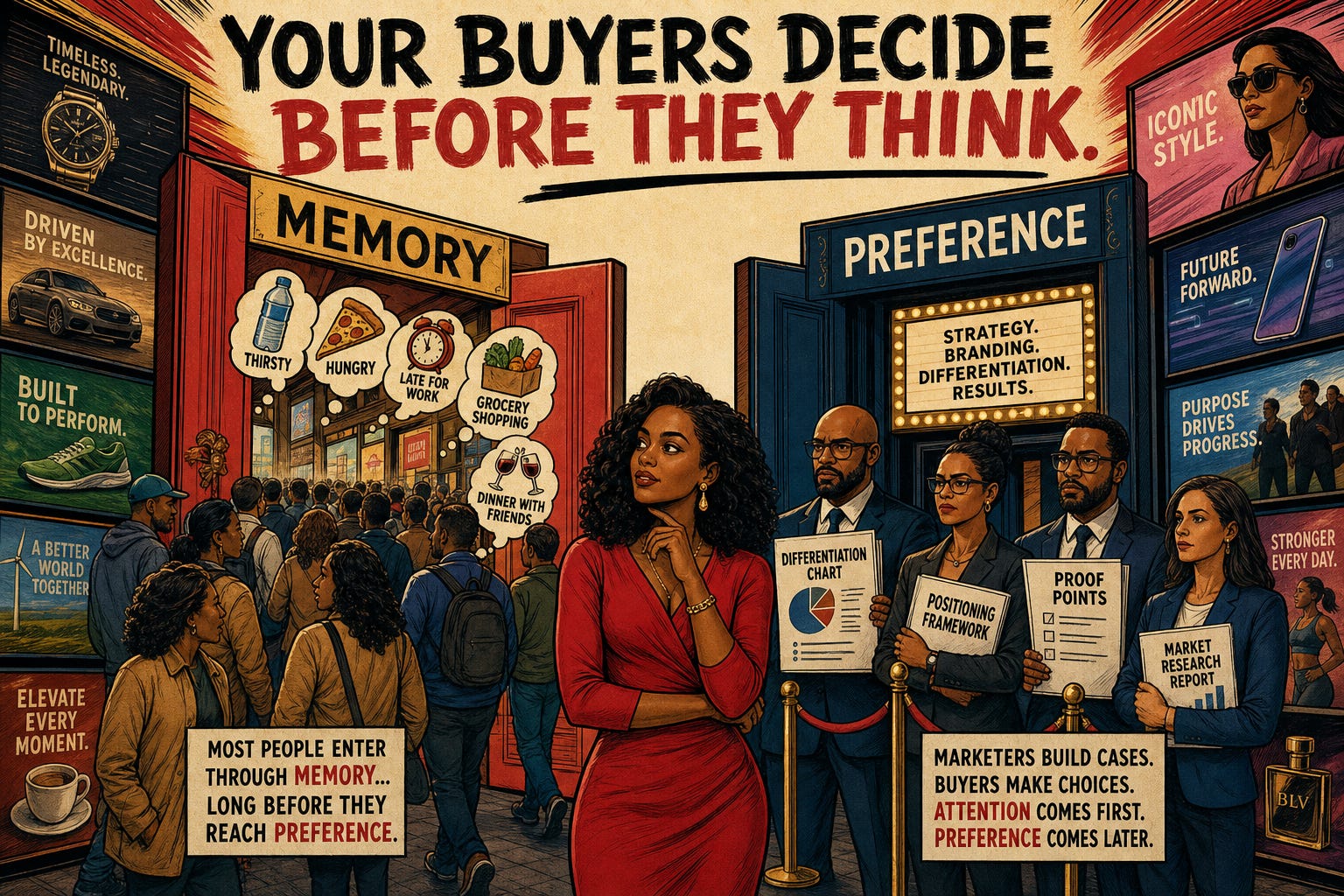
Think of memory as a web of triggers. A buying situation is a trigger: thirsty on a hot afternoon, a fast lunch before a meeting, something to bring to a friend’s house. Each time you run into one of those situations and a particular brand is around, your brain quietly ties the two together. Later, when the same situation comes up, the brands tied to it pop into your head, and you usually grab the first one that does. The brand tied to the most situations, in the most heads, gets bought the most. That is mental availability, the chance your brand is the one that pops up when the moment arrives. Sharp calls those buying situations category entry points, and the whole game is getting your brand wired to as many of them as possible.
The whole buying decision really has two parts. First, does your brand even come to mind when the need shows up. Second, once it does, do they pick you. Almost all marketing energy pours into the second part: the reasons to prefer us, the proof points, the difference. The bigger and more ignored leak is at the first. A brand nobody remembers in the moment cannot be preferred no matter how strong its reasons are. You can hold the best argument in the world for a meeting you were never invited to.
So the shift Sharp asks for is this. Stop asking what your brand means to people. Start asking what moments make them think of you.
Takeaway: Win the first door before you spend a cent polishing the second. Audit your brand by the buying moments it shows up in, not the qualities you wish people admired.
Recognizable beats different
Here the two camps split, and it is worth getting the disagreement right, because junior marketers keep flattening it into something dumb. Ritson wants differentiation to keep real weight. He would put mental availability at maybe seventy percent of the job and save the rest for being meaningfully different, since difference is what lets you charge a premium and build something durable. He also worries, fairly, that “differentiation doesn’t matter” gets misheard by a twenty-four-year-old as “never try to be better than your rivals.”
Sharp looks at the data and mostly shrugs. Genuinely differentiated brands turn out to be rare. Buyers usually cannot tell competing products apart on the qualities we obsess over. Even where a real difference exists, it tends to move share far less than the books promised. His estimate for what difference contributes sits well below Ritson’s thirty percent, and a lot of the time it rounds toward almost nothing.
Two ideas get tangled here, and separating them clears most of the fog. Being different means you offer something rivals do not. Being distinctive means you are instantly recognizable as yourself. Coca-Cola is not meaningfully different from any other cola in a blind taste test; people fail that test all the time. It is wildly distinctive: the red, the script, the curved bottle, the swirl. The distinctiveness is doing the heavy lifting, and it works because the brain rewards what it can pull up with no effort. Easy recall feels like quality, and quality feels like a reason, even when all that really happened was that your hand already knew the label.
There is a reason we overrate difference anyway. We judge the whole field by its freaks. Apple, Tesla, the rare oddball that built a fortune on being strange. We sample the very top of the heap and conclude that being different is the road, when those are the unusual survivors, not the map.
Takeaway: Aim to be recognized before you aim to be different. A genuine difference is a price lever you pull after availability is handled, not the floor you build on.
Look like yourself
If buyers barely think about you, then on the rare occasions you do appear, you had better look unmistakably like yourself. The thing that sparks recognition before anyone reads the name is what does this work: the color, the logo, the character, the jingle, the shape, the line. The golden arches from a mile off. Intel’s four notes. The Nike swoosh with no word attached. These are distinctive brand assets, the property you actually own inside a buyer’s memory.
The field has invented too many words for one thing. Codes, assets, fluency devices, mnemonics, brand properties. Ritson’s sensible plea is to settle on one term so we stop confusing the young marketers we are meant to be training. Call them distinctive brand assets, DBAs, and stop renaming the furniture.
There is a cheap test for whether you have any. Cover your logo and watch your own ad. If, with the name hidden, the spot could belong to any rival after a one-word swap, then you spent your budget building the category’s memory and not your own. You paid to remind people they were thirsty and let whoever owns the strongest assets collect the sale.
Takeaway: Treat your distinctive assets like a balance sheet. Pick a small set, lock them down, and put them in everything, because a brand that shows up rarely and looks generic when it does is paying rent on someone else’s house.
Selling to everyone again
For about a decade the fashion was to narrow. Segment hard, find your tribe, and proudly chase off everyone outside it. The data points the other way. Brands grow mainly by reaching more buyers, and most of those buyers are the light and occasional ones who barely know you and hardly think about the category at all. That is where the growth lives, and you cannot win them by talking only to the faithful who already buy from you.
The Nike campaign built around Colin Kaepernick gets waved about as proof that picking a side pays. It did pay, for Nike, because Nike is already enormous, already stands for defiance to a customer base that leans a certain way, and can afford to lose the people it loses. That is a poor template to hand a normal brand. For most companies, taking a public side mainly subtracts buyers you needed and keeps the ones you already had. The drift now is back toward what some call sophisticated mass marketing: reach broadly, build availability across the whole category, and stop congratulating yourself for the customers you turned away.
Takeaway: Your next ten percent of growth is almost certainly hiding among people who feel lukewarm about you. Build for the indifferent majority, not the devoted few who would buy anyway.
Purpose is not a reason to buy
Two different things wear the word purpose, and mixing them up causes most of the noise. Purpose as mission, the reason a company exists and the thing it is trying to build, is real and it does real work. Brand Finance, for one, runs on bridging the gap between marketing and finance, and that mission shapes the actual job every day. That kind of purpose belongs in the engine room.
The purpose under fire is the other kind: a moral or social stance bolted onto a brand to make strangers buy more shampoo. The evidence that a brand’s position on a social issue moves choice is thin and getting thinner. People buy detergent because it is in front of them and it cleans, not because the company posted the right sentiment last spring. A stance can be sincere and still do nothing for the till, and pretending otherwise burns money that could have bought reach.
Takeaway: Keep your mission, drop the posturing. If a campaign’s main job is to announce your values rather than make you easier to remember and buy, it is brand decoration, not brand building.
Consistency and the cost of starting over
One line from this debate deserves a frame on the wall: leave your brand cakes in the oven longer. Mental availability and distinctive assets compound. Every consistent exposure deepens the same paths and strengthens the same colors, sounds, and shapes. The cost of consistency is invisible in any single quarter and decisive over years, which is exactly why it gets cut first.
The obvious worry is that a cake left too long burns. That is real. Run the same ad too hard for too long and it does wear out: people stop noticing it, or start to resent it, and the returns sag. But wear-out sits much further down the road than almost anyone believes, and the far more common death is the opposite one. The cake comes out raw. A marketer sees the ad in every meeting, every cut, every review, until they are sick of it, and they mistake their own exhaustion for the audience’s. They have seen it five hundred times. The customer has seen it maybe five, half-watched, on a phone. Pulling the campaign at that point is taking the cake out the moment the edges turn gold and calling it done. The few brands that genuinely burn are rare enough to study; the many that bake raw are everywhere.
Memory links also fade when you stop refreshing them. There is a simple way to picture it. Whatever place you hold in someone’s mind today slowly leaks away if you go quiet, and how fast it leaks depends on how steadily you keep showing up. Refresh the same assets and the same paths, and the leak is slow to the point of barely moving. Rebrand every eighteen months, fire the agency, change the colors, chase a fresh look, and you yank the cake out half baked and start the bake again from cold. The rival who simply kept showing up the same way for ten years is now unbeatable on the one thing that matters most, and they got there by being boring on purpose.
Takeaway: Boredom is not a wear-out signal, it is an occupational hazard of the people who made the ad. Pick assets you can live with for ten years, then actually live with them, and only worry about burning the cake once the evidence, not your own fatigue, says the audience has had enough.
Spending more than your size
Now the money, because none of this is free, and Binet and Field gave us a clean way to size the bet. Picture the whole category as a crowded room where every brand is talking at once. How much of that total noise is yours is your share of voice. How many of the people in the room already buy from you is your share of market.
Here is the one idea to hold on to. If the share of the noise you make is bigger than the share of customers you already have, you tend to grow. If your noise is quieter than your size, you tend to shrink. That gap, between how loud you are and how big you are, is excess share of voice.
Think of your market share like a savings balance, and your advertising as the contribution you make to it. Match your spending to your current size and you are putting in just enough to cover what naturally drains away; the balance holds flat. Spend louder than your size and you are adding more than drains out, so the balance, your market share, climbs over the next year or two. Spend quieter than your size and the drain outpaces what you put in, and the balance slips. The dangerous part is that the slip is invisible for a while. Your sales can look flat and reassuring the whole time, while your share leaks underneath, the same hidden loss as a salary that never quite keeps up with inflation. Steady on paper, shrinking in truth.
Now the actual arithmetic, which is simple enough to follow:
SOV = your ad spend ÷ total category ad spend
SOM = your sales ÷ total category sales
ESOV = SOV − SOM
You read this as follows. Your share of voice is your slice of all the advertising money spent in the category. Your share of market is your slice of all the sales. Excess share of voice is the first minus the second, how much louder you are than your size. Then the rule that connects spending to growth:
change in SOM over the year ≈ 0.05 × ESOV
You read this as follows. Take your excess share of voice and multiply by about one twentieth, and that is roughly how many points of market share you pick up in a year. Work a real case. Your brand holds twenty percent of the market. You buy enough advertising to reach thirty percent of the category’s voice. Your excess is thirty minus twenty, ten points. Multiply by 0.05 and you get half a point of share, so you head toward twenty and a half percent over the year, and that bigger base then earns more attention on its own and funds the next push. Run it the other way to see the trap. You hold twenty percent of the market but buy only fifteen percent of the voice. Your excess is minus five. Multiply by 0.05 and you get minus a quarter point, a slow bleed of share that your flat-looking sales will hide until it is a problem.
Binet and Field paired this with one more number worth memorizing: roughly sixty percent of budget to long-term brand building and forty percent to short-term promotions tends to work best over time. Brand building gathers slowly, like sediment, and fades slowly. Promotions spike and drop fast, the way a discount empties a warehouse this week and changes nothing about next year. Excess share of voice is mainly how you fund the slow, compounding kind.
Takeaway: At minimum, make enough noise to match your size, because advertising quieter than your market share is paying for a slow decline. To grow, run the numbers: a sustained ten points of excess share of voice buys roughly half a point of share a year, and the bill lands before the growth shows up.
Mental availability needs a shelf
Most of these findings come out of saturated Western markets with full shelves and endless competing messages. Run the same thinking in a market like Ethiopia and the inputs move, not because the rules break but because the ground is different.
The first thing that changes is what advertising is even being used for. Where there are few brands and supply is the constant worry, a lot of advertising is really just a tool to clear stock this week. That moves boxes fast and builds almost no memory. When the stock runs out, the brand drops out of mind with it. It is a short-term promotion wearing a brand-building costume.
The second thing is that mental availability is useless on its own. Being the first name a shopper thinks of does nothing if the product is not on the shelf when they reach for it. It is like being the first restaurant a hungry person remembers, on a night when the place has no open tables. In markets where the real friction is distribution and logistics, paying for voice before you can reliably be found is pouring money down a hole. Advertising cannot fix a broken supply chain.
The third thing is the one most people miss, and it is an opportunity. In a quiet street a normal voice carries a long way; in a packed stadium you have to scream just to be heard at all. Emerging markets are the quiet street. The advertising noise is low, so excess share of voice is far cheaper to buy. A brand that builds proper memory in a market where rivals only run price promotions is buying voice at a discount and can end up owning the category’s memory before the global players arrive. By the time distribution matures and the big competitors show up, the default name in people’s heads is already taken, and it is yours.
Takeaway: In an uncluttered market, attention is on sale, but only once you can actually deliver. Fix the shelf first, then buy the cheap voice and own the memory before the street gets loud.
Be impossible to forget
Stack the parts and the argument holds its own weight. Mental availability is the engine, being the brand that comes to mind across the widest spread of buying moments. Distinctive assets are how you make that availability stick to you instead of leaking to the rival who advertised next to you. Broad reach is how you build it across all the category’s buyers rather than a flattering tribe. Consistency is how you compound it instead of resetting the oven. Excess share of voice is how you fund it at a rate that outruns the leak. Physical availability is the shelf it all has to land on. Differentiation lives in there too, a genuine lever but a smaller one than you were promised, most useful for pricing and meaning once availability is handled, not the thing you lead with.
The marketers who keep losing are not lazy and they are not stupid. They are working hard at the wrong door, perfecting reasons to prefer a brand that never showed up in the buyer’s head in the first place. Sharp, Ritson, Binet, and Field disagree about the exact weights, and that argument is real and worth following closely. They agree on the part that should change how you spend Monday morning. Be easy to remember, easy to recognize, easy to find, easy to buy, and present across the moments that matter, for long enough that the cake finally sets.
So the next time someone in a meeting wonders aloud whether all this advertising is really necessary, whether a good enough product should not just sell itself, ask them what they would do if their own child went missing tonight. They would not wait for the world to notice on its own. They would paper every pole in the city with the same blunt, distinctive, unmissable poster, and they would not stop until the face was in every head that might catch it. And if anyone still insists the perfect product needs no marketing, then by all means believe your child is perfect, stay home, and wait for the world to find and return them on its own. And what is a perfect baby anyway? Every parent is certain theirs is the special one, just as every brand is certain it is the differentiated one. The certainty is the same, and it is wrong just as often.