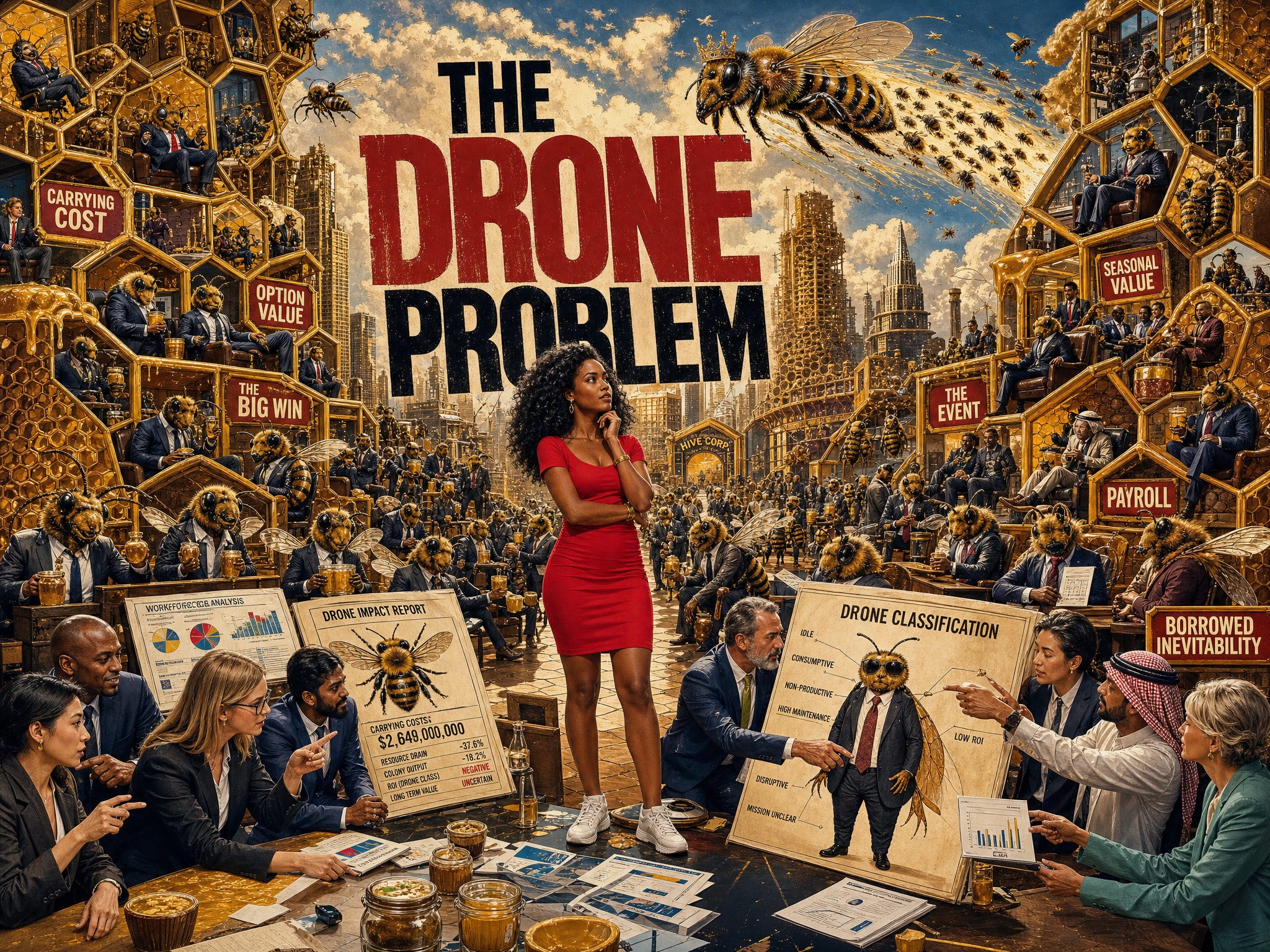
If you have ever built a budget or sat through the HR side of running a company, you know the moment. You are going down the list of names, and you stop on two or three of them and wonder. They cost real money. They show up, they are pleasant, and for the life of you, you cannot point to the thing they actually make. Before I tell you what I think we get wrong about those names, let me tell you about drones. Not the war kind, though there is an explosion coming. The sex kind. Read on.
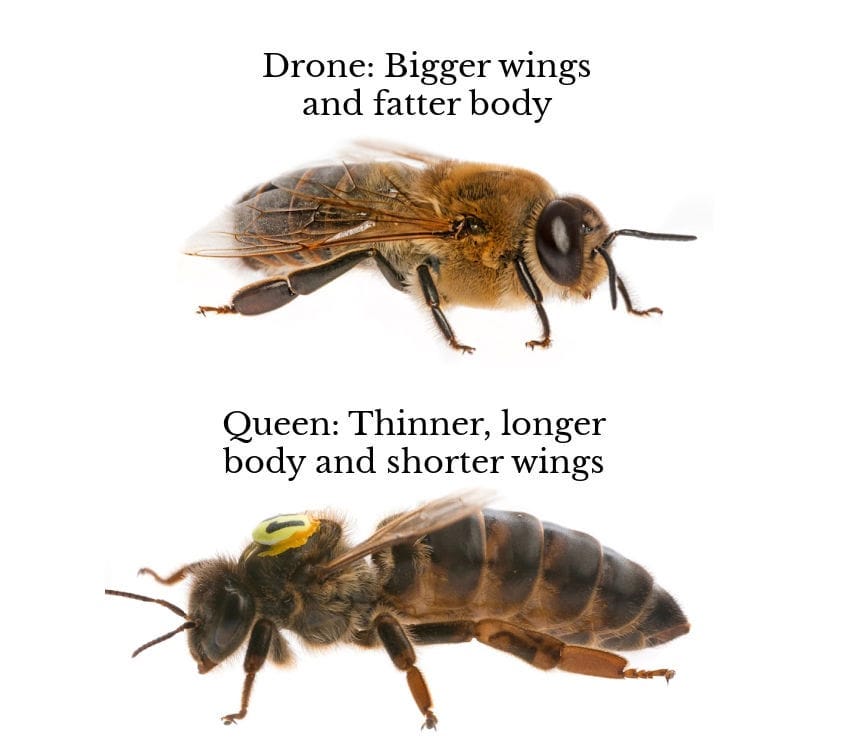
A drone is the male honeybee, and almost everything about it is strange, starting with how it gets made. Every living thing is built from a kind of instruction set, a recipe for the whole body. In most animals that recipe comes in two copies, one written by the mother and one by the father. A new bee normally begins when an egg from the mother meets a sperm from the father. The egg brings the mother’s copy, the sperm brings the father’s copy, and the two halves snap together into one complete double recipe. That snapping together is all that fertilization really is, two half sets joining into a full one.
A drone skips half of that. The queen lays the egg and simply never lets a sperm reach it. No father, no second copy. The egg grows into a bee anyway, but it grows from the mother’s half alone. So a drone goes through its whole life carrying a single recipe where every other bee carries two. Those copies sit on little bundles called chromosomes, and a drone has sixteen of them where a worker or a queen has thirty-two. Half the instructions, and all of them from its mother.
Drones do no work of any kind. They gather no nectar, guard no door, build no comb, feed none of the young, and make not a single drop of honey. They cannot even feed themselves well, so their sisters spoon food into them. They eat three to four times what a worker eats. A hive runs thousands of them through the summer, and every one exists for a single event that it will not survive.
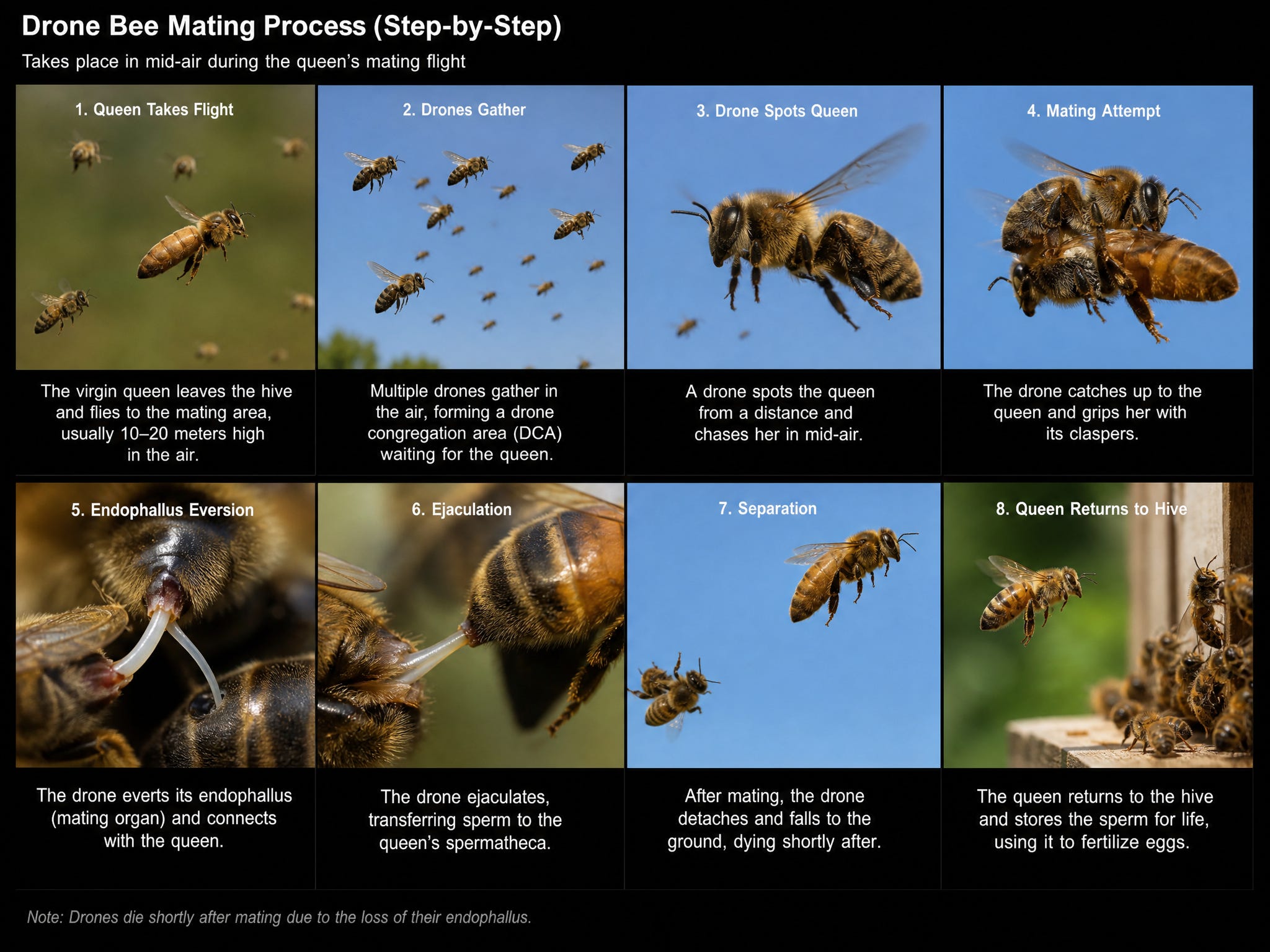
On warm afternoons the drone flies out to a patch of open sky where males from every colony for miles gather and hang in the air, waiting. When a virgin queen passes through, they give chase, a comet of males streaming behind one female. The fastest few reach her and mate on the wing, and mating is the end of them. The act takes less than a second. The drone’s blood pressure spikes hard enough to fire its reproductive organ out of its own body, the organ rips free, the abdomen tears open, and the drone drops out of the sky dead with the job finished. What is left of it stays plugged into the queen as a temporary seal, and the next male in line has to pull the previous one’s remains out before it gets its own turn to die the same way. A queen does this with about a dozen drones on average, sometimes forty or more, across a few flights early in her life, and then she never mates again and carries that sperm for years.
Forget bees for a second. Think about you and a normal brother or sister, same mom and dad. You each got half your genes from your mother and half from your father. So how much of your genes does your sibling also carry? Take your father’s side first. Your dad has two copies of everything, and he passed one of the two, more or less at random, to you, and another random one to your sibling. On his side, then, you and your sibling happen to match about half the time. Your mother’s side works the same way, another random half, another fifty percent match. Average the two sides and a normal full sibling shares about fifty percent of your genes. That is the ordinary number for brothers and sisters across almost every animal, us included.
Bees bend that number, and the drone is the reason. The mother’s side is normal: the queen hands each daughter a random half of her genes, so sisters match about fifty percent through their mother, same as anyone. The father’s side is where it breaks. Remember that the drone carries only a single set of genes, with nothing to shuffle. He gives every one of his daughters the exact same set, not a random half but the whole thing, identical down the line. So on the father’s side, sisters do not match half the time, they match all of it. They got the same genes from their father, every one of them.
Put the two sides together. Through their mother, bee sisters share about fifty percent. Through their father, they share one hundred. Average those and full sisters in a hive share roughly seventy-five percent of their genes, three quarters. Now compare that to what a queen would share with her own daughter, which is the ordinary fifty percent, because a mother shuffles and passes down a random half like any other parent. That gap is the whole engine of the hive. A worker’s sister carries three quarters of her genes. A worker’s own daughter would carry only half. If what matters in nature is how much of your genetic recipe reaches the next generation, then for a worker bee, sisters beat children. So the smart move is not to have young of her own. It is to keep her mother laying more sisters and to guard those sisters with her life, because raising sisters spreads more of her own genes than raising daughters ever could. Run that same deal through thousands of bees and the colony stops behaving like a team of separate individuals and starts behaving like one body, with the bees as its cells.
And the brothers, the drones, sit outside this entirely. A worker is related to her sisters at that lopsided three quarters, but a drone has no father, only a single half-set from the queen, so a worker shares just about a quarter of her genes with her own brother. He is the least related member of the family, not the most. The sisterhood math that holds the hive together only ever counts sisters. Brothers are worth a quarter, sisters three quarters, which is exactly why the workers pour everything into raising more sisters and carry the males as nothing more than a seasonal expense. The drone is never inside the circle the math draws around the family. He is the cost the colony pays to send its genes out to other hives, kept while the weather is good and walked to the door the moment it turns.
Which brings us to autumn. The drones that never mated do not get to retire. As the season ends and the flowers dry up, the same sisters who fed them all summer turn on them. They cut off the feeding first. Then they block them from the honey. Then they bite their wings and legs and drag them to the front door and shove them out to starve or freeze on the step. A hive full of males in July holds none by the time it is cold. The colony is about to live all winter on what it stored, and a drone is a mouth that makes nothing. So the mouth goes.
Most organizations have at least one drone. It is the person whose entire value sits inside one rare, expensive event. The trial lawyer who is idle for two years and then earns the whole fee in three weeks in a courtroom. The closer who will not touch daily account work but lands the one client nobody else could get near. The tax specialist who is the most important person in the building for ten weeks and a passenger for the other forty-two. Day to day the contribution looks like very little and the cost looks like a lot. In a good year you carry that person without blinking, because the event they exist for is coming and the payoff covers all the dead stretches in between.
The mating death has a corporate cousin too, and most of us have watched it up close. Somebody pours everything into one decisive win, the contract that saves the year, the production that defines the season, the launch the whole company is built around, and crosses the line with nothing left. Some burn out. Some deliver the thing and quit a month later. The win was real and the company banked it. The person who made it is gone, and the way the work was built made that close to certain. A win with no bench behind it tends to eat the one who delivered it.
Put it in numbers, since the relationship is easier to see as a quantity than as a feeling.
Value of a single-event role ∝ (chance the event lands × payoff if it does) − (carrying cost × time you hold the role)
You read this as: a role that only pays off when one rare, expensive thing happens is worth keeping as long as the odds of that thing, times what it is worth, stay bigger than what you spend holding the role open while you wait. Two numbers pull against each other. One is the jackpot you might hit. The other is the meter running the whole time you keep the seat warm for it.
The bees run this calculation every year without knowing they are running it. Spring and summer, queens are flying, the odds are real and the prize is large, so the colony feeds its expensive males and never argues about it. Autumn comes and no queens are flying anywhere. The odds fall to zero, which drags the prize to zero with them, and the equation has nothing left in it but the carrying cost, a negative number that gets worse every day the drones keep eating. The workers are not angry. They have read the result, and the result says feed these males through winter and the colony might not see spring.
The comparison is sound right up until someone uses it to skip a decision instead of make one.
The colony’s logic works because a colony is a single animal that happens to be spread across thousands of bodies, related by that three-quarters accident, sharing one fate. The workers cannot reproduce. The queen is the only one who does. The drones are not staff, they are closer to envelopes of genetic material the hive mails into the sky. A drone that cannot mate has, in the most exact sense of the word, no purpose left, and there is no Monday where it shows up and learns a new skill.
People are not built that way. A name on a payroll is not an envelope of sperm, and your company is not one animal sharing three quarters of its genes. When a manager looks at an expensive specialist in a slow quarter and reaches for the honeybee, what is usually going on is that the decision came first and the biology got hired afterward to make it sound like weather. I call this Borrowed Inevitability: taking a choice you have already made and dressing it in the language of natural law, so a thing you decided starts to feel like a season you are merely enduring. The bees make culling look like physics. Nothing on your org chart is physics.
There is also a bill the hive never has to pay. When the workers throw the drones out, the rest of the colony does not lose faith in the hive. No foragers hand in their notice the next morning because they watched the eviction and figured they were next in line. There is no reputation to damage, no exit interview, no survivor running the numbers on whether to start looking elsewhere. A company has every one of those. The people you keep are watching how you treat the people you cut, and they fold it straight into how hard they work and how long they stay. The honeybee has no term for what the survivors remember. A company runs almost entirely on what the survivors remember.
The hive does have one true thing to teach, and it is not the brutal line everyone quotes. It throws the drones out because their job has genuinely gone away for the season, and because it plans to raise a fresh batch in spring when queens are flying again. The eviction is seasonal. It is not a ruling that the drones were worthless all along. The honest corporate version of that is rehiring and option value, not contempt. If a role exists for an event that truly is not coming this year, you can end it without rewriting the person’s whole history into dead weight, and you can plan to bring the capacity back when the event returns. The dishonest version keeps the contempt, cuts the people, and then tells a story afterward about how they never really mattered. The hive tells no story at all. It has nothing to say about the drones. The story is the part we bring, and the story is where the lie usually hides.
Takeaway: ruthless efficiency is a real survival tool and also the easiest thing on earth to counterfeit, because the counterfeit wears the same clothes. The colony pays only for survival. A company that cuts badly pays for survival, plus its reputation, plus the trust of everyone still sitting at a desk, and then tells itself it only paid the first one.
The honeybee is a better mirror than a blueprint. Hold it up to the moment you have decided to cut, and what it shows you is the gap between an animal shedding a part it no longer needs and a group of people deciding what kind of group they want to be, while telling themselves the decision was never theirs.
If you want more of this, where biology and math and the real job of running a company get treated as one subject instead of three, subscribe to STRATEX