In 1847, Ignaz Semmelweis discovered that doctors were killing their patients. He ran the maternity ward at Vienna General Hospital, where one in ten mothers died of childbed fever after giving birth. Semmelweis noticed something: the mortality rate in the ward staffed by doctors was triple that of the ward staffed by midwives. The difference? Doctors came straight from autopsy rooms to deliver babies without washing their hands. Semmelweis instituted a chlorine handwashing policy. Deaths dropped to under 1%. He had the data. He had the proof. His peers rejected him anyway. They mocked him. They blackballed him from medical positions. In 1865, at age 47, Semmelweis died in a mental asylum after a beating by guards. The medical establishment didn’t accept his findings for another two decades. How many mothers died in those years because 200,000 years of tribal psychology couldn’t let doctors admit they were wrong?
You think you’re special. Your brain doesn’t.
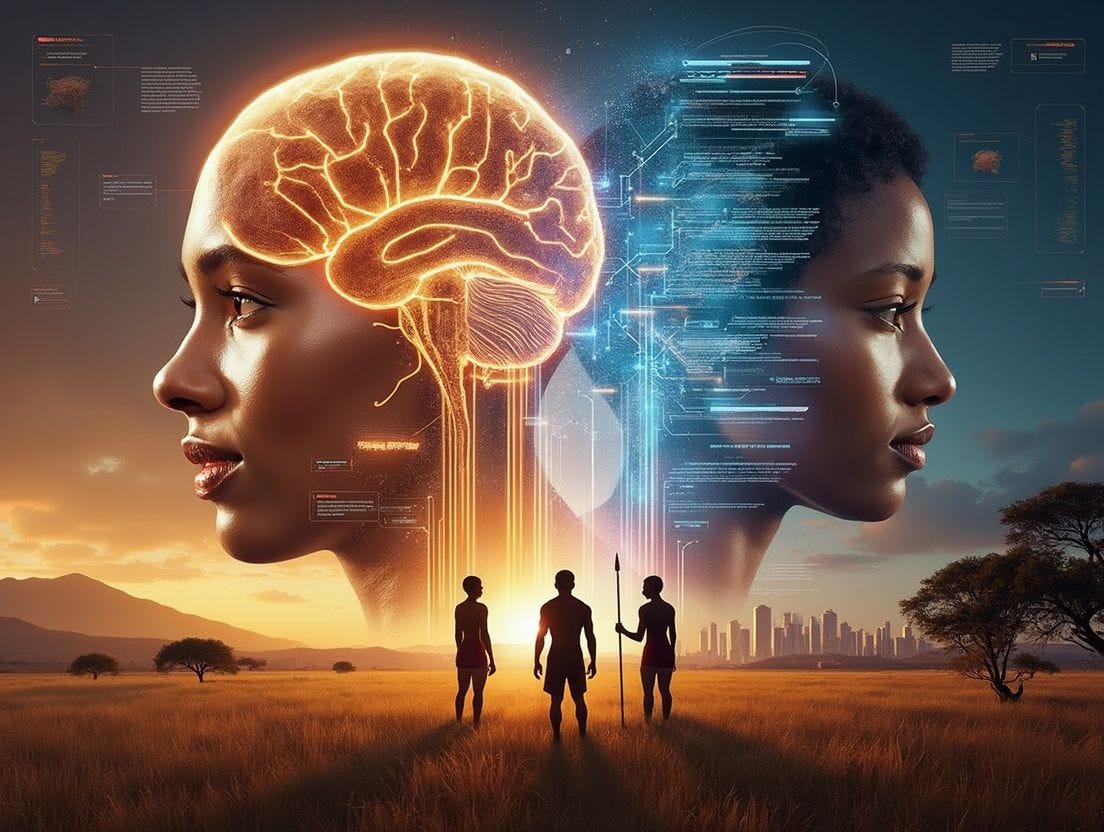
Your brain is running software written for the African savanna. Code optimized for small tribes, status hierarchies, pattern recognition in rustling grass, and caloric scarcity. It has not received a major update in 200,000 years.
You walk around with a Stone Age operating system trying to navigate a world built by statistical outliers.
⸻
The Outlier Problem
Roughly 110 billion humans have ever lived. If you look at who actually shaped the trajectory of civilization, who invented things that mattered, who wrote ideas that propagated, who built structures that lasted, you’re looking at fewer than 100,000 people whose names we still know.
That’s 0.0009% of everyone who has ever existed.
The other 109,999,900,000 people? They lived. They died. Their thoughts evaporated. Their contributions dissolved into the noise of subsistence and survival. They were not dumb. They were not lazy. They were simply running the same firmware you are: a brain designed to prioritize immediate threats, conserve energy, conform to group consensus, and avoid risk.
The hunter-gatherer brain is spectacular at keeping you alive in a world of scarcity and predators. It is catastrophically bad at producing novel ideas that threaten social cohesion or demand delayed gratification.
⸻
You Are Not Wired For Greatness
The research on how much our psychology has changed since the Stone Age (the Pleistocene epoch, roughly 2.6 million to 12,000 years ago) points to the same answer: almost nothing fundamental has changed.
Your amygdala still treats social rejection like a physical threat. In a tribe of 150 people, exile meant death. So when your manager criticizes your work in front of colleagues, your body floods with cortisol as if you’re being chased by a predator. The physical sensation of shame exists because for 200,000 years, losing social standing meant losing access to food, protection, and mates.
Your dopamine system rewards immediate gratification far more than distant payoffs. A calorie today was worth infinitely more than a hypothetical calorie next month when you might already be dead from starvation or predation. This is why you can intellectually understand that investing for retirement is important, yet still blow your paycheck on things that feel good right now. Your reward circuitry wasn’t built for 401(k)s.
Your prefrontal cortex does long-term planning and abstract reasoning. But it’s a thin layer of executive function trying to manage a brain that fundamentally wants to eat, reproduce, avoid pain, and not get kicked out of the tribe. Think of it as a modern apartment built on top of an ancient foundation that’s slowly sinking.
Procrastination isn’t a character flaw. Your Stone Age brain is correctly concluding that the lion in front of you matters more than the abstract future benefit of finishing your project proposal. The immediate threat always wins.
You conform to obviously stupid social norms because your brain runs a subroutine written when challenging the tribal elder could get you ostracized and killed. Better to go along with nonsense than risk exile.
That paralysis you feel when faced with too many options? You’re using hardware designed for a world with maybe 50 total choices in a lifetime to process a menu with 47 types of coffee. Decision fatigue is a feature of abundance your brain was never designed to handle.
⸻
The Outliers Were Statistical Mutations
So what about the 0.0009%? The ones who actually moved the needle?
Think about height. Most humans cluster around average. Then you get people who are 6’8”. Then 7 feet. Then the one-in-a-billion person who hits 7’6”. They’re statistical outliers in the distribution of a genetic trait.
The same thing happens with neural wiring.
Most brains have standard-issue dopamine reward circuits that respond strongly to immediate social approval and weakly to abstract future rewards. Then you get the rare variants. People whose reward circuits fire intensely for pattern completion instead of social status. People whose anxiety systems don’t trigger the normal “stop doing the socially weird thing” response. People whose attention regulation allows 12-hour focus sessions that would exhaust a normal brain in 90 minutes.
Newton spent 18 months barely leaving his room, deriving calculus and the laws of motion. A rare dopamine variant gave him more reward from solving abstract problems than from any social interaction.
Einstein couldn’t function in normal employment. He failed to get academic positions. He worked as a patent clerk because he couldn’t navigate institutional politics. But his spatial reasoning circuits and his tolerance for rejecting obvious assumptions were multiple standard deviations from the mean.
Marie Curie’s nervous system didn’t generate the normal fear response to social ostracism that would make most people abandon research after death threats and professional exile. Darwin’s brain produced 20 years of obsessive documentation despite crippling anxiety about social rejection.
These were rare genetic variants in neural architecture. Like being 7 feet tall. Useful in basketball. Useless in most of human history. Occasionally useful for reaching fruit nobody else could reach.
The outliers who shaped history had neural wiring that happened to be adaptive for specific historical moments. Most of them would have been useless or dead in a hunter-gatherer band.
Semmelweis couldn’t ignore what he saw in the data even when every social incentive told him to shut up. A mutation in his social compliance circuitry happened to align with a historical moment when empiricism was starting to matter more than hierarchy.
⸻
The Tyranny of Normal
The rest of us live in the world those genetic outliers built, using tools they invented, following ideas they had, inside structures they imagined. We do not build new structures. We inhabit theirs.
And we tell ourselves we’re special.
We’re not. We’re the median. We’re the 99.9991%.
Our brains are optimized for:
Following what the majority does
Avoiding short-term discomfort
Seeking immediate status rewards
Conserving energy whenever possible
Mistrusting ideas that don’t fit existing patterns
This is fine if your goal is to survive and replicate. Our ancestors did exactly that for 200,000 years.
This is catastrophic if your goal is to create something that outlives you.
And critically: you cannot simply decide to rewire these circuits. They’re genetic. They’re the median configuration because the median configuration worked for 200,000 years of human survival.
The outliers are rarer. Like people over 7 feet tall. Useful for basketball. Would have been useless or actively harmful in 99% of human history.
⸻
The <100,000 Who Shaped Everything
The number of humans whose individual contributions measurably bent the arc of civilization hovers somewhere between 50,000 and 100,000 total. Out of 110 billion!
These people are not a random sample. They cluster in specific times and places: Athens in the 5th century BC. Baghdad and Cordoba during the Islamic Golden Age. The Mayan city-states developing zero and advanced astronomy. Song Dynasty China inventing paper, printing, and gunpowder. Timbuktu’s manuscript culture in West Africa. The Kerala school in 14th century India developing infinite series and calculus concepts centuries before you thought Newton and Leibniz invented them. Florence during the Renaissance. Vienna in the early 1900s. Silicon Valley in the 1970s.
They cluster because outlier behavior is contagious when environmental conditions permit it. When the penalty for breaking tribal consensus drops low enough, a handful of people stop running the standard programming. Then others see it’s possible. Then it cascades.
But even in those golden ages, across all civilizations, we’re talking about dozens to hundreds of people per century. Not millions.
The majority, then and now, still run the Stone Age code. Consensus-seeking, risk-averse, energy-conserving, status-conscious, present-biased primates trying to survive inside social structures.
⸻
How Did They Make Everyone Submit?
If 99.9991% of people have brains wired to resist change and conform to consensus, how did a handful of outliers reshape the entire world?
They didn’t convince everyone. They convinced the next layer.
The printing press didn’t spread because Gutenberg persuaded every scribe in Europe that their job was obsolete. It spread because a few merchants saw profit margins. Then kings saw propaganda potential. Then the Catholic Church saw a threat it had to either control or be destroyed by.
By the time the average person encountered printed materials, adoption was already mandatory. You didn’t choose to live in a world with printing presses. You were born into one.
The steam engine didn’t win philosophical debates. It won economic ones. Factory owners who adopted it could produce goods at 1/10th the cost of those who didn’t. The workers who lost their craft trades to machines had no vote in the matter. Neither did the children sent into mines. The market made the choice. Individuals just absorbed the consequences.
Penicillin didn’t require convincing every patient that germ theory was real. It required convincing a few dozen doctors who controlled hospital formularies. The patients who got penicillin instead of dying didn’t need to understand why it worked. They just needed to not be dead.
Most revolutionary ideas succeeded through three mechanisms that bypass the need for mass consensus:
Economic coercion: If your competitor adopts the new technology and you don’t, you go bankrupt. The choice isn’t really a choice. Railroad companies didn’t adopt standardized time zones because they philosophically believed in them. They adopted them because train collisions were expensive.
Institutional capture: Once an idea captures positions of power (universities, governments, religious institutions, corporations), it gets enforced regardless of popular opinion. You don’t get to opt out of double-entry bookkeeping if you want a business license. You don’t get to opt out of calculus if you want an engineering degree.
Material survival pressure: When the old way stops providing food, shelter, or safety, brains that resist change suddenly become flexible. The Agricultural Revolution didn’t happen because hunter-gatherers were persuaded. It happened because climate change made hunting-gathering untenable in certain regions. Adapt or starve.
Semmelweis couldn’t convince his peers to wash their hands. But 30 years later, after germ theory became institutionally entrenched and hospitals that didn’t adopt antisepsis became liability nightmares, handwashing became mandatory. The doctors who rejected Semmelweis were mostly dead. The new doctors were trained in a system where handwashing was already assumed.
The outliers rarely see their ideas adopted in their lifetimes. They see resistance, mockery, exile. The ideas win afterward, when the next generation of power holders realizes they have no choice.
Darwin published in 1859. By 1900, evolution was taught in universities despite widespread public rejection. Why? Because the biologists who controlled university curricula realized they couldn’t do modern biology without it. Students didn’t get to vote.
The masses don’t adopt revolutionary ideas. They inherit the world those ideas created, usually 50-100 years after the original outlier died poor and unrecognized.
Your Stone Age brain never agreed to live in a world with electricity, antibiotics, or the internet. It simply woke up one day in a reality where not using them meant starvation or irrelevance.
So Are You 1 in a Million?
Probably not.
Your brain doesn’t want you to be. It wants you to fit in, stay safe, avoid risk, and replicate the patterns of those around you. That’s what it’s optimized for.
The outliers who shaped history had rare genetic variants in neural circuitry that happened to align with historical moments that rewarded those variants.
You can’t decide to be 7 feet tall. You can’t decide to have a dopamine system that rewards abstract pattern completion more than social approval. You can’t decide to have threat-detection circuits that don’t fire when you challenge consensus.
But you can notice when your brain is running subroutines written for a world that no longer exists.
When you feel the urge to defer to consensus without examining it, that’s the tribe talking.
When you avoid a project because it lacks immediate payoff, that’s the calorie-scarcity calculator running.
When you reject an idea because it feels socially uncomfortable, that’s the exile-avoidance system.
These circuits kept your ancestors alive.
They will not make you one of the 100,000.
⸻
The Sobering Math
If you live to 80 years old, you get roughly 29,000 days. Most people spend 24,000 of those days running scripts: wake up, perform economically necessary tasks, consume food and entertainment, sleep, repeat.
The 100,000 who shaped history spent their 29,000 days differently. Their neural reward systems made different activities feel necessary.
The time broke down like this:
Obsessive single-problem focus: Darwin spent 8 years studying barnacles. Just barnacles. 40,000 hours on barnacles. His brain’s reward system fired for taxonomic pattern completion in a way that a normal brain’s wouldn’t. Most people can’t spend 40 hours on barnacles without their dopamine system screaming for something, anything else.
Tolerance for zero immediate payoff: Gregor Mendel spent 7 years breeding 29,000 pea plants to figure out inheritance patterns. The monastery fed him. He had no economic pressure to produce immediately useful work. But more importantly, his brain didn’t require the immediate social validation that makes most people abandon projects after a few months of no visible results.
Immunity to status games: Ramanujan worked as a clerk in Madras, spending his nights filling notebooks with mathematical proofs while his peers spent their time on normal status-seeking behavior: socializing, career advancement, impressing potential mates. His reward circuits fired for abstract pattern discovery, not social climbing.
Imperviousness to social cost: Galileo kept publishing astronomical observations after the Inquisition told him to stop. Normal brains have threat-detection systems that would make continuing feel physically painful. His didn’t generate the normal “stop or you’ll be exiled/killed” signal with sufficient intensity to override the reward he got from publishing his findings.
Energy allocation that makes no evolutionary sense: Thomas Edison ran 10,000 experiments on the light bulb. Each failure should have triggered the ancient brain’s energy-conservation circuit: “Stop wasting calories on this.” His brain’s persistence circuitry was mutated in a way that made continued experimentation feel less painful than stopping.
Think about how the median person might allocate their 29,000 days:
Meeting survival needs (work, sleep, eating, basic maintenance): ~18,000 days
Social bonding and status maintenance: ~5,000 days
Entertainment and rest: ~5,000 days
Novel creation with no immediate payoff: ~1,000 days
The outliers flipped this ratio entirely. They still met basic survival needs, maybe 8,000 days. Social maintenance dropped to 1,000 days. Rest and entertainment, 3,000 days. That left 17,000+ days for obsessive focus on problems that had no immediate survival value.
That requires a dopamine system wired so differently from the median that the activities feel reversed in their reward value.
Semmelweis couldn’t stop investigating maternal mortality even when it destroyed his career. Normal doctors could stop easily. They did stop. Their brains correctly calculated that social harmony with colleagues was worth more than solving an abstract problem.
His brain calculated differently.
And that difference killed him but eventually saved millions of mothers.
The world runs on the ideas of people with rare neural variants that let them ignore normal programming. Everyone else just lives in the world they built, convinced they’re special because they can use an iPhone.
You’re reading this on a device designed by a hundred people, running software written by a thousand people, transmitted through infrastructure imagined by a dozen people, all of it made possible by physics discovered by maybe twenty people.
The odds say we’re not among them. Our brains inherited the same wiring that kept our ancestors alive for 200,000 years. That wiring worked. It still works. It’s just optimized for a world that no longer exists.