If you’ve ever been part of a big company, you’ve heard the refrain. “Things move so slow here.” “It takes forever to get anything done.” “We used to be able to turn around a decision in a day, now it takes three weeks.” People say it in meetings, in hallway conversations, in exit interviews. The complaint is so common it becomes background noise.
What they’re describing, whether they know it or not, is arthritis.
The word comes from Greek: arthron (joint) + itis (inflammation). Joint inflammation. And that’s exactly where it starts in the body. Inflammation. The body, in its attempt to protect itself, floods the joint space with immune cells and fluid. What begins as a defensive response becomes chronic. Over time, the synovial membrane (think of it as the lining of the joint, the tissue that produces the lubricating fluid that lets bone surfaces glide past each other) thickens and gets irritated. The fluid that’s supposed to be slick and smooth, like oil in an engine, becomes viscous and cloudy. Cartilage that once provided frictionless movement begins to wear down. The joint stiffens. Movement becomes painful.
The interesting thing about arthritis (and I mean interesting in that clinical, slightly grim way) is where it manifests. Not in the bones themselves. Not in the muscles. The damage accumulates at the interface, at the precise point where one structure must communicate with another. The knee, the elbow, the knuckles. Places designed for transfer, for coordination between distinct parts of a larger system.
Each bone might be perfectly intact. Strong, dense, functional on its own. But the joint, the connection point, deteriorates. What was meant to be fluid becomes rigid. What was meant to enable becomes a bottleneck.
I watch this same pattern in organizations. Companies hire brilliant people, build strong departments, invest in specialized expertise. Marketing is excellent at marketing. Engineering builds solid products. Sales knows how to close. Each function operates well within its own domain, optimizing for its own metrics, developing its own language and rituals.
The breakdown happens between them. Marketing creates campaigns that engineering can’t support. Sales makes promises that operations can’t fulfill. Product builds features that customer success teams didn’t know were coming. The inflammation starts small. A misaligned launch. A feature that doesn’t match what was sold. Customer complaints that never reach the product team.
Then the chronic phase. Departments develop their own protective responses. More meetings to “align.” More documentation to cover themselves. More approval layers to prevent mistakes. The synovial fluid of organizational life, the informal communication and trust that once allowed smooth handoffs, gets replaced by bureaucracy. The cartilage wears away.
Here’s what I’ve come to understand as the fundamental equation:
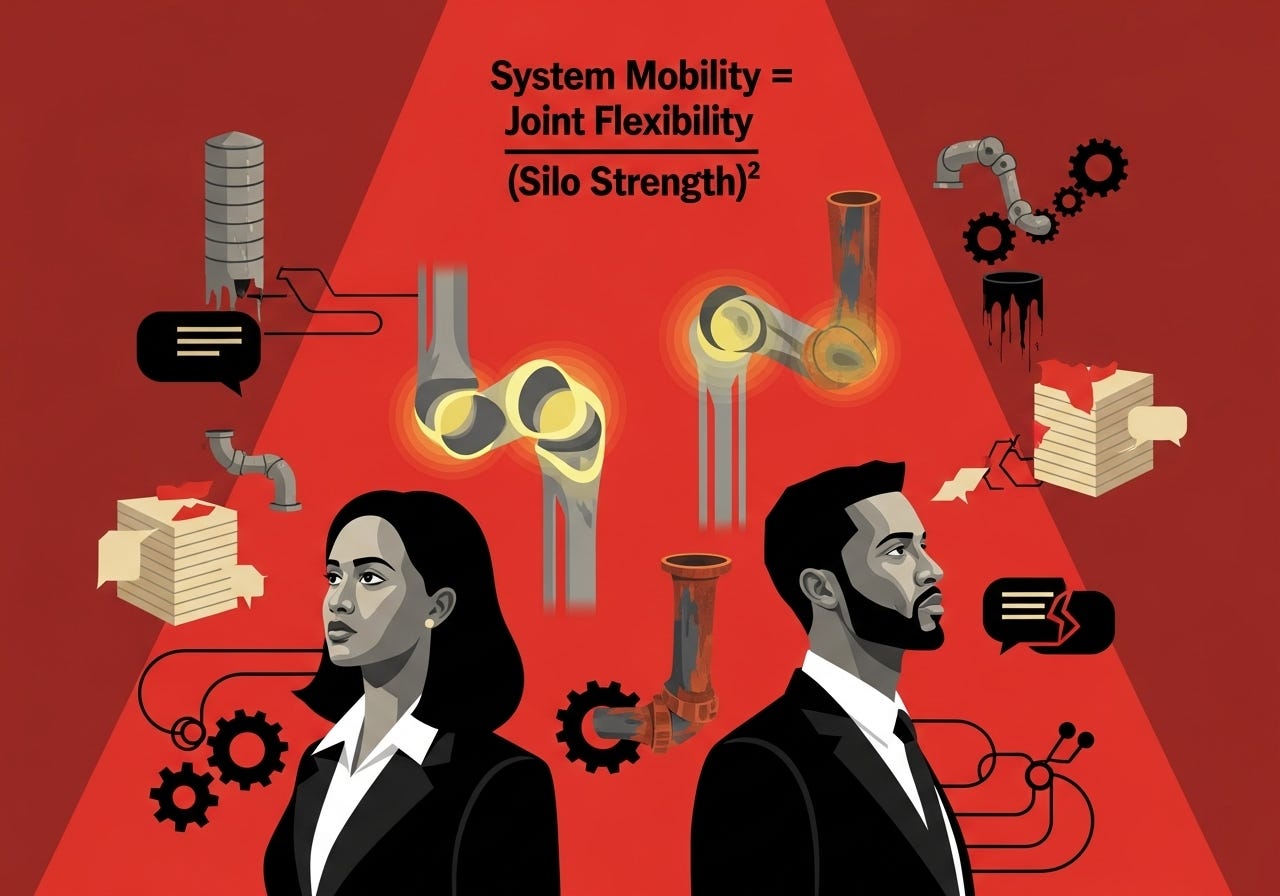
System Mobility = Joint Flexibility / (Silo Strength)²
The stronger each department becomes in isolation, the more coordination capacity you need to maintain movement. It’s not a linear relationship. It’s exponential. Double your functional excellence and you need quadruple the joint flexibility just to maintain the same organizational mobility.
Watch a competitive bodybuilder try to scratch their back or tie their shoes. Months of isolated muscle training, biceps curls and quad extensions, hypertrophy programs designed to maximize individual muscle groups. Each muscle is impressive on its own. Defined, powerful, capable of moving significant weight within its specific range. But the person can barely touch their toes. Can’t reach overhead without compensating. Struggles with basic agility movements that require coordination across multiple joints.
They’ve optimized for muscle mass without maintaining range of motion. The muscles got so strong that the connective tissue, the fascia, the joint capsules couldn’t keep up. Everything tightened down. What they gained in isolated strength, they lost in integrated function. Try asking them to do a cartwheel or climb over a fence. The very size that looks impressive becomes a limitation.
Corporate silos do this. They bulk up their departments. Hire more specialists. Build deeper expertise. Create more sophisticated processes within their domain. Marketing gets better at marketing metrics. Engineering gets better at engineering metrics. Finance gets better at financial controls. And the organization, as a whole, becomes less capable of doing anything that requires those groups to work together fluidly.
Boeing’s 737 MAX crisis is arthritis in its terminal stage. The engineering department was still technically proficient. Manufacturing facilities were capable. The supply chain functioned. Each limb worked. But the joints between them had deteriorated completely.
Engineers in one division weren’t communicating effectively with engineers in another. Safety information that should have flowed from design to training got lost in the handoffs. Quality control findings from the factory floor weren’t making it back to engineering with sufficient urgency or clarity. The interface between what management promised regulators and what engineers were actually building had gaps wide enough to miss critical assumptions about pilot training.
The MCAS system itself was competently designed within its narrow parameters. But the handoff to the people who would document it, train pilots on it, integrate it into the broader aircraft systems... those joints had calcified. Each group optimized for its own pressures. Engineering faced timeline demands. Manufacturing had production targets. Management was focused on competing with Airbus and maintaining the MAX’s selling point: minimal retraining requirements.
Nobody failed dramatically within their silo. The catastrophe lived entirely in the spaces between. In the information that should have transferred but didn’t. In the assumptions each group made about what adjacent groups understood. In the coordination that used to happen naturally but had been replaced by formal processes that nobody trusted or followed completely.
Two planes went down. Hundreds of people died. Boeing’s reputation, built over a century, sustained damage it’s still trying to repair. And if you read the investigations, the congressional testimonies, what emerges is not a story of incompetence but of advanced arthritis. Rigid, calcified interfaces between groups that were, individually, trying to do good work.
The paradox is that the more competent each function becomes in isolation, the worse the condition can get. Excellence in a vacuum doesn’t prevent arthritis. Sometimes it accelerates it. Because highly functional silos can operate semi-independently for quite a while, masking the deterioration at the joints until the whole system fails catastrophically.
Mobility training, in the physical sense, means taking the joint through its full range of motion regularly. Deliberately. Even when it hurts. You don’t let it stiffen into a single position. You don’t let surrounding muscles compensate and allow the joint to freeze.
Bodybuilders who want to stay functional do yoga. They do dynamic stretching. They work on joint rotations and movement patterns that don’t isolate muscles but integrate them. It’s not about making the bicep weaker. It’s about making sure the elbow, shoulder, wrist can still coordinate. That the system can still perform complex, multi-joint movements under load.
Pixar does a version of this with their “Braintrust” sessions. Different departments review work together regularly. Not occasionally, not when there’s a crisis, but as a fundamental rhythm. Animators, directors, writers, technical teams all in the same conversation, repeatedly, throughout a project. The joint gets worked constantly. The handoff happens in real time, with immediate feedback, before misalignments compound into crises.
The key is that mobility training feels inefficient in the short term. It takes time to have cross-functional conversations. It’s slower to make decisions when multiple perspectives need to align. A siloed team can move faster on its isolated metrics. Boeing’s individual divisions could have moved faster if they’d coordinated less, reported less, integrated less.
But speed in the limb doesn’t matter if the organism can’t move safely.
Which brings me to the second equation:
Organizational Velocity ≠ Departmental Speed × Number of Departments
You can have six departments each moving at impressive speeds and still have an organization that’s essentially paralyzed. Because organizational velocity depends on how well those departments transfer energy to each other. A sprinter with arthritic knees doesn’t run faster by strengthening their thighs. They run faster by restoring the joint.
Inflammation starts immediately, the moment you create functional boundaries. Sales separates from engineering. Product separates from customer support. Strategy separates from execution. Each separation is logical, even necessary at scale. Specialization creates expertise. But it also creates joints that require maintenance.
You either work them deliberately or they stiffen gradually. There’s no third option where they maintain themselves. The companies that stay mobile treat coordination as a skill to develop, not an overhead to minimize. They reward the people who work at the interfaces, not just the people who excel within silos. They build rituals that force the handoffs to happen continuously, with real stakes, before the gaps become chasms.
Most companies wait until they can barely move. They notice the symptoms when it takes six weeks to launch a simple feature, when customer issues bounce between departments for days, when obvious problems somehow surprise everyone simultaneously. By then, the arthritis is advanced. The joints have calcified.
And everyone is so used to the pain that they’ve forgotten what smooth movement feels like.
A note for the pedants: the equations here are conceptual frameworks, not peer-reviewed mathematical proofs. They’re meant to crystallize a pattern, to give you a mental model that’s stickier than prose alone. If you’re looking for axiomatic rigor, you’re in the wrong newsletter. These are tools for thinking, not theorems for proving. Use them accordingly.