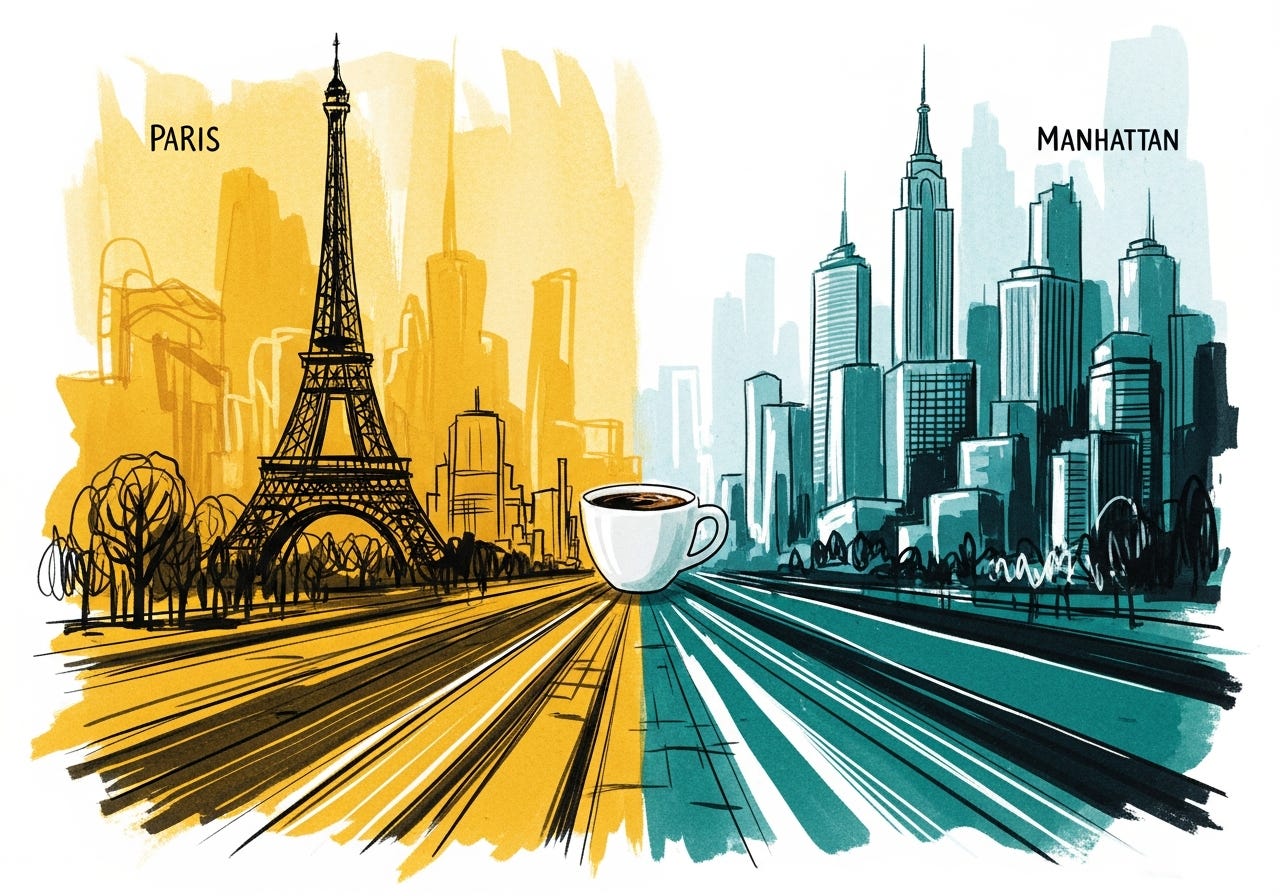
In Paris this week, I noticed Angelina, the café. Same lineups I knew. A full block of people waiting for that famous hot chocolate. Except this time, I contrasted it to the lineup I didn’t see in Manhattan a few months ago. In fact, every Angelina I came across there looked like just another café. No lineups. No buzz. Utilitarian in some sense.
The product is identical, yet the experience couldn’t be more different. Not about the drink, about the context. Paris Angelina feels like a ritual. Manhattan Angelina feels like an option.
For those of you who might not know, Angelina is a Parisian tearoom founded in 1903 on Rue de Rivoli, famous for its impossibly rich hot chocolate called “L’Africain” and its Mont-Blanc dessert. It’s been a fixture of Parisian café culture for over a century, the kind of place Coco Chanel and Proust used to frequent. The original location still draws tourists and locals alike, though it has since expanded to other cities, including New York.
Perception travels slower than expansion
In Paris, Angelina sits inside the city’s myth. You go because others go. The wait itself becomes part of the charm, a social validation loop. The queue tells you it’s worth it.
In New York, that mythology doesn’t exist. The same crowd posting stories from Paris walks past Angelina in Midtown without a glance. The brand’s aura doesn’t cross borders as easily as its recipe.
When you change geography, you don’t just change customers. You change their state of mind.
The inverse example
Walk a few blocks from the empty Angelina in Midtown and you’ll find The Halal Guys. Lines wrapping around corners. Tourists and locals both waiting 30 minutes for a $7 platter from a cart.
Open a Halal Guys franchise in Cleveland or Phoenix and nobody cares. Just another gyro spot competing with a dozen others. The mythology stays in Manhattan. The recipe travels, the meaning doesn’t.
Two brands, two cities, same lesson. Geographic context creates or destroys perceived value independent of the actual product. What commands devotion in one place inspires indifference in another.
The coordinates matter more than the ingredients.
The pattern repeats everywhere
A Toyota Hilux in Nairobi commands respect. Rugged, reliable, the vehicle that crosses deserts and survives decades. In Los Angeles, invisible. Just another truck in a sea of options, outclassed by F-150s and Silverados that signal American muscle.
Range Rovers in London blend into the landscape of Kensington. Understated wealth, appropriate luxury. Drive that same Range Rover through Kampala and it becomes a spectacle.
A cafe in Melbourne that roasts its own beans and obsesses over pour-over technique attracts lines of devotees. Open that same cafe in Naples and Italians will ignore it. They already have their bars, their rituals, their espresso pulled in 25 seconds exactly. Your craft coffee reads as pretension, not innovation.
Conversely, an Italian espresso bar transplanted to Sydney becomes destination dining. The same speed-focused service that’s utilitarian in Rome becomes exotic efficiency in Australia. The tiny cups that are quotidian in Milan become Instagram moments in Melbourne.
⸻
V = Q × C × M
Where V is perceived value, Q is product quality, C is context fit, and M is accumulated mythology.
Oversimplified, obviously. Brand value involves pricing, distribution, acquisition costs, and variables business schools spend semesters on. But those don’t explain why identical products perform radically differently across geographies.
What changes is C and M. Same Q, wildly different context and mythology depending on coordinates.
Multiplication matters because it’s unforgiving. A context multiplier near zero makes quality irrelevant. Mythology at zero does the same. You can’t compensate for weak context with strong product. The math doesn’t allow it.
Geography of desire
Brands don’t live in markets. They live in cultural climates.
Turkish dramas in Ethiopia feel cinematic. In Istanbul, just Tuesday night TV.
Vintage Levi’s in Tokyo are luxury. In Texas, work pants.
Uniqlo in New York signals smart minimalism. In Tokyo, just clothes.
Whole Foods in Manhattan means you care about health. In Berkeley, means you’re not trying hard enough.
Meaning is not portable. Reconstructed by context, rhythm, and collective desire.
The invisible architecture of experience
Marketers often overvalue intrinsic factors (taste, design, ingredients) while undervaluing environment. Yet environment scripts emotion. Scarcity, tempo, lighting, even queue length shape how we interpret worth.
In Paris, waiting for Angelina adds anticipation. In Manhattan, it would add irritation.
One city interprets scarcity as prestige, another as inefficiency. One culture reads waiting as ritual, another as poor service.
So the same brand, unchanged, performs differently because the audience’s cognitive software expects different rewards.
How perception gets constructed
Your brain doesn’t wait to taste the hot chocolate before deciding if it’s good. The decision happens earlier, built from context clues assembled in the seconds before consumption.
In Paris, you’ve been primed for hours. The flight, the arrondissement, the guidebook mention, the Instagram posts you saw months ago. The queue itself becomes data. Your brain interprets the wait as signal: valuable things require patience. The mirrors, the servers in black and white, the tourists speaking six languages around you. All inputs constructing an expectation framework.
By the time the cup arrives, your perception is 80% complete. The actual taste just confirms what context already told you to believe.
In Manhattan, different priming. You’re between meetings, or it’s Saturday errands, or you’re a local who’s walked past a dozen comparable spots in the last ten minutes. No guidebook anticipation. No travel mindset activating your receptivity to “authentic Parisian experience.” The same mirrors read as trying too hard. The queue length would register as poor operational efficiency rather than social proof of quality.
Same mechanism works for The Halal Guys but reversed. Manhattan locals have the mythology embedded. They know the origin story, the cart on 53rd and 6th, the late night salvation narrative. Tourists absorb it from the queue, from the Instagram geotags, from the yellow signage that promises authentic New York. All priming before the first bite.
In Phoenix, none of that exists. You’re primed by strip mall context, by competing fast casual options, by the absence of mythology. The same chicken and rice arrives with zero narrative scaffolding.
Psychology calls this expectation-driven perception. Wine studies show it ruthlessly. Tell someone a wine costs $90 versus $10 and their brain’s pleasure centers light up differently for identical wine. The price information changes the neurological experience of taste.
Location does the same thing. Paris codes as “place where exceptional things happen.” Manhattan codes differently for tourists (discovery) versus locals (discernment). Each geography provides different priming, constructing different perceptual frameworks before the product touches your lips.
Social proof amplifies everything. Long lines mean different things in different places. In Paris, lines mean you found something authentic. In Manhattan, lines might mean the same thing or might mean tourist trap, depending on who’s in the line and what neighborhood you’re in. In Lagos, lines might mean scarcity or inefficiency rather than quality. Same visual data, opposite interpretive lenses.
We think we taste the chocolate. We taste the story we’ve constructed about the chocolate, built from a thousand micro-signals the environment provided. The drink is just the final confirmation of a narrative already written.
Translating gravity
Every brand has a gravity field, an invisible pull shaped by perception.
F = G(m₁m₂)/r²
Gravitational force depends on mass and distance. Brand gravity works the same way.
Angelina in Paris has enormous cultural mass. The distance between what it represents and what tourists want approaches zero. Strong pull.
Angelina in Manhattan has minimal cultural mass. The distance between its promise and what Manhattan audiences want widens dramatically. Weak pull.
The Halal Guys reverse it. Massive cultural weight in Manhattan, distance to audience desire near zero. In Phoenix, cultural mass collapses, distance expands. Same cart, opposite physics.
A Mercedes in Stuttgart is reliable transportation. In Kigali, it’s status incarnate. Same car, different mass terms in the cultural gravity equation.
An apartment in Brooklyn that Manhattanites call authentic, Parisians might call unfinished. Same exposed brick, different r values measuring distance between aesthetic and aspiration.
You change the geography, you change both mass terms and the distance term simultaneously. The equation recalculates completely. The gravitational force collapses or amplifies by orders of magnitude.
Brand gravity isn’t transportable. Every new geography requires solving for entirely different variables. You can’t just copy the visible product and expect invisible forces to replicate.
Intra-geographic fractures
Which provokes a question: does this happen within regions too? Not just Paris versus Manhattan, but Upper East Side versus Williamsburg? Shibuya versus Ginza? Bole versus Old Airport in Addis?
Probably. Geography isn’t just longitude and latitude. It’s cultural pockets, neighborhood mythologies, microcultures separated by a bridge or a few subway stops.
A restaurant worshipped in Brooklyn might feel fraudulent in Tribeca. A bar concept that thrives in the Mission could die in Pacific Heights. An injera spot beloved in Merkato might struggle in the affluent suburbs where diners expect different atmospheres entirely.
The fracture lines run deeper than we think. Meaning doesn’t just fail to cross oceans. Sometimes it fails to cross neighborhoods. The mythology that binds one community doesn’t bind another ten blocks away.
We think of geography as maps. Maybe we should think of it as psychological territories. Places where collective stories align, where shared desires create gravitational wells. Cross those invisible borders and the physics change entirely.
Brands that translate
The winning brands, though, manage to cross territories while maintaining their pull.
Apple stores work in Tokyo, London, Dubai, São Paulo. Starbucks crosses not just countries but income levels, age groups, cultural contexts. Nike resonates in Lagos and Los Angeles and Seoul alike.
Not because they’re universally loved. Because they’ve engineered stories flexible enough to absorb local meaning while keeping their core mythology intact. They don’t rely on a single context to prop them up.
Maybe they tap into desires so fundamental they predate local culture. Status. Belonging. Identity signaling. Or maybe they’ve built mythologies so self-contained they don’t require local narrative scaffolding to support them.
Either way, they’ve solved the translation problem most brands can’t. They maintain gravitational mass across contexts. The cultural weight shifts slightly, the distance to audience desire adjusts, but the force remains strong enough to pull.
Most brands aren’t built this way. Most brands are prisoners of their origin context. Strip away the local mythology and nothing remains but a product competing on product terms alone. Which almost never works because product parity is easy and context advantage is everything.
Could teff be our translation
Which makes me wonder about teff. Our ancient grain with genuinely exceptional intrinsics. Gluten-free naturally, complete protein profile, resistant starch that feeds gut bacteria, low glycemic index. In an era where quinoa became a global health obsession and acai transformed from Amazonian staple to superfood commodity, teff has every nutritional credential to compete.
Yet it sits almost entirely without mythology outside Ethiopia. A few wellness blogs mention it. Some health food stores stock teff flour on obscure shelves. Compare that to quinoa’s journey from Andean obscurity to Whole Foods ubiquity, complete with UNESCO recognition and celebrity endorsements.
Teff has Q in the equation. Exceptional product quality. But C and M remain near zero in most global markets. Context fit is missing because no one has constructed the narrative framework. Mythology hasn’t been built because the story hasn’t been told in a way that travels.
Could teff become the supergrain of our nation brand? The product that carries Ethiopian identity into global consciousness the way Italian espresso or Japanese ramen did for their origins?
The intrinsics are there. The global health movement creates receptive audiences. What’s missing is the gravitational mass, the mythology that makes people in Brooklyn or Berlin or Bangkok seek it out specifically, wait for it, pay premium prices for it, tell their friends about it.
We have the Q. We need to solve for C and M across territories. Build the story that travels, that resonates with health-conscious consumers in Los Angeles and London, that creates social currency worth pursuing. Turn utility into aspiration, sustenance into story.
Otherwise teff remains what it is now: excellent product, zero pull. High Q, low V. The multiplication doesn’t work in our favor until we solve the mythology problem.
Maybe that’s the next challenge. Not just making good things, but making the stories around those things travel with the gravitational force needed to pull across territories.
The paradox of sameness
What I love most about all of it is the quiet irony: The same cup of hot chocolate can taste different not because of ingredients, but because of expectation. The same chicken and rice can be transcendent on 53rd and 6th, forgettable in a food court in Dallas.
In Paris, Angelina is the taste of arrival.
In Manhattan, the taste of memory.
In Manhattan, The Halal Guys is the taste of belonging.
In Phoenix, the taste of confusion.
In Nairobi, a Hilux is reliability made metal.
In Los Angeles, a forgotten utility.
The product didn’t change. The story did.
And stories, not substances, define brand gravity.
Maybe every city has its own untranslatable ritual. Paris has Angelina. Manhattan has The Halal Guys. Addis has its coffee ceremonies that no Starbucks can replicate. What looks like a product is actually a coordinate system. Remove it from those coordinates and you’re left holding just chicken, just chocolate, just coffee, wondering why the magic evaporated.
Geography isn’t background. Geography is half the recipe.