Somewhere in South Africa, 100,000 years ago, a human being ground a piece of ochre into powder and rubbed it onto their skin. Ochre is an iron-rich clay that produces red and yellow pigments when processed. It was the first makeup, the first body paint, the original medium for decorating human flesh. We know this happened because archaeologists found the evidence in Blombos Cave. Over 8,000 pieces of ochre, many showing deliberate scraping and processing. Shell beads with wear patterns indicating years of use. Geometric engravings that persisted as a cultural tradition for 30,000 years.
This wasn’t survival behavior. You don’t need body paint to hunt antelope. You don’t need shell beads to gather roots.
So why did they do it?
The same reason you updated your LinkedIn profile last week.
Status, Tribe, Mate, Skill: The Permanent Variables
Regular readers know I keep circling back to Sapien Logic. The cognitive architecture running your decisions about what to post, what to wear, and how to present yourself was built during the Pleistocene and hasn’t been updated since.
The Pleistocene is the geological epoch that lasted from about 2.6 million years ago until roughly 11,700 years ago. Geologists named it from the Greek words pleistos (most) and kainos (new), meaning “most recent.” The label made sense in 1839 when Charles Lyell coined it. We now live in the Holocene, which began when the last Ice Age ended.
Homo sapiens emerged around 300,000 years ago. Agriculture began around 12,000 years ago. Cities appeared around 6,000 years ago. The iPhone launched 18 years ago.
This means roughly 96% of our existence as a species occurred before we planted the first crop. Our brains are Pleistocene hardware. Small bands, face-to-face interaction, everyone knowing everyone, status negotiated in person with people you’d see again tomorrow. That’s the environment the circuitry was optimized for.
Everything since agriculture is a rounding error, evolutionarily speaking. Not enough generations for selection pressure to rewire the architecture. We’re running social media on neural software designed for bands of 150 people who hunted together and slept around the same fire.
Anthropologists studying traditional societies have documented the functions of body modification with striking consistency across cultures. The Dinka of South Sudan scar their foreheads to signal clan membership. The Maori of New Zealand carved intricate tattoos that served as permanent identity documents. The Kaningara of Papua New Guinea cut crocodile patterns into their skin during initiation ceremonies that transformed boys into men.
None of this was decorative in the trivial sense. Every mark served social functions that we can still map today.
Status signaling. Who you are in the hierarchy. Among the Suri of Ethiopia, men scar their chests to indicate they’ve killed enemies in battle. A horseshoe shaped scar on the right arm means a male victim. Left arm, female. You could read a man’s military record on his body.
Group membership. Which tribe you belong to. The Bétamarribé of Benin cut ancestral symbols into children’s faces between ages two and three. Without these marks, a child who died would not be buried in the community cemetery. The scars were citizenship papers.
Mate quality. Fitness indicators for reproductive selection. Nuba women receive scarification on their torsos at puberty. The ability to endure the pain signals readiness for childbirth. Additional marks after each child document fertility.
Competence display. What you can do and what you’ve accomplished. In northeastern Zambia, the Tabwa once covered themselves from head to foot with scarification patterns that told their complete life story.
The physical skin was the original profile page.

From Costly Scars to Cheap Posts
In 1899, the economist Thorstein Veblen published The Theory of the Leisure Class and introduced the concept of conspicuous consumption. His insight was that spending serves social functions beyond utility. The newly rich of the Industrial Revolution weren’t buying expensive goods because those goods worked better. They were buying expensive goods because expensive goods communicated something that cheaper goods could not.
Veblen identified this as a modern phenomenon, but he was describing behavior that emerged the moment humans had surplus resources to display. The ochre at Blombos Cave required effort to gather, process, and apply. The shell beads required travel to the coast, perforation with bone awls, and careful stringing. These were costly signals before anyone had coined the term.
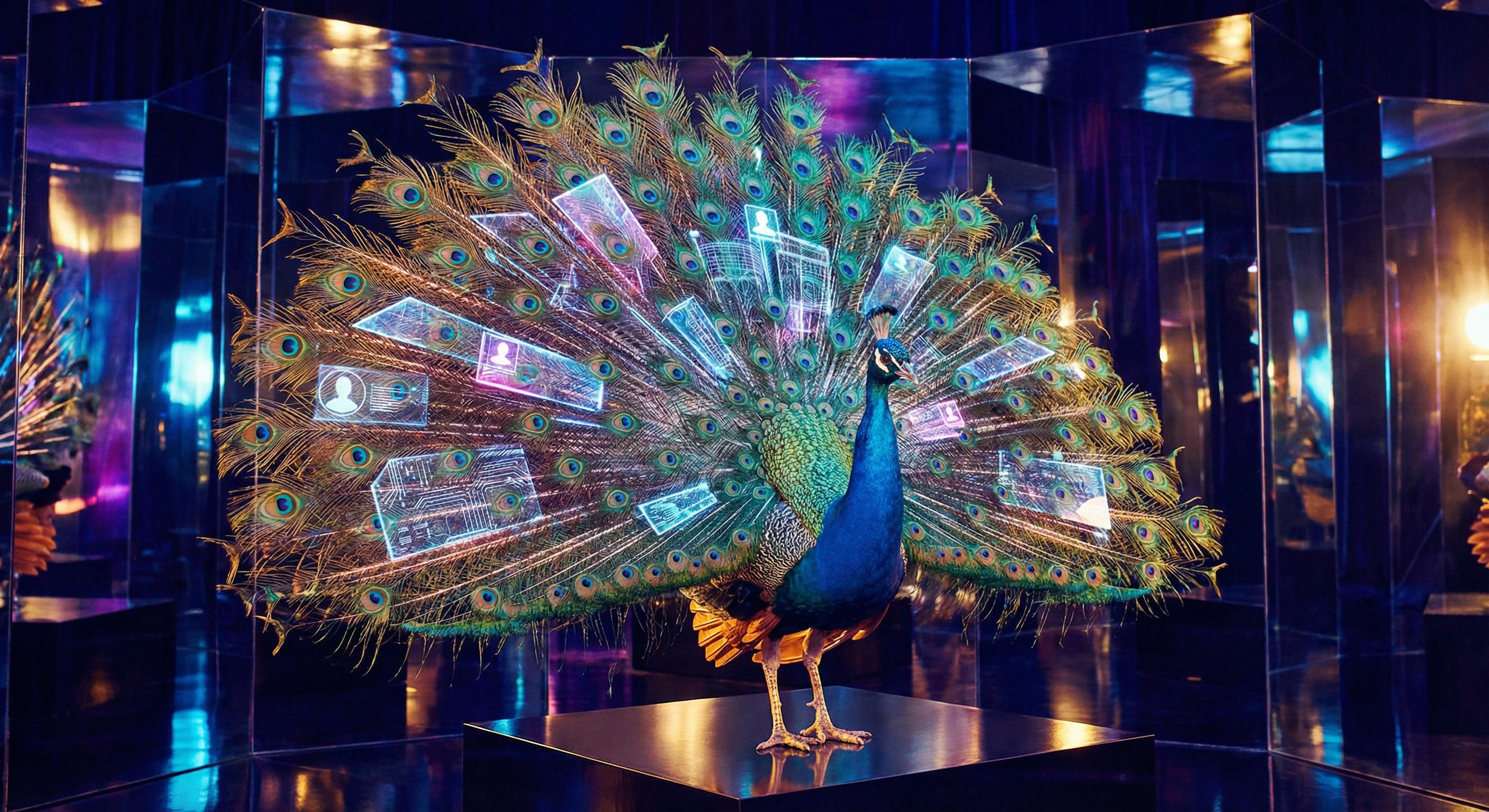
The Israeli biologist Amotz Zahavi formalized this logic in 1975 with his handicap principle. His argument was that signals are honest when they’re expensive to fake. A peacock’s tail is metabolically costly to grow and maintain. It makes the bird more visible to predators and harder to escape. Only a male in genuinely good condition can afford the handicap. The wasteful display becomes proof of underlying quality precisely because it’s wasteful.
Recent research has challenged some of Zahavi’s theoretical claims, but the core intuition holds for understanding human signaling. Researchers at the Hungarian Academy of Sciences have shown that what matters isn’t the cost to the signaler but the cost to potential cheaters. If faking a signal is expensive, the signal remains reliable.
Consider how this logic applied to traditional body modification. Scarification hurt. The Chambri of Papua New Guinea subject young men to hundreds of cuts that take months to heal. You couldn’t fake the marks. You either endured the pain and received the patterns, or you didn’t. The permanence of the marks and the cost of acquiring them made them honest indicators of group membership and personal resilience.
Now consider what happens when signaling moves to a digital substrate.
LinkedIn is professional scarification. Your title, your connections, your endorsements, your activity feed. All status markers painted onto your digital body. The content you share positions you in hierarchies of expertise and affiliation. The influencers you follow signal which tribes you belong to.
Instagram is lifestyle body paint. Curated aesthetics, travel photos, consumption displays, taste performances. The visual equivalent of decorative shells and ochre patterns. Each post an attempt to communicate something about who you are and what resources you command.
TikTok is campfire performance. Skills demonstrated, humor displayed, competence performed publicly before audiences that can number in the millions. The hunting dance translated into video format.
The underlying psychology never changed. Only the substrate.
The Math of Display
We can write an equation for why people post.
Display Value = (Status Gain × Audience Size) / (Effort Cost + Vulnerability Risk)
You read this as: a person will engage in a display when the potential status benefit, multiplied by how many relevant people will see it, exceeds the effort required to produce it plus the risk of looking foolish.
This explains several otherwise puzzling behaviors.
Why do people obsess over follower counts? Because the Audience Size variable directly multiplies the value of every subsequent post. A display that would be worthless with 50 viewers becomes valuable with 50,000.
Why do people post about achievements that seem mundane? Because what reads as bragging to outsiders reads as legitimate status signaling to the poster’s actual reference group. The marathon finish photo communicates fitness. The conference badge photo communicates professional standing. The meal at the expensive restaurant communicates access and taste.
Why do people engage in performative vulnerability? Because admitting difficulty under controlled conditions can be a form of competence display. The founder posting about startup struggles signals they’re playing at a level where such struggles occur. The Vulnerability Risk variable flips sign when executed skillfully.
The ancestral version of this equation operated under different constraints. Audience Size was capped by Dunbar’s number, roughly 150 people who could be kept track of in the social memory. Displays were witnessed only by those physically present. The campfire performance reached dozens, not millions.
Digital technology removed the ceiling on the Audience Size variable. This changes everything.
The Paradox of Cheap Signals
Ancestral body decoration was expensive in ways that made it inherently honest. Scarification left permanent marks after significant pain. Tattooing required rare pigments and skilled practitioners. Collecting shell beads meant traveling to the coast and spending hours perforating each one. The cost of the display was the proof of the display.
Digital signaling is almost free. Anyone can post. Anyone can claim expertise. Anyone can curate a feed that presents a version of themselves disconnected from underlying reality.
This should, in theory, make digital signals worthless. Basic signaling theory predicts that when cheating becomes costless, signals become meaningless. Receivers stop attending to them because they no longer carry information.
And yet we keep posting. We keep scrolling. We keep attending to displays that our rational minds know could be fabricated.
The ancient circuits don’t know the signals are cheap. They respond to status displays as if rare shells were still involved. A photo of someone on a yacht triggers the same neural response that watching the tribal chief receive tribute would have triggered 50,000 years ago. The image says resources, and the brain files the information under high status, and the conscious mind does not intervene to say wait, that could be a rental.
This creates a new kind of arms race. Because digital signals are cheap to produce but still trigger ancestral status responses, the volume of signaling has exploded. More posts, more performances, more attempts to capture diminishing attention. The feed scrolls forever because everyone is trying to paint themselves with ochre and there’s no limit on the ochre supply.
The Accidental Anthropology of the Like Button
Social media companies did not design their products based on evolutionary psychology papers. But they discovered through iteration that certain features drive engagement, and the features that drive engagement happen to tap into ancient signaling instincts.
The like button is a status feedback mechanism. It provides quantified information about how your display was received by your reference group. The Dinka warrior could see how his clansmen reacted to his new scars. The Instagram poster can see exactly how many people acknowledged their photo.
The follower count is a tribal size indicator. It tells you how large your audience for status displays has become. Larger tribes meant more allies, more mating options, more protection. The number grows and something in the brain registers that your social position is strengthening.
The notification is an attention reward. Someone has noticed you. Someone has responded to your existence. In the ancestral environment, being noticed by others was often the difference between reproductive success and failure. Each ping says you matter to someone.
None of this is manipulation in the crude sense. The platforms are surfaces onto which ancient behavioral programs project themselves. The companies just learned which surfaces reflect the signal most intensely.
The Impossible Demand of a Single Public Face
A curious pattern has emerged among younger users. The main Instagram account, carefully curated, exists alongside the “finsta” or fake Instagram, where the “real” self supposedly lives. TikTok dances for the public, private accounts for friends. LinkedIn for professional display, group texts for actual communication.
This is not new behavior. It’s an old solution to a new problem.
In traditional societies, context determined display. You presented differently to potential mates than to tribal elders than to rival group members. Each context called for different aspects of identity. The Maori warrior’s facial tattoo was appropriate for battle and inappropriate for nothing because everyone in his world understood the meaning.
Digital platforms collapse these contexts. Your boss, your ex, your mother, your college friends, and your professional network can all see the same post. Researchers call this “context collapse” and it creates impossible demands on self-presentation. No single display can appropriately address all audiences simultaneously.
The finsta and its equivalents are attempts to restore context. To create separate stages for separate performances. To allow the ancient multi-faceted self-presentation system to function in an environment that tries to flatten it into a single permanent public face.
The hunger for “authenticity” that researchers keep documenting among young social media users is partly this. A desire to escape the impossible burden of continuous performance for collapsed contexts. A yearning for the old model where display could vary appropriately by situation rather than being fixed for all observers forever.
The Tribe Is Now Everyone With WiFi
The ochre processed at Blombos Cave 100,000 years ago served purposes we would recognize immediately. The humans who ground it and applied it were building social selves, positioning themselves within hierarchies, signaling membership in groups, advertising qualities to potential mates, recording their own histories on their own bodies.
We continue to do exactly this. The substrate changed from skin to screen. The audience expanded from tribe to planet. The cost of signaling dropped to nearly zero. But the underlying drive remains identical to what it was when we hunted mammoth and gathered roots in small bands on the African savanna.
The LinkedIn profile is professional scarification.
The Instagram feed is lifestyle body paint.
The TikTok is a campfire performance.
Understanding this doesn’t necessarily change behavior. The circuits run whether we’re aware of them or not. But it might help explain why we spend hours scrolling through other people’s displays, why we feel compelled to add our own, and why the whole enterprise feels simultaneously addictive and hollow.
We’re painting ourselves with digital ochre, hoping the tribe notices. The tribe is now everyone with an internet connection. The stakes feel as high as they ever did around the ancestral fire, because the brain computing those stakes has not learned the difference.