
If you view the global economy as a grand equation, China has effectively solved for the variables of physics. They can out-engineer, out-scale, and out-iterate almost any competitor. They compress production cycles and ship hardware at speeds that defy Western logistical constants.
By all standard metrics like price, speed, and performance, China should own every premium category. Yet a distinct inequality persists in the global marketplace.
You can find Chinese products everywhere. You struggle to find Chinese brands people use to signal their identity.
This is not a moral critique. It is a variable imbalance. China has mastered the transaction, but it has not yet mastered the transmission of value.
The Aspiration Delta
Buying is rarely a calculation of pure utility. If it were, the luxury market would not exist. To understand this, we need to look at a simple formula for how humans perceive value.
We can model the Total Value of a purchase as the sum of two distinct functions:
V(total) = V(functional) + V(symbolic)
Let’s break this down. V(functional) is the physics. It is what the product does. It is the battery life, the torque, the thread count. V(symbolic) is the metaphysics. It is what the product says. It is status, taste, and belonging.
The United States and Europe have spent a century maximizing that second variable, V(symbolic). China, conversely, has spent forty years aggressively optimizing the first variable, V(functional).

Take the automotive sector as our laboratory. A Tesla carries a high symbolic score. It signals futurism and tech-savviness. Now look at the BYD Leopard 5. If you strip away the badge and look at the engineering schematics, this machine is a statistical monster. It often matches Western luxury EVs feature-for-feature, and frequently does so at a superior engineering-to-price ratio.
However, its V(symbolic) approaches zero in other markets. This creates what I call The Aspiration Delta. This is the gap between a product’s technical capability and its perceived worth. China is currently trapped on the wrong side of this inequality.
The “PhD Shift” and The Optimization Function
Why does this Delta exist? It is not an accident. It is the result of the specific variable China is optimizing for.
In math, an “objective function” is the goal you set for your system. China’s industrial playbook is built on an objective function of Efficiency, which looks something like this:
f(x) = Output / (Time × Cost)
This is a ratio. To win this game, you want the biggest number possible. You do that by increasing the Output (making more stuff) or by decreasing the bottom of the fraction (doing it faster and cheaper).
This formula creates excellent hardware and rapid market entry. But aspirational brands require a different objective function. They require Mythology. Creating a myth is inherently inefficient. It requires narrative redundancy and spending money on things that have no immediate return on investment.
We can actually see this bias in the inputs of the system.
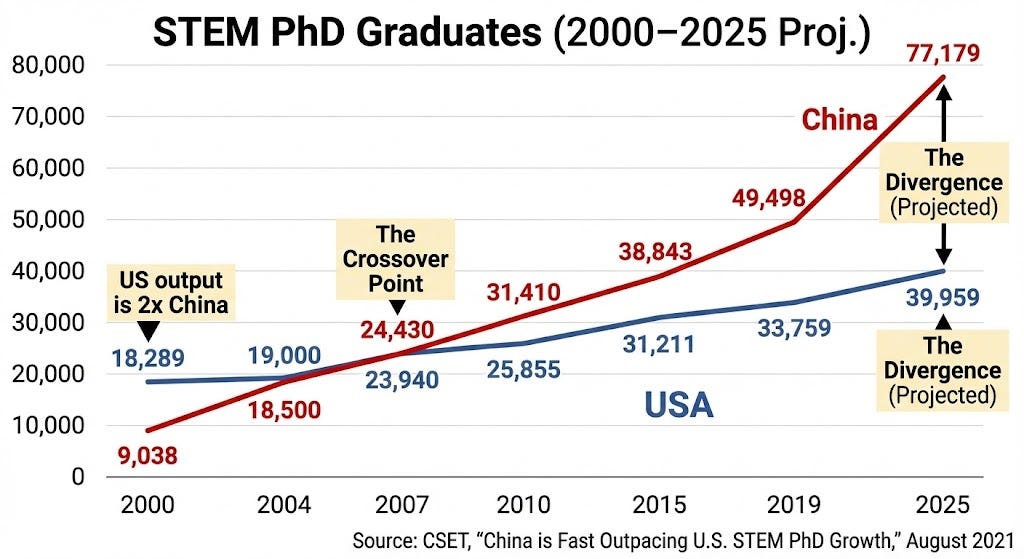
According to data from Georgetown’s CSET and the OECD, China is projected to produce nearly double the number of STEM PhDs as the U.S. by 2025. This trend was accelerated by a 2020 directive from China’s Ministry of Education to prioritize “professional doctorates,” which are degrees aimed at solving industrial problems.
A skeptic might look at this chart and shrug. “China has 1.4 billion people. The US has 330 million. Of course they have more engineers. They just have more humans.”
But this is a mathematical error we call the Denominator Fallacy.
If this were purely a function of population size, China would also dominate the US in PhDs for Art History, English Literature, and Law. They do not.
In fact, on a per-capita basis, the United States still produces more doctoral degrees total. We are simply allocating our talent differently.
The US invests heavily in the Symbolic Arts (Law, Humanities, Social Sciences).
China invests almost exclusively in the Functional Sciences (Engineering, Material Science, Manufacturing).
This is not a demographic accident. It is a strategic allocation of human capital. One system is optimizing for debate and theory. The other is optimizing for production and output.
Regardless, this is a strategic victory. It explains why China dominates the hard sciences of batteries, solar panels, and EVs. But it reinforces a national orientation to solve for function, not for story.
You do not build a Porsche or a Hermès in a factory. You build it in the stories we tell ourselves.
The Coefficient of Friction
History suggests a sequence to global dominance. Countries that produce aspirational brands almost always export their cultural codes first. In physics, we measure resistance using the coefficient of friction, represented by the Greek letter Mu (μ).
We can express the ease of adoption like this:
Adoption = Product Quality / Cultural Friction (μ)
Think of Cultural Friction as the headwind. If people do not understand or value your culture, the friction is high. The denominator is a large number, which drives Adoption down.
The Exceptions (Local Maximums)
“But what about DJI?” or “What about Shein?”
In calculus, we distinguish between a Local Maximum and a Global Maximum. A Local Maximum is the highest point on a specific hill, but it is not the highest point on the mountain range.
DJI dominates 70% of the drone market because it maximizes V(functional). It is simply the best tool for the job. Shein wins by minimizing time-to-market.
Ask a consumer what it “means” to own a Shein dress. The answer usually returns to utility. It was cheap. Aspirational brands live in the exponential zone where value creates identity.
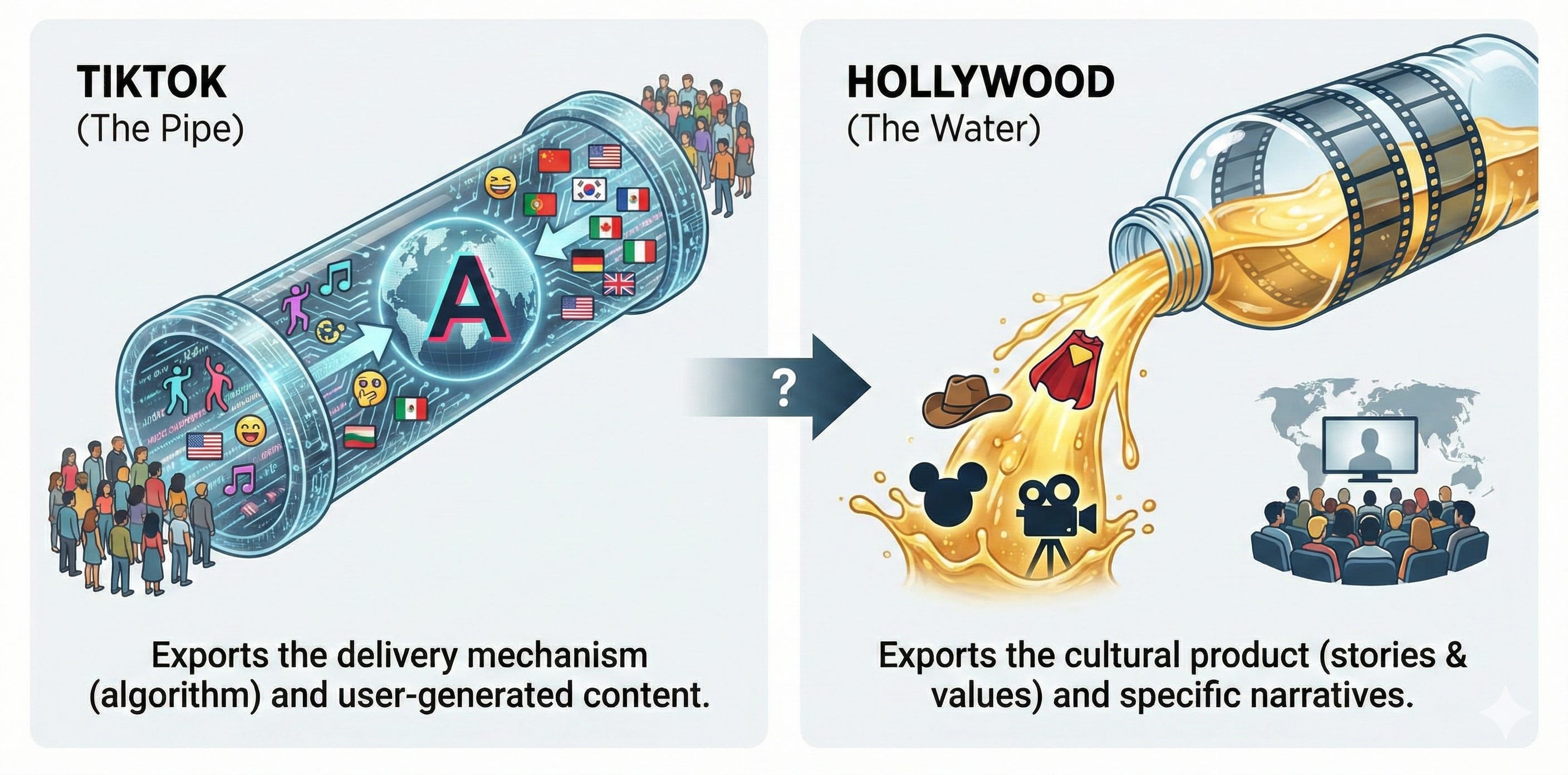
“But wait,” you ask. “TikTok is the most culturally dominant force on Earth. Surely that counts as a Chinese cultural export?”
This is the most common counter-argument. But if we look at the variables, TikTok is not a cultural export. It is an infrastructural export.
In the media business, we distinguish between the Pipe (distribution) and the Water (content).
Hollywood exported the Water. When you watch a Marvel movie, you are consuming American values, American humor, and American aesthetics.
TikTok exported the Pipe. When an American teenager opens TikTok, they are not watching Chinese opera or learning about the Monkey King. They are watching other American teenagers dance to Drake.
TikTok did not win because it seduced the West with Chinese culture. It won because ByteDance built a superior sorting algorithm. They solved a math problem—how to match video A to eyeball B more efficiently than Facebook or YouTube.
They engineered a better slot machine. They did not export the game being played inside it.
The Decay Rate
The world is entering an era where physical products are increasingly commoditized. The problem with relying on engineering advantages is their rate of decay.
In calculus, we look at what happens as time (t) goes to infinity (∞).
Limit (as t → ∞) of Technical Advantage = 0
This reads as: “The limit of a technical advantage, as time goes on, approaches zero.”
Competitors eventually catch up. Price advantages decay even faster. What has a stable half-life? Identity.
The moment a major Chinese company decides to invest a decade into the metaphysics of their brand, and not just the physics of their production, the landscape will shift. They have the capital. They have the talent density.
But for now, they are solving only one equation.
Countries that optimize for utility generate the volume. Countries that understand the algebra of identity generate the margins.
China has mastered the volume. Aspirational value is the final, unsolved variable.