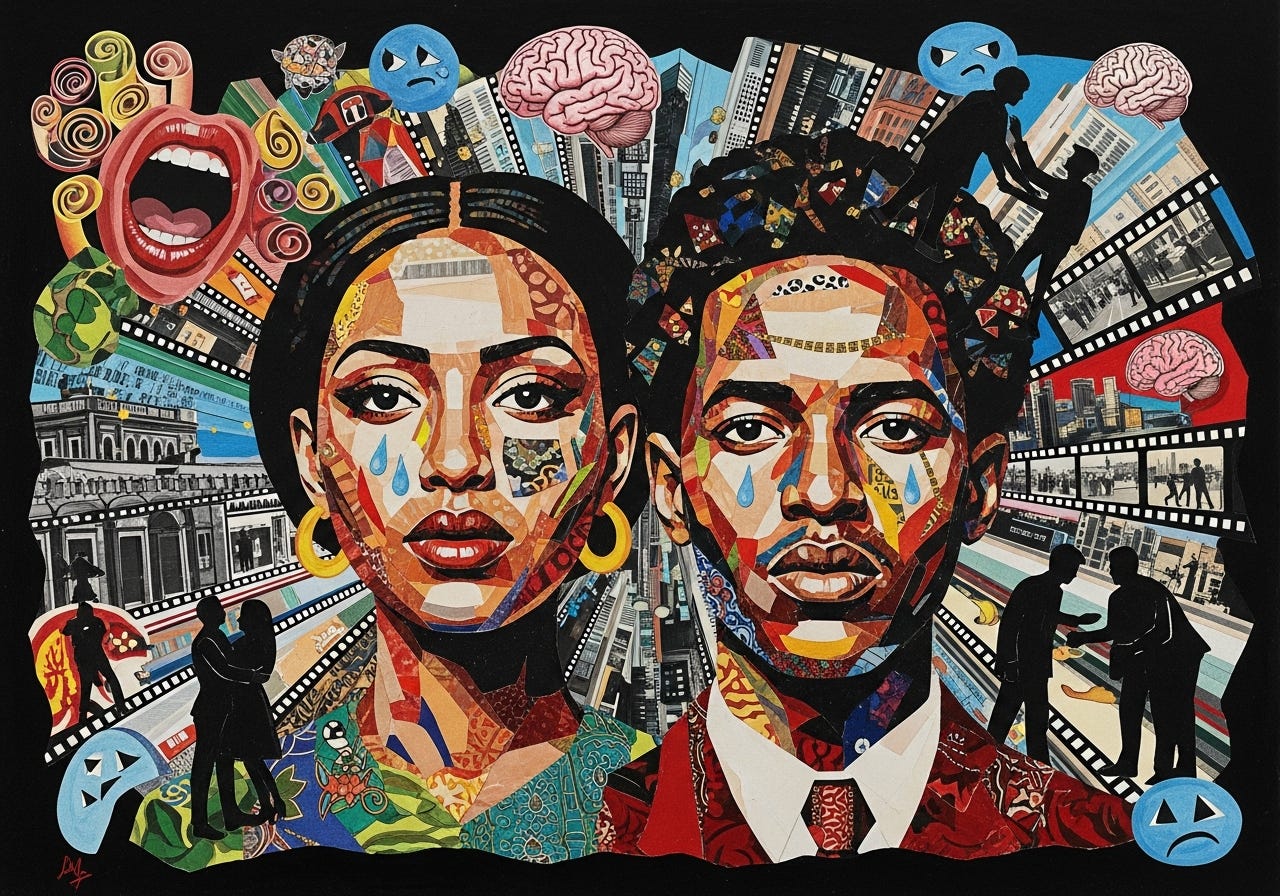
In 2011, a team of researchers analyzed 1,112 parole decisions made by eight Israeli judges over a ten-month period. They tracked the timing of each ruling. They tracked the outcomes.
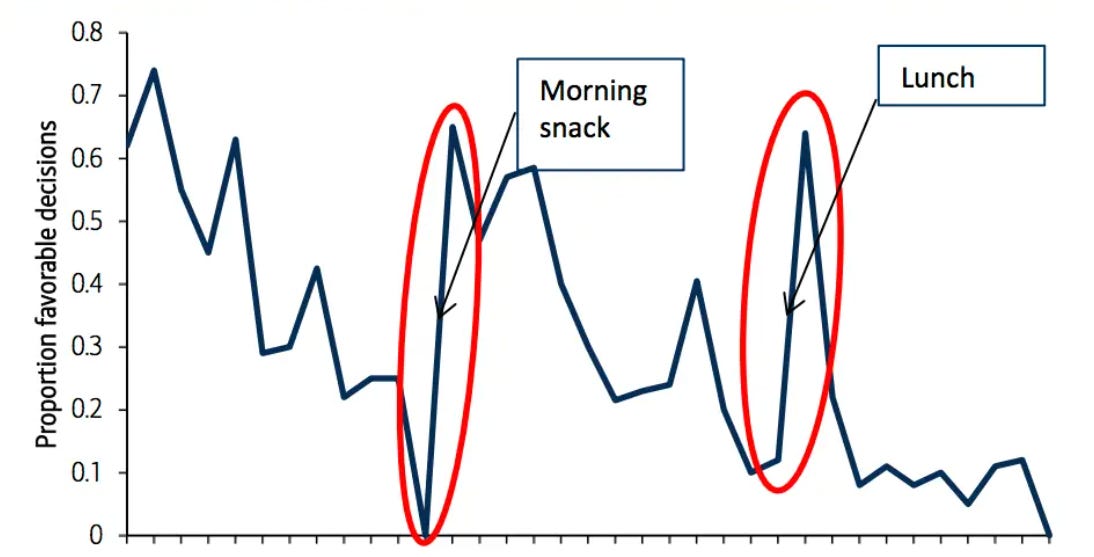
At the start of each session, judges granted parole roughly sixty-five percent of the time. As the hours passed, the rate declined steadily, falling toward zero. After a meal break, it reset to sixty-five percent and began declining again.
The crime did not predict the ruling. The time served did not predict the ruling. The prisoner’s ethnicity, the presence of a rehabilitation program, the existence of a reintegration plan: these influenced outcomes at the margins. The variable with the largest predictive power was how recently the judge had eaten.
These were experienced jurists. They had reviewed thousands of cases. They operated within a legal system designed with appeals, precedents, and oversight specifically to neutralize individual bias. They believed they were weighing evidence.
They were weighing their own physiology. A dropping blood sugar level registers as a vague sense of depletion. That depletion gets interpreted as risk. Risk shifts perception toward threat. The same prisoner who looked reformable at 9 a.m. looked dangerous at 11:45. The judges did not decide differently. They saw differently.

Lisa Feldman Barrett is a leading figure in the constructionist theory of emotion, and one psychologist I have found incredible to learn from. Her book How Emotions Are Made is one I cannot recommend enough.
Barrett calls this phenomenon affective realism. The term is worth unpacking. Affect comes from the Latin affectus, meaning a disposition or state of mind. In psychology, it refers to the felt quality of experience, the background hum of pleasantness or unpleasantness, energy or fatigue, that accompanies every waking moment. Realism is straightforward: the quality of being real. Affective realism, then, is the claim that your affect does not merely influence reality. It becomes reality. The feeling is not a filter over the world. The feeling is the world you perceive.
Barrett demonstrated this in a simple experiment. Show subjects an ambiguous face. Ask them what emotion they see. The answers diverge. But the divergence follows a pattern. Subjects who arrive at the lab anxious perceive anxiety in the face. Subjects who arrive angry perceive hostility. Subjects in good spirits perceive warmth.
The face is constant. The perception is not.
One reading: people project. They see what they expect. They are bad at objectivity.
Barrett’s reading: the emotional state does not distort perception. It generates perception. The feeling arrives first. The seeing follows. Your affect does not color reality. Your affect is your reality. The construction happens before consciousness, below awareness, prior to any possibility of correction.
Imagine you receive a text from your partner that says “We need to talk.” If your body budget is flush, if you slept well and the day has gone smoothly, those four words are just a request for conversation. Maybe something logistical. Maybe something interesting. If your body budget is in deficit, if you are depleted, anxious, running on low reserves, those same four words become a verdict. Evidence of catastrophe. The relationship is ending. You have done something wrong. You do not interpret the words differently. You see different words. The threat is in the letters themselves. By the time you are aware you have read a text, your brain has already decided what it means. There is no moment where you perceive neutral words and then add fear. The fear is in the seeing. You never had a chance to correct it. The construction was complete before you knew there was anything to construct.
The Israeli judges were not biased. Bias implies a deviation from some accessible truth. They had no access to unfiltered truth. None of us do. They experienced depleted blood glucose, and depletion produced a felt sense of risk, and risk produced perception of threat, and threat produced a ruling. The prisoner in front of them looked dangerous because the judge was hungry. The danger was real. It was real because it was perceived. It was perceived because it was felt.
Your brain consumes twenty percent of your metabolic resources while representing two percent of your body mass. This ratio makes it the most expensive organ you own. Evolution does not tolerate expensive organs unless they pay for themselves.
The expense purchases prediction. Your brain runs continuous simulation of what comes next. The next sound, the next face, the next touch, the next word. Sensory data arrives and gets compared against these simulations. Matches pass through efficiently. Mismatches trigger expensive processing. The system optimizes for prediction accuracy because accurate prediction is cheap and surprise is costly.
Waiting for reality to fully arrive before responding to it is a luxury your ancestors could not afford. The rustle in the grass could be wind or predator. The organism that waited for confirmation became food. The organism that predicted and acted survived long enough to reproduce. Your brain is not designed for accuracy. It is designed for speed. And speed requires guessing.
Prediction requires priors, baseline assumptions about what is likely. And the deepest prior, the one running beneath all others, comes from the body itself.
At every moment, your brain tracks your physiological state. Blood glucose. Hydration. Immune activity. Cardiac output. Sleep debt. Barrett calls this continuous accounting the body budget. The felt sense of that budget, the conscious experience of your resource status, is what you call emotion.
The technical term for this internal sensing is interoception. Not to be confused with introspection, which is thinking about your thoughts. Interoception is sensory. You have an entire perceptual system pointed inward, monitoring visceral signals from organs, muscles, temperature, pain, hunger, thirst. Imagine the difference between knowing you should be tired because you slept four hours, and actually feeling the fatigue in your body. The first is reasoning. The second is interoception. It is not as vivid as vision or hearing. It hums beneath awareness. But it shapes everything above.
Think of it as a corporate board that sets the annual budget before any department gets to work. Every division operates within the constraints the board dictates. When the budget is flush, expansion is possible. When the budget is in deficit, conservation takes over. Same company. Different fiscal year. Different strategy.
When the budget runs surplus, you feel expansive. The world appears to contain opportunities. When the budget runs deficit, you feel contracted. The world appears to contain threats.
The feeling does not respond to the opportunity or threat. The feeling determines whether opportunity or threat is what you perceive.
Neuroscience maps emotional experience onto two dimensions. The horizontal axis is valence, the pleasantness or unpleasantness of a feeling, its positive or negative charge. The vertical axis is arousal, the intensity or energy level, from sluggish to electric.
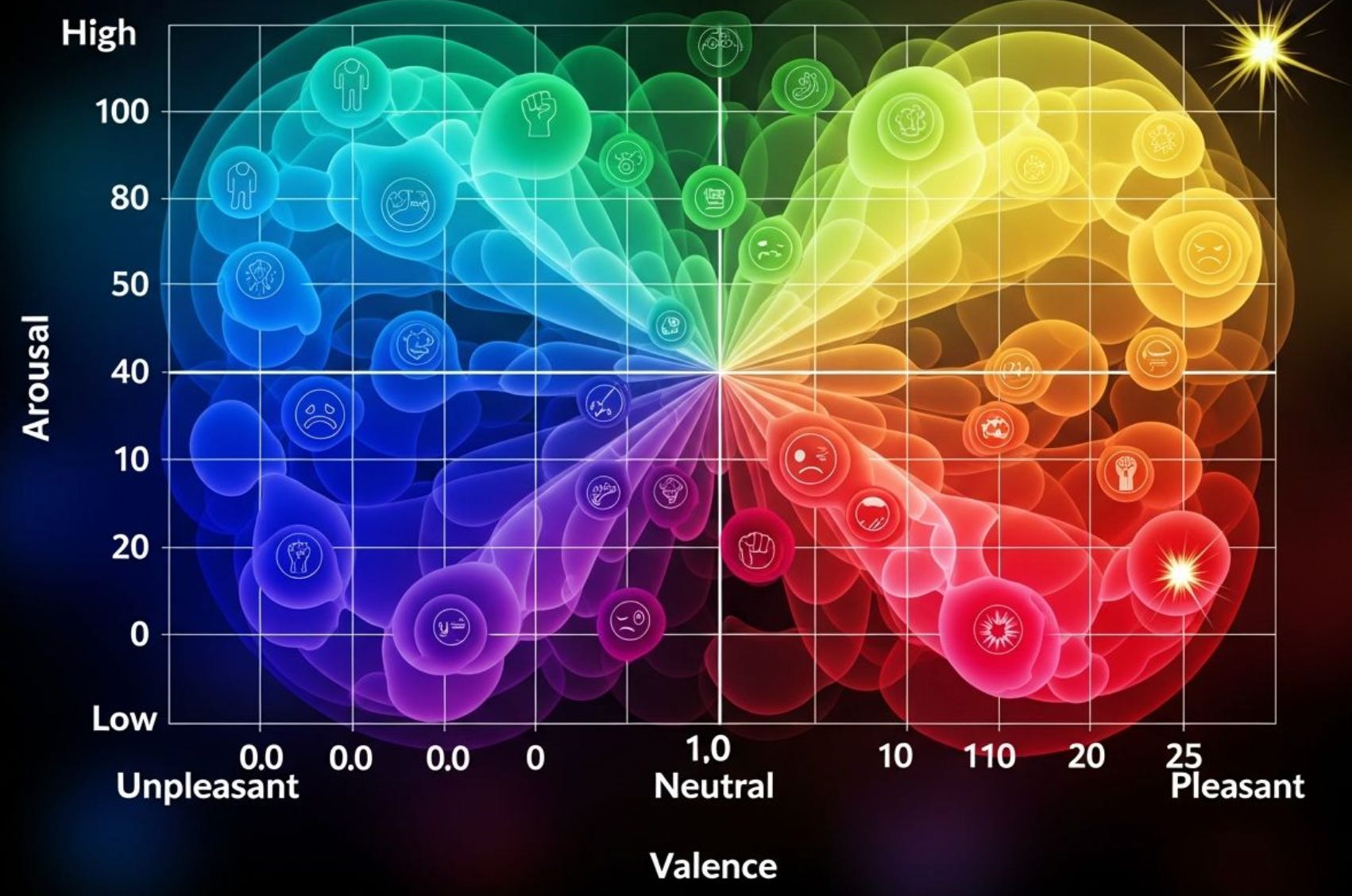
Every waking moment positions you somewhere on this plane. There is no origin you can occupy, no neutral coordinate. Calm is low arousal, moderate positive valence. Boredom is low arousal, mild negative valence. Terror is high arousal, strong negative valence. Ecstasy is high arousal, strong positive valence.
You are always somewhere. And wherever you are determines what you see.
Your brain takes raw sensory input and filters it through two questions. First, if my current emotional state is accurate, how likely is this input? Second, how likely is my current emotional state to begin with? The answers combine to produce perception. Feeling is not removed from the calculation. Feeling is the calculation.
An anxious body budget places you in negative valence, elevated arousal. Your brain asks: given that the world is threatening, what am I likely to encounter? Ambiguous stimuli get resolved toward threat. The neutral face becomes hostile, not calm. The prisoner becomes dangerous, not reformed. The request becomes a demand.
And because affective states emerge from body budgets, and body budgets change slowly, the filter persists. If you woke depleted, you remain depleted for hours. The world stays dangerous all day.
Consider a different scenario. You want a raise. You have prepared your case. You have the metrics, the comparables, the narrative of your contributions. You request a meeting with your manager.
The meeting lands at 4:30pm on a Thursday. Your manager has been in back-to-back sessions since noon. She skipped lunch. Her body budget is in deficit. She does not know this consciously. She knows only that she feels pressed, cautious, slightly irritated. You walk in with your carefully prepared case. Her brain, running predictions consistent with her physiology, resolves your request toward threat. Another demand. Another problem. Another thing requiring resources she does not have. She perceives your ask as aggressive, your timing as inconsiderate, your expectations as unrealistic. She says no. She believes she evaluated your case on its merits.
Run it again. Same you, same case, same manager. But the meeting is at 10:15am on a Tuesday, right after her morning coffee, right after a workout, right after a call that went well. Her body budget is flush. She feels capable, generous, open to possibility. You walk in with the same request. Her brain resolves it toward opportunity. A chance to retain talent. A reasonable ask. A problem she can solve. She says yes. She believes she evaluated your case on its merits.
Same case. Same manager. Different glucose. Different verdict.
Reasoning is not erased. It operates downstream of prediction. Affect sets the frame, logic fills in the details.
This is not an invitation to start plotting your boss’s energy states, mapping her circadian rhythms, timing your asks to catch her fifteen minutes post-lunch.
But of course, it just might help.
The feedback runs longer than a single meeting. Affect generates perception. Perception guides action. Action shapes environment. Environment confirms affect. The loop closes. The loop tightens.
Ecologists use niche to describe the environmental conditions a species requires. The polar bear’s niche is arctic. The cactus’s niche is arid. Each organism fits a slot in the world, sculpted across evolutionary time to match its surroundings.
Humans construct niches. We do not merely inhabit environments; we build them. And the blueprint is affective.
The anxious person, perceiving threat, makes choices that minimize exposure to risk. Cautious friends. Predictable routines. Information sources that confirm danger. Living spaces designed to prevent surprise. Each decision feels rational. Each decision is a brick. Over years, the structure completes itself. An anxious world, built by anxious perception, inhabited by an increasingly anxious person.
The architecture runs in every affective region. The angry person builds a world dense with offenses. The depressive builds a world drained of possibility. The optimist builds a world thick with opportunity. None are deluded. All are architects who have forgotten they are building.
Two forces race against each other. The first is self-reinforcement: the more you feel something, the more you build a world that makes you feel it, which makes you feel it more. This force has a ceiling. You can only build so much world, sustain so much intensity. The second force is correction: sometimes reality breaks through, contradicts the feeling, updates the prediction.
The race is uneven. Self-reinforcement is strong. Correction is weak. Prediction suppresses disconfirming data unless the mismatch is large enough to force an update. Most daily experiences are too small to break through. Compliments get dismissed as flattery. Kindness gets reframed as manipulation. Good days become anomalies. Bad days become baseline. The predictions defend themselves against revision.
Given time, feeling saturates its niche. You live in the world your emotions built, and that world provides daily evidence that your emotions were accurate.
The niche has a shape. The shape is determined by repertoire.
Repertoire is the range of experiences your brain has learned to predict. The set of environments it can model. The variety of affective states it has practiced inhabiting. Think of it as your prediction vocabulary. The larger it is, the more situations you can simulate, the more realities you can construct.
Consider a guitarist who has spent twenty years mastering blues. Every phrase, every bend, every shuffle rhythm lives in his fingers. He can hear four bars and predict exactly where the song is going. His brain has built a deep model of that territory. He is extraordinary within it.
Now put him in a jazz trio. The chord changes move faster. The rhythms land in unexpected places. The harmonic language is foreign. His predictions fail. He cannot simulate what comes next because his repertoire does not include this terrain. He is not a bad musician. He is a musician with a narrow repertoire. His niche has walls.
The same architecture governs affect. A person who has only ever lived in one city, worked one job, known one social circle, has a narrow repertoire of affective experience. Their brain has learned to predict a limited range of environments. Their body budget has calibrated to a specific rhythm. Their priors are deep but not wide. They are the blues guitarist of emotional life. Masterful in their domain. Helpless outside it.
When such a person encounters novelty, an unfamiliar culture, an unexpected kindness, a situation their predictions cannot model, the brain struggles. It cannot simulate confidently. The priors weaken. For a moment, the construction loosens its grip.
This is why travel works. Not the travel of resorts and packaged tours, where the environment has been engineered to match existing predictions. The travel of genuine foreignness. The brain cannot run its usual simulations in terrain it has never mapped. The food is different, so the body budget fluctuates in unfamiliar ways. The rhythm of the day is different, so arousal patterns shift.
In that disorientation, new affective coordinates become accessible. The person who has only known anxious vigilance might stumble into calm. The person who has only known muted contentment might stumble into awe. These are not transformations. They are expansions. The repertoire widens. The niche grows. The guitarist learns a new scale.
A wider niche is harder to saturate. The person with a broad affective repertoire has more realities available. When their body budget dips, they have more places to land. When prediction fails, they have more templates to draw from. They are not trapped in a single room of their own construction. They have built a house with many rooms. A richer repertoire expands the brain’s predictive templates, giving it more ways to interpret ambiguity before affect solidifies perception.
This is the deep argument for novel experience. Not that travel is fun. Not that new relationships are enriching. But that every genuinely unfamiliar encounter deposits a new coordinate in the repertoire. Every disrupted prediction is a door installed. The architecture becomes more spacious. The self becomes harder to corner.
If perception is constructed, where does choice enter? Where is the lever? What can you actually control?
Intervention points exist. They are slow. They are unglamorous.
You cannot decide to feel different. Core affect emerges from body budget, and body budget does not take executive orders. But the budget responds to inputs. Sleep repairs it. Movement regulates it. Nutrition stabilizes it. Social connection buffers it. These are levers. They work over weeks and months, not moments.
Language matters more than intuition suggests. Emotions are not discovered; they are constructed through categorization. The person with only good and bad in their vocabulary experiences the entire valence spectrum in binary. The person who distinguishes disappointed from melancholic from wistful from bereft has four realities available where the other had two.
Different concepts recruit different predictions. Different predictions build different worlds. Vocabulary is architecture.
Tonight you will enter a room you have entered before. Your home, perhaps. An office. A restaurant you know.
You will perceive that room. You will trust your perception. You will act.
The room will respond to your action. The response will feel like confirmation.
Nowhere in that sequence will you notice the body budget that set your affective coordinates before you opened the door. Nowhere will you observe the predictions filtering sensory data before it reached consciousness. Nowhere will you catch the moment when feeling became seeing, when seeing became doing, when doing became being.
You will experience yourself as a witness. You are an architect.
The Israeli judges returned from lunch at sixty-five percent. They did not feel merciful. They felt fed. The mercy followed.
You are making a decision right now.
What did you have for lunch?