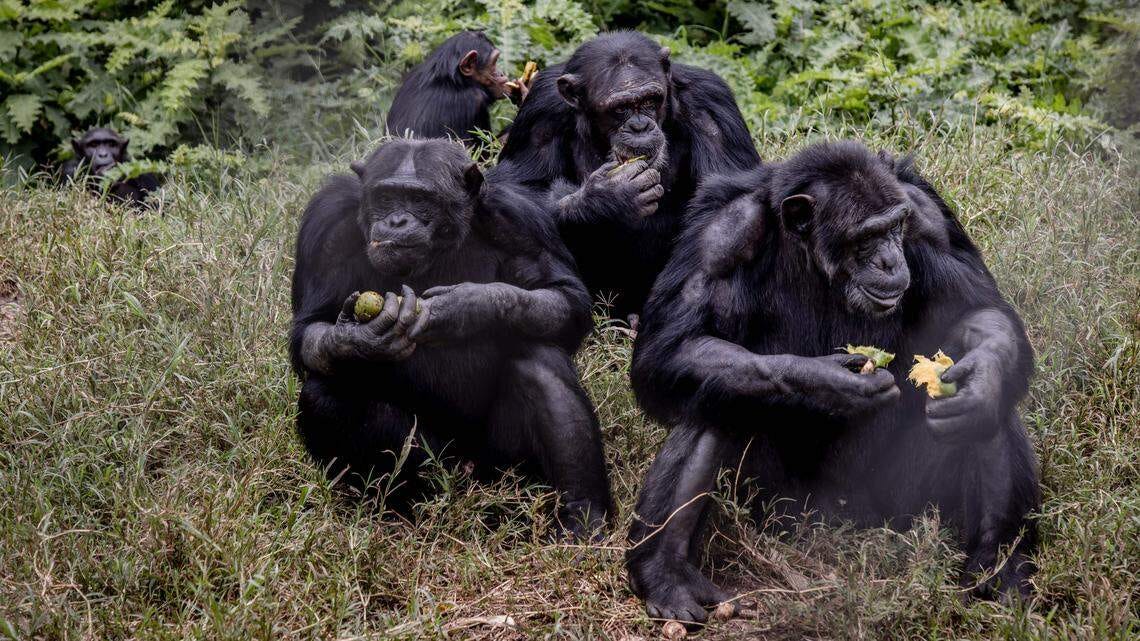
Basie woke up in a nest of branches and leaves on what would be the last morning of his life. He foraged. He rested. As daylight faded over Uganda’s Kibale Forest, a patrol of thirteen adult chimpanzees arrived from the opposing faction. Three surrounded him. Ten more piled on, biting and slamming. He died the following morning, his longtime companion BF sitting beside him, extending a hand toward a body that could no longer respond.
Basie’s killers were not strangers. They were individuals he had grown up alongside, groomed, and patrolled with for years. What separated his first morning in Kibale from his last was not the arrival of a new enemy. It was the slow disappearance of a shared identity.
This month, primatologist Aaron Sandel of the University of Texas at Austin and colleagues published a study documenting what they describe as lethal conflict following a community split among the Ngogo chimpanzees of Kibale National Park. Commentators have called it a civil war. It is only the second prolonged case of intracommunity fragmentation leading to lethal conflict ever documented in a well-observed wild chimpanzee population, and the first recorded without the confounding influence of human food provisioning at the study site. The dataset behind it is substantial: a decade of GPS tracking, thirty years of demographic data, and twenty-four years of detailed field observations recording who was grooming whom, foraging with whom, and, eventually, avoiding whom. The study required no ideology, no religion, no political grievance to explain the violence it describes. It required, at minimum, the collapse of a social network and the loss of a small number of individuals who had been holding it together.
The sequence matters more than the outcome. The war did not produce the fracture. The fracture produced the war.
What Happens When a Group Outgrows Its Own Cohesion?
When the Ngogo community was at its largest, it numbered roughly 200 individuals, the largest habituated chimpanzee community ever studied. That scale, researchers now believe, was itself part of the problem.
Group cohesion is not free. It is produced through daily acts of grooming, shared foraging, joint territory patrol, and the fluid temporary groupings that form throughout the day as individuals move across their range. These interactions are how individuals maintain their bonds and, by extension, how a community maintains its sense of being a community. Social identity in primates is not abstract. It is behavioral. You are who you spend time with.
The cost of maintaining those connections scales badly with group size. If you have n individuals in a group, the total number of unique relational pairs is:
r = n(n-1) / 2
You read this as: every new individual added to a group increases the number of relationships that could meaningfully connect the group not by one, but by the full count of everyone already present. Think of it like a dinner party where each new guest must not only be introduced to every existing guest, but those existing guests must now maintain the new relationship going forward.
At ten people, 45 pairs exist. At fifty, 1,225. At the Ngogo community’s peak of 200, roughly 20,000 pairs existed in theory.
Primate networks are sparse in practice, not all pairs require equal investment, but the group still needed to maintain enough active connections to prevent the whole structure from partitioning into isolated clusters.
As Sandel’s co-author John Mitani, a primatologist at the University of Michigan who helped establish the Ngogo research site over three decades, put it directly: the group had become “victims of their own success. The group continued to grow and grow and grow, and it reached the size that individuals couldn’t pull together anymore.”
Takeaway: Scale and cohesion work against each other in a precise mathematical sense. A group does not become twice as socially complex when it doubles. The relational burden grows as the square of membership. This applies in forests and in federations alike.
What Happens When the People Holding Everyone Together Are Gone?
In ecology, a keystone species is one whose presence holds an ecosystem together out of all proportion to its abundance. Remove the wolf from Yellowstone and the elk overgraze the riverbanks, the vegetation collapses, the water table shifts, the downstream ecology changes in ways that took decades to fully document. The wolf was a small fraction of the total biomass. The system did not visibly register its absence immediately. Over years, it did.
The Ngogo community had keystone individuals. Five adult male chimpanzees died within roughly a month of one another in 2014, likely from a respiratory illness. These were not the most dominant males in the group. They were connectors, individuals who maintained strong relationships across the community’s informal neighborhoods, moving easily between the groups that would later harden into the Western and Central factions. Sandel described them as having “strong ties throughout the community.” Joseph Feldblum, a Duke University primatologist who identified a comparable sequence in Jane Goodall’s Gombe data from the 1970s, described the function such individuals serve: “You can imagine some avuncular figures friendly with everyone who play this bridging social role. If they die, that hardens the divisions between subgroups.”
In 2015, an established alpha male was deposed by a new one, adding leadership instability to a network already missing its bridges. A second respiratory outbreak in 2017 killed roughly twenty-five more, cutting the last threads of regular contact between the two subgroups. The killings began the year after.
No one declared war. No faction issued a manifesto. The community simply ran out of the relational bandwidth needed to keep treating the other half as us. As co-author Jacob Negrey observed: “When you stop coming together, it’s possible to stop seeing yourselves as part of the same group. That can lead to violent consequences in a shockingly short period of time.”
Takeaway: In social systems, the most consequential losses are rarely the most visible ones. Dominant individuals attract ceremony when they fall. The connectors, the ones who maintain regular contact across internal divisions, do not. Their absence is only noticed after the fault lines they were spanning have become chasms.

What Happens When the Office Goes to War?
In 2000, Microsoft was the most valuable company on earth. It had 39,000 employees and operating income that most companies could not reach with a decade of effort. It had also, by that point, grown large enough that the relational arithmetic was becoming unmanageable, dozens of divisions each running their own roadmaps, their own hiring, their own internal politics. The connector role, the person who moved easily between groups and kept the Windows team and the devices team and the online team in genuine working contact with each other, was becoming harder to sustain at scale.
What happened next is documented in detail by journalist Kurt Eichenwald, whose 2012 Vanity Fair investigation into Microsoft’s lost decade drew on dozens of interviews with current and former executives. The company ran a performance management system called stack ranking, in which every team was required to designate a fixed percentage of its members as underperformers regardless of the team’s actual output. If ten people worked together, two would receive strong reviews, seven mediocre ones, and one would be marked for exit. The curve was mandatory. Its behavioral effect on cross-divisional contact was immediate and logical.
If your ranking depended on performing better than your colleagues, helping a colleague was irrational. Sharing information across teams was a competitive disadvantage. Being seen as a connector, someone who made others more effective, made you more useful to the company and more vulnerable in your review. One Microsoft engineer told Eichenwald: “People responsible for features will openly sabotage other people’s efforts. One of the most valuable things I learned was to give the appearance of being courteous while withholding just enough information from colleagues to ensure they didn’t get ahead of me on the rankings.”
The mechanism here is different from what happened in Kibale. There, demographic shocks removed the connectors. At Microsoft, incentive design made the connector role irrational to occupy. Different causes, same network effect. What the stack ranking system accomplished, methodically, was the functional elimination of cross-divisional contact. The result was divisions that employees described internally as fortresses, isolated clusters that guarded their territory, competed for resources, and stopped maintaining the working relationships that had once held the company together as a single organism with a shared direction. By the time Ballmer launched his “One Microsoft” initiative in 2013, explicitly designed to reconnect what had fractured, a decade of internal avoidance had already hardened into something that looked, at the organizational level, exactly like what Negrey described in Kibale: groups that had stopped coming together, and consequently stopped seeing themselves as part of the same thing.
When Satya Nadella took over as CEO in 2014 and abolished stack ranking, the language he used was notable. He did not talk primarily about innovation or market share. He talked about rebuilding a culture of collaboration, about reconnecting people across the company who had learned, over a decade, to treat each other as competitors. The recovery Microsoft made under Nadella, driven by multiple factors including a cloud strategy that had nothing to do with organizational structure, was built on that reconnection as a necessary precondition. The product strategy required the social substrate to be repaired first.
Takeaway: Organizations do not need a hostile takeover or an external crisis to fracture. They can engineer the conditions of fracture themselves by systematically penalizing the connector role, rewarding isolation, and allowing the daily contact that maintains a shared identity to quietly disappear. The fighting that follows is the visible part. The avoidance came first.
How Does This Hold Up When You Add Oil, Land, and Ideology?
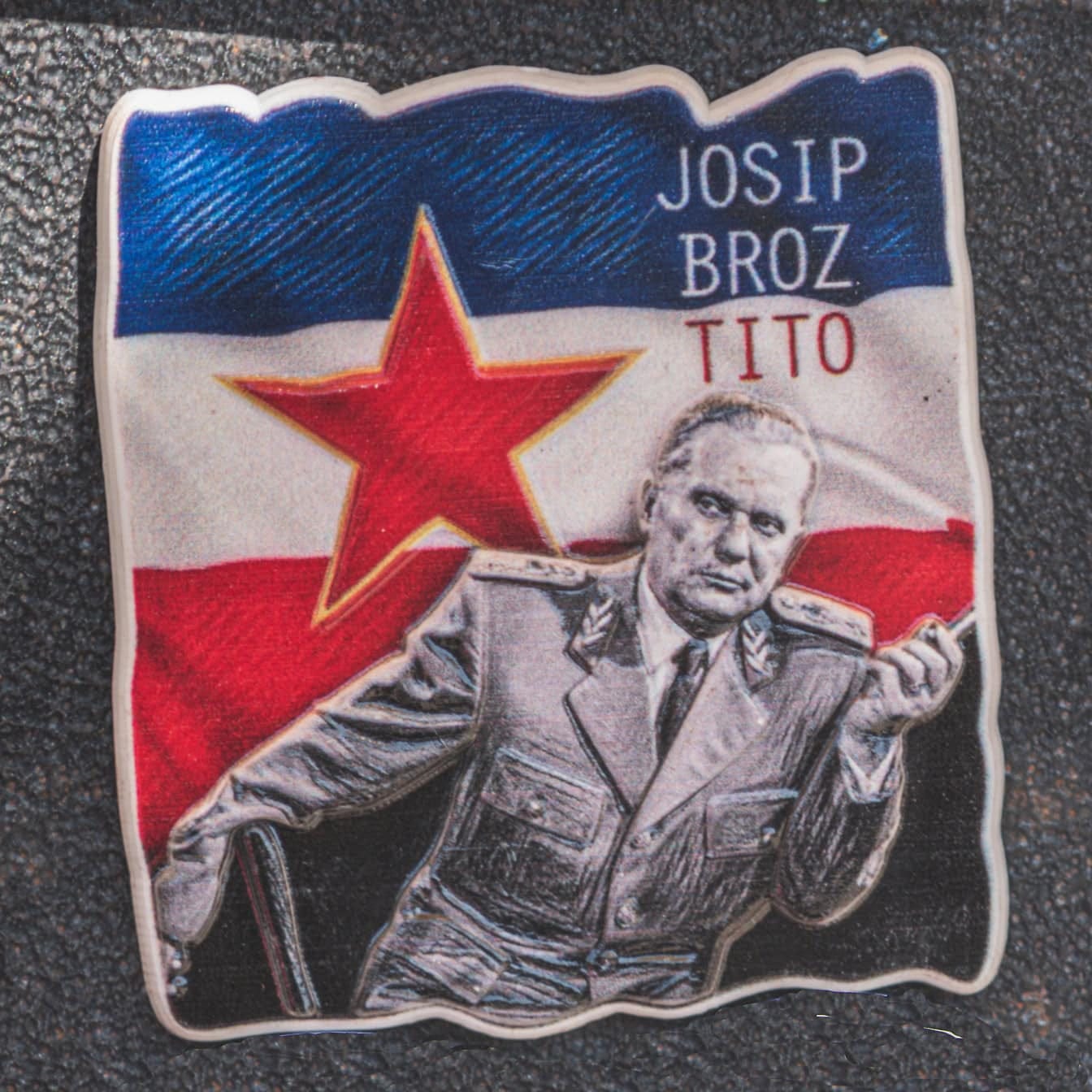
Yugoslavia under Josip Tito was, by every formal measure, a unified state. It held together across four decades and five major ethnic and religious communities through constitutional power-sharing and a national identity built around the partisan resistance rather than any single ethnicity. It also held together, less formally, because Tito was one of the most effective keystone nodes in twentieth-century European politics, a leader who held genuine relationships across every major faction, respected by Slovenians, Croats, Serbs, Bosnians, and Macedonians in a way no single-ethnicity successor could replicate.
Tito died in May 1980. His 1974 constitution had established rotating one-year presidencies across the eight republic and provincial representatives, a system that worked as long as someone with personal authority held the center together and failed the moment that person was gone. Yugoslavia’s external debt, initially estimated at around $6 billion, later turned out to be significantly higher, and IMF-imposed austerity through the 1980s intensified competition between republics for shrinking federal resources. As Western strategic interest in Yugoslavia declined through the decade, so did the external incentives for keeping the federation intact. The republic-level elites, no longer bridged by a common connector, began optimizing for their own subgroups. Political discussions about resource redistribution, as one historical account of the period describes, reached “ethnic fever pitch.” The wars did not begin until 1991, eleven years after the keystone’s removal.
What happened between 1980 and 1991 resists any simple narrative. The fracture was not only social. It was simultaneously institutional, economic, and geopolitical. Slobodan Milosevic, rising through Serbian politics in the late 1980s, recognized that ethnic nationalism was the most efficient available fuel for political mobilization in a vacuum of federal authority. The ideology did not create the fracture. It accelerated and weaponized it in ways that purely social dynamics, without language and without deliberate political entrepreneurship, cannot replicate.
This is the honest version of the comparison: the Ngogo study does not explain Yugoslavia, or any human war. What it does is expose the substrate on which these other forces operate. Resource competition, colonial history, deliberate propaganda, geopolitical maneuvering by external powers, all of these are real and well-documented drivers of human conflict. Political scientist Jeff Colgan, writing for Harvard’s Belfer Center, found that between one-quarter and one-half of interstate wars since 1973 have been linked to oil-related mechanisms. Water scarcity already underlies tensions across North Africa, South Asia, and the Middle East. Sierra Leone’s eleven-year civil war was financed in significant part by diamond revenues that kept rebel groups operational long after any ideological coherence had dissolved. These are not soft claims. They are documented and quantifiable.
The contribution of the Ngogo study is not that it renders those factors irrelevant. It is that it isolates the prior condition. Before resources become the stated justification for fighting, before an ideology provides a vocabulary for grievance, before a political entrepreneur decides to play the ethnic card, a group has to stop seeing itself as one group. That transition does not require a resource shortage or a colonial legacy to occur. It can happen through nothing more than the arithmetic of relational complexity, the loss of the individuals who bridged internal divisions, and the slow accumulation of avoidance.
Ideology and resource competition, then, do something specific: they accelerate and fix the fracture, give it a name, and make it feel like destiny rather than the outcome of social dynamics that could, in principle, have gone differently. As the Yugoslav historical record shows, even in a population with genuine ethnic diversity, genuine economic grievances, and genuine historical trauma, there was a decade in which those things coexisted without producing mass violence. Interethnic marriages were actually increasing in the years before the war.
The share of the population identifying as Yugoslav rather than by ethnic nationality grew in the early 1980s. Many ordinary people, by multiple historical accounts, did not know or care about the ethnic identity of their neighbors before the hostilities began.
The fracture needed help to become a war. The help arrived in the form of economic collapse, deliberate nationalist mobilization, and the institutional failure to replace what Tito’s personal authority had provided. But the social substrate, the network already partitioning along subgroup lines, was ready to receive all of it.
Takeaway: Resource wars, colonial grievances, and ethnic nationalism are all genuine and well-documented causes of conflict. The Ngogo finding does not compete with those explanations. It identifies the social precondition on which they all operate: a group that has already, quietly, stopped being one.
What Stays the Same Across All of It?
Sandel noted that the Ngogo findings show that even without ethnicity, religion, or political ideology, social networks can divide and produce collective violence. That is the finding’s precise contribution to the larger literature. Not that human wars are reducible to primate social dynamics, but that the primate case identifies a floor, a minimum viable set of conditions sufficient to produce lethal collective violence between former allies. Those conditions are: a group that has grown beyond its capacity for mutual maintenance, the loss of the individuals who spanned its internal divisions, and enough time passing without meaningful cross-contact for the two halves to stop recognizing each other as the same thing.
Every additional driver of human conflict, oil, diamonds, ideology, historical grievance, external interference, operates on top of that floor. Sometimes those drivers are doing most of the work. Sometimes they arrive after the social fracture is already advanced and simply provide the justification for what the network had already prepared. The question of which is doing more in any given conflict is empirical and cannot be answered from Kibale Forest. But the floor itself has now been observed, cleanly, in conditions free of all the confounds that complicate the human record.
Any institution that has grown beyond the size at which its members maintain genuine mutual familiarity, any polity that has simultaneously lost its keystone political figures while navigating a succession crisis, any community absorbing compounding losses while its internal contact rates quietly decline, has recreated the preconditions of Kibale 2014 in its own idiom and at its own scale.
What keeps groups from fracturing is the same across all of it: individuals who move across the lines that are quietly forming, and the daily, unglamorous work of keeping disparate subgroups in actual contact with each other. When those individuals are gone, or when the organization is structured to penalize their existence, the other drivers of conflict, the ones with names and histories and geopolitical coordinates, find a structure already prepared to receive them.
The fracture is always first. The rest arrives to explain it.
Planet of the Apes was supposed to be science fiction. Turns out it was a nature documentary with better costumes and a larger budget. The chimps in Kibale did not need ideology, a charismatic leader calling for blood, or a LinkedIn post about company values to tear their community apart. They just needed to stop having lunch together. We have been doing the same thing for centuries and writing considerably longer explanations for it, most of which arrive well after the avoidance has already done its work.
STRATEX by Naz explores the cognitive and behavioral foundations of how people, organizations, and markets actually work. Subscribe below.