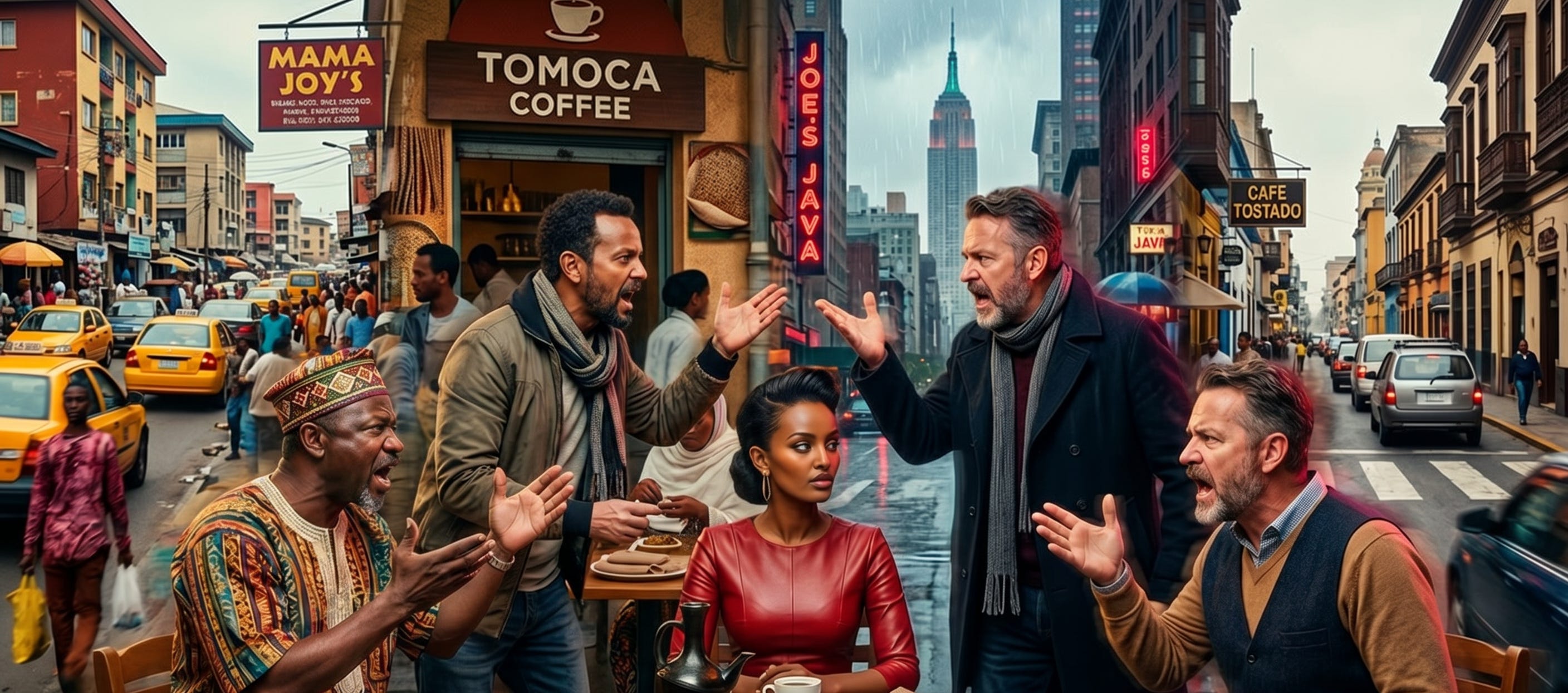
A man in a café spends forty minutes explaining to a friend, with real precision, why his country is broken. Ministers get shuffled every six months before anyone learns their own job. The price of cooking oil has doubled since last Ramadan. The internet drops three times during a video call with a client abroad and nobody at the provider will give him a straight answer about why. The waiter comes to take the order. The man asks for the chicken. The waiter says the chicken has gone up again, it is now almost what beef was last year, and would he like to see the new menu. He does not look at the new menu. He leans back and connects the price of the chicken to the price of feed, the price of feed to the cost of imports, the imports to the exchange rate, the exchange rate to the last policy announcement, the announcement to the minister who made it and then got reshuffled, the reshuffling to the president’s cousin, the cousin to a contract somewhere in the Gulf, the contract to the bandwidth cables that are always almost here and never quite arrive, and back to the chicken, which is why, he concludes, a man cannot even eat a proper lunch in this country anymore. The friend across from him has stopped nodding and is quietly eating bread.
Every city from Lagos to Lima to Manila to Addis to Manhattan has some version of this man. Some of what he says is exactly right. Some of it is out of date by five years and he has not updated the file. The dam he is thinking of actually got finished. The ring road around the city opened last spring. The new terminal at the airport works. None of that enters the monologue, because the monologue is not really a news report. It is a habit. He is also, quietly, a scaled-down version of the thing he is describing. The complaint and the behavior live inside the same person without ever meeting each other.
It is tempting to read this as a cultural quirk or a character problem. That reading does not survive much contact with the evidence. Watched long enough across enough places, the behavior begins to look like something else. An answer the mind has arrived at, quite rationally, after years of living in a particular kind of environment.
What Scarcity Does to a Mind
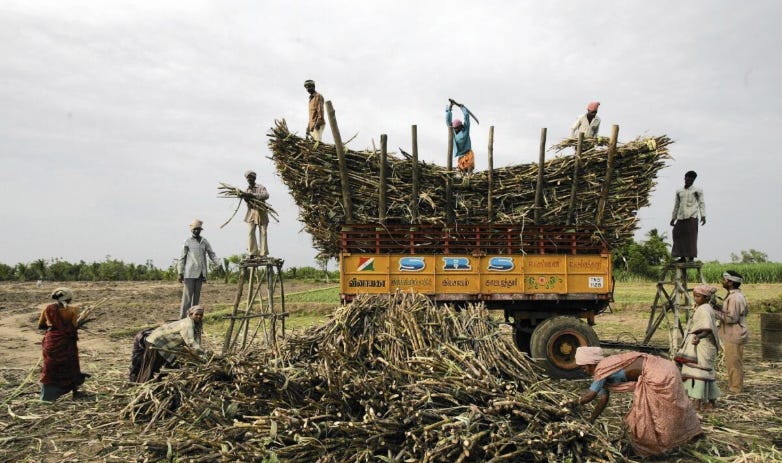
Consider the sugarcane farmers of Tamil Nadu, a state on the southern tip of India where a large share of rural income rises and falls with a single annual harvest. A few years ago a group of researchers led by Anandi Mani, Sendhil Mullainathan, and Eldar Shafir followed a group of these farmers across a single harvest cycle. Before the cane came in, when money was thin and debts were due, the farmers sat for a standard cognitive test. They took the same test a few months later, after the crop had cleared their books. The post-harvest scores were thirteen to fourteen IQ points higher than the pre-harvest ones. Same men. Same brains. What had changed was the live ledger running in their heads. When a mind is rehearsing how to make rent, feed a child, and cover an unexpected bill, it has less room for anything else. Scarcity does not lower intelligence. It occupies it. Like a phone with too many apps open in the background, the machine still works, but slower, and with less spare capacity for the task in front of it.
The same researchers ran a version of the study on shoppers in a New Jersey mall. Pose a costly car repair to a poor American and their reasoning collapses. Pose it to a wealthy one and nothing measurable happens. The effect is larger than a night of missed sleep.
Where the Blame Goes, and Why
Now zoom out from a single farm and a single mall. Psychologists since Julian Rotter’s work in the 1960s have tracked what they call locus of control. It is a dry name for a simple question. Do you believe your outcomes come mostly from your own actions, or mostly from forces outside you? The question has been asked of people in more than forty countries across six decades. Where institutions are reliable, people credit themselves. Where institutions are arbitrary, they credit the weather. The finding holds inside countries too. A poor New Yorker answers the question more like a poor Nairobian than like his middle-class neighbor two blocks away.
This is the piece that rarely enters the usual conversation about why some societies look outward for answers while others look inward. The outward gaze is not a flaw in the person. It is the honest report of what that person has seen happen, over and over, in their own life.
Think about it through ride-hailing. In a well-run city, you order ten rides and nine drivers show up, take you where you asked, and charge what the app said they would. You learn that opening the app is worth the effort. You do it again the next time you need to move. In a rougher city, you order ten rides and three cancel at the curb, two reroute to pad the fare, one refuses the destination, and the rest arrive late enough to make you miss what you were going to. After a few months of this, you stop using the app the same way. Not because you are lazy. The system has taught you, patiently and at your expense, that tapping that button does not have the causal power you once believed it did.
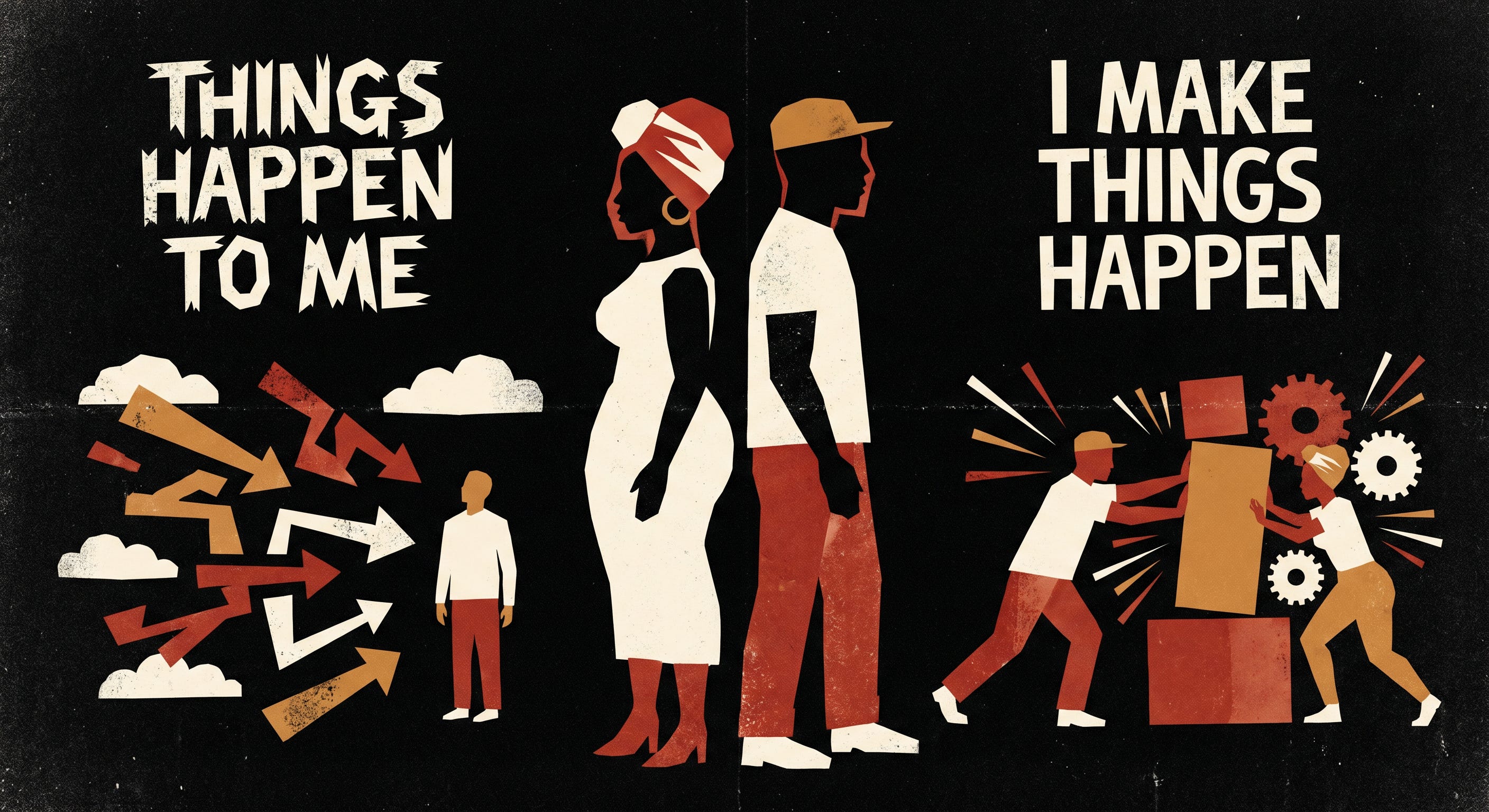
Stretch that out across a whole life, across schools that rarely teach, banks that lose your paperwork, courts that move in directions nobody can predict, bosses who promote their nephews, and the lesson goes deep. Seven out of ten serious efforts hit a wall nobody built and nobody will move. The other three succeed in ways that do not reliably reward the best work. After a decade of this, the mind stops doing the expensive math on each new situation. It saves energy by collapsing the whole question into a default. Things happen to me. I rarely happen to them. Even in the narrow corners of life where effort actually would land, the default answers first, and the effort is never quite made. Whatever a person could have been is quietly discounted before they get to the door.
A further twist sits inside this. The capability itself is not safe from the erosion. Live long enough in an environment where effort rarely pays, and the skills that would have paid slowly stop being practiced. The discipline thins. The confidence thins. The same person, dropped into a higher-trust environment ten years later, is no longer quite the same person. The friction takes more than the outcomes. It takes pieces of the machine that was supposed to produce them.
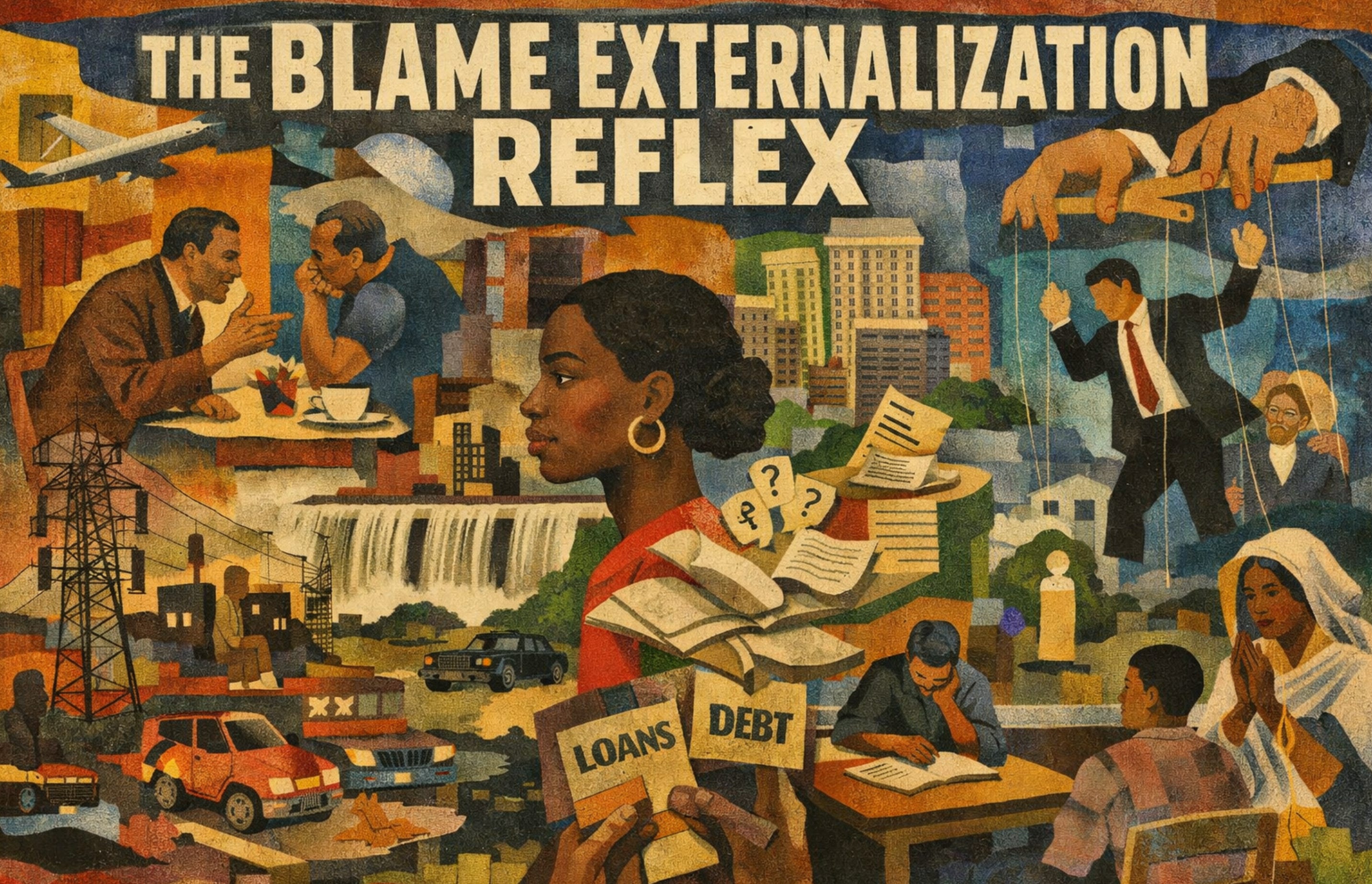
Call this default the Blame Externalization Reflex. A woman in Addis applies for a bank loan with a real business plan, watches the paperwork disappear into the back office, waits four months, and is told to resubmit for reasons nobody can name. A young man in Lima interviews for a government job he is qualified for, and loses it to someone’s nephew. A shop owner in Karachi pays taxes on time, and watches the municipality dig up his street and leave it open for a year. None of these are paranoia. Each is a data point. Twenty years of data points teach the nervous system a lesson the conscious mind would rather not draw, and the lesson stays. The next time a new opportunity appears, the response comes preloaded. It will probably not work. Someone has probably already decided. Why spend the energy?
Takeaway: Externalizing blame in a high-friction society is not a character flaw. It is the correct reading of decades of experience. The trouble is that the reading keeps getting applied after the situation has quietly changed, in the small corners of life where effort really would have landed.
The Second Half of the Operating System
The reflex does not stand alone. It travels with religion. Pippa Norris at Harvard and Ronald Inglehart at Michigan built the sturdiest cross-cultural account we have of why some societies remain devout and others drift secular. They called it existential security theory. Religiosity tracks lived insecurity. Where survival, livelihood, and the well-being of children are exposed to real and frequent risk, faith stays close to the center of life. Where those risks fall, religious intensity fades across generations without anyone having to argue against it. Insecurity is not the only driver of devotion. Religion also carries culture, identity, community, and family inheritance, and in some places those alone would keep it central. What existential security theory does explain is why the curve is so sharp between regions, and why the curve moves when the conditions underneath it move.
In sub-Saharan Africa, Latin America, South and Southeast Asia, and most of the Middle East, the share of adults who say religion is very important in their daily lives usually sits above seventy percent and frequently above ninety. In Western Europe, East Asia, and Canada, the same question yields answers in the low twenties or below. The question is identical. The answer varies by a factor of five, and the variation tracks the steadiness of the ground people are walking on.
External attribution and deep religiosity are doing related work. The first absorbs the pain of unearned failure. The second absorbs the silence of unearned suffering. A child dies young, a harvest fails, a marriage breaks, a promotion goes to the wrong person, and something has to carry the weight of that. The reflex says the world did it. Faith says the world is not the final word. Together they make a life livable under conditions that would otherwise crush it. Neither is a lie. Both carry weight. A society carrying that much friction without some version of either would not be a society. It would be an open wound.
The cost is not in the presence of either response. It is in their generalization.
Two Verdicts for the Same Action
Here the man in the café returns. He is accurate about much of his country. He is also, inside his own small jurisdictions, running the same playbook at reduced scale. He shows up an hour late to a meeting he himself scheduled. He misses his son’s school event because he assumes nothing he says there will matter. He promises his sister he will help with something on Saturday, and on Saturday he is not there. Thomas Pettigrew, a social psychologist who spent much of his career studying prejudice, noticed a related asymmetry years ago, one that rougher environments tend to amplify. We explain our own group’s bad behavior through circumstance, and the bad behavior of outside groups through character. The government is corrupt because of what it is. We missed the meeting because of what we had to deal with today. Same action, two verdicts. The harsher the environment, the wider that gap grows, because the same reflex that pushes friction outward is also available, at a lower volume, to excuse the small liberties we take with each other. From the outside it reads as hypocrisy. From the inside it feels like being the one sensible actor in a landscape of fools, while also being entitled to the occasional corner cut because of everything one has had to endure. The same tool is doing both jobs, pointed outward when the subject is them and inward with leniency when the subject is us.
Takeaway: A society can speak with one voice about what is broken at the top while behaving, in private and at small scale, exactly like the actors it criticizes. The behavior looks like hypocrisy and functions like survival. Both are true at the same time.
What Changes the Reflex
What undoes the reflex is unromantic. The farmers in Tamil Nadu became sharper thinkers the moment the crop cleared their debt. They did not read a book, attend a seminar, or gain a new belief. Their bandwidth was returned to them by a change in their conditions. Societies undo the Externalization Reflex the same way, and never all at once. A school that reliably teaches. A court that occasionally surprises people by doing its job. A bank that returns the deposit. A boss who promotes the right person for the right reasons. Each small restoration of the link between effort and outcome shaves a little friction off the everyday, and the shaving compounds across decades. Singapore in 1965 and Singapore in 2005 were not populated by different kinds of people. They were populated by the same kinds of people living inside two very different environments, and the difference between those environments was built by hand, one enforced contract at a time, one uncorrupted licensing office at a time, one teacher held to a standard at a time, until the population around those institutions began to trust that effort, once made, would not simply vanish.
For the person living inside a rougher society, the useful move is also narrow. Not a theatrical display of self-reliance in domains where the system will flatten it. Not a denial of the aggregate truth about where the friction actually sits. Something smaller. A disciplined refusal to treat every personal situation as if it were the whole country. Your child’s homework is not the tax authority. Your morning run is not the municipality. What you ship at work on Tuesday is not the central bank. The promises you keep with people close enough to notice are not the parliament. These almost always carry far less friction than the headline picture of the society around them. A reflex calibrated to the country, applied to a dinner table, becomes a self-inflicted wound, separate from anything the system has done.
The man in the café is accurate at the scale he is describing. He is also, at the scale of his own table, the country he resents, in miniature, produced by his own hand.
The first truth is the one he will keep talking about. The second is the only one that ever answers him back.
STRATEX by Naz explores the cognitive and behavioral foundations of how people, organizations, and markets actually work. Subscribe below.