A note before we start:
I write here about patterns across domains; markets, attention, incentives, human behavior. This piece applies that lens to the media industry. It’s a closer look at how platforms have rewritten the rules of value and power in filmed entertainment. Different topic, same underlying mechanics.
A strange thing happened to Sony this year.
A movie that collapsed in theaters became a streaming giant. Madame Web opened to a humiliating $15 million. The industry wrote it off. Yet on Netflix it became one of Sony’s most-watched titles of the year.
That should have been good news. Instead it exposed the trap.
Sony’s licensing deal with Netflix pays them based on theatrical performance, not actual streaming value. So the studio that financed the film and carried the risk was compensated as if it had failed, while Netflix captured the upside of a surprise hit. Sony created the value. Netflix harvested it.
Think of it this way - If a $15M opening weekend earns a studio a licensing payout indexed to that number, but a streaming platform extracts the equivalent of a $150M global run in viewing hours, the value captured is asymmetrical by an order of magnitude. The input is priced. The output is not.
This is the system working as designed: studios take the risk, platforms take the value.
What “Free Studios” Actually Means
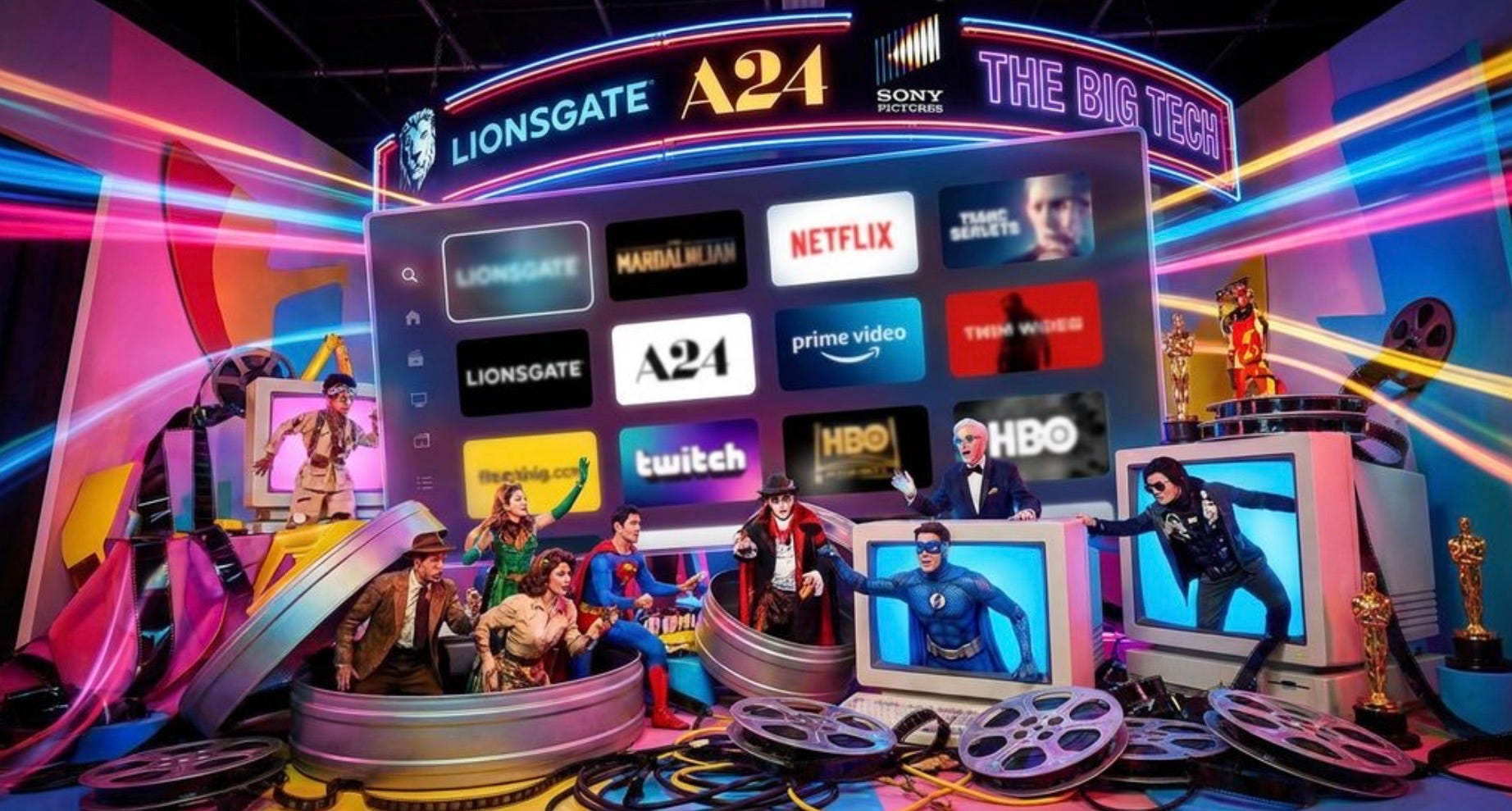
When I say “free studios,” I am referring to a tiny group of companies that still operate outside the logic of platforms. Studios that own IP but not a streaming service, depend on transparent markets rather than opaque dashboards, and survive on theatrical revenue, international sales, and licensing, not subscription churn.
There are only three meaningful players left in this category.
Sony is the last global major without a streaming platform.
Lionsgate is the lean genre machine now exposed after spinning off STARZ.
A24 is smaller in scale but identical in structure, a boutique studio whose economics depend entirely on open-market demand rather than internal platform leverage.
These three operate in the final patch of open creative territory. Everyone else either owns a platform or feeds one. They are “free” not because they have more liberty but because they lack the protective shell that comes from owning the distribution, the data, and the monetization channel. They operate in the last open market left in filmed entertainment — a market that is shrinking fast.
They operate in the last part of the business where outcomes are publicly observable, even though those outcomes now reflect only a fraction of a film’s real audience reach.
How the Old Economics Came Apart
The old marketplace had a simple advantage: transparency.
A theatrical release was a public scorecard. Box-office numbers were observable, verifiable, and priced into every downstream window. Distributors, networks, licensors, and talent all negotiated from the same sheet of reality.
Streaming destroyed that.
The minute the primary monetization channel moved behind a black-box interface, the bargaining power shifted. Only platforms know what wins. Only platforms control the metrics. Only platforms control the windowing.
Sony is discovering the cost of that opacity. Lionsgate is discovering something harsher.
Lionsgate’s Slow Slide Toward Irrelevance
For a decade, Lionsgate was the heroic outlier.
John Wick. Twilight. Hunger Games. Saw. They proved that a nimble studio with strong IP could punch above its weight without a Disney-sized empire. They stayed lean, owned their franchises, and used theatrical distribution as their oxygen.
That math no longer works.
Lionsgate just posted a $42.5 million loss in a single quarter and still carries the weight of debt from spinning off STARZ. Their revenue model depends on markets where scale is everything, yet they do not have scale. They exist in the same strategic void as Sony: too small to fight the giants, too large to pivot into a boutique studio.
If they move too slowly, they drift into a new category: the zombie studio.
A zombie studio does not die publicly. It simply loses relevance. It keeps releasing films, but every dollar goes to creditors. Creativity is shaped by debt covenants, not by audiences. The brand remains alive but hollowed out — like a library feeding someone else’s platform.
When Consolidation Becomes Control
This story is not about box office. It is about power. Cultural power.
When three or four platforms determine what gets made, four things happen. Creators lose leverage. With only a few buyers left, the market for ideas collapses into take-it-or-leave-it bargaining. Audiences lose variety as platforms buy for algorithmic efficiency, not artistic range. Culture becomes uniform as risk is eliminated in favor of data-shaped predictability. And transparency disappears, because platforms control the scoreboard, which means they control perception of success.
Streaming promised infinite choice. What it delivered was the smallest number of decision-makers in entertainment history.
The death of independent studios is not a business footnote. It is the erosion of the last alternative pathways for creators, viewers, and entire genres of filmmaking.
The New Logic of Value
The Sony–Netflix mismatch reveals a structural truth. If you do not own the platform, you do not capture the value you create. Theatrical strength no longer sets the terms. Viral global streams no longer guarantee financial reward. And any studio without a direct consumer funnel is negotiating blind.
We have reached the point where a flop can be a hit, a hit can be underpriced, a studio can create cultural impact but receive economic scraps, and a platform can shape entire genres without ever financing them.
The studios make the thing. The platforms decide what it’s worth. And the studios have no way to argue because the data is locked inside the platform.
Think of it this way - A theatrical flop is visible because revenue is discrete. A streaming hit is invisible because value is continuous. The first has a number attached; the second has an internal metric only one party can see. If one side negotiates with public numbers and the other negotiates with private ones, the bargaining model becomes a lopsided equation:
Public numerator / Private denominator = zero leverage.
This is precisely why Sony, Lionsgate, and A24 matter. They represent the last space where a film’s success is determined by what audiences actually choose in a competitive market, not by what an algorithm optimizes for retention. Their vulnerability is also their significance. They are exposed because they still operate in the open.
How Consolidation Reshapes Culture
The transition from many studios to a few platforms is not the natural evolution of entertainment. It is the financialization of attention. It shifts the definition of value from audience response to platform optimization, from creative markets to closed ecosystems.
If Sony and Lionsgate disappear as independent forces, the industry loses more than logos. It loses the last buyers who negotiate on content, not algorithms. The last theaters of transparent data. The last creative markets not tied to monthly churn. The last check against vertically integrated cultural monopolies.
A world with four platforms and no independent studios is not just a business consolidation. It is a cultural bottleneck.
Where This Ends
The risk is not that streaming kills cinema. Cinema will survive.
The risk is that the economic architecture collapses into a system where creativity is priced by a handful of companies that not only distribute content but decide what “success” means.
If the independent studios fade, we lose the last pieces of competitive pressure that kept the system honest. And once that happens, value is no longer created in the market. It is assigned.
Once platforms decide the value of culture, creators don’t negotiate. They comply.
This is the real story behind Madame Web and Lionsgate’s slow slide, not bad movies, but the shrinking space in which movies can be anything other than data-shaped products of platforms that own both the audience and the outcome.