
My previous pieces have explored why corporate transformations fail at a 70% rate, why your Instagram feed runs on hunter-gatherer software, why attention spans aren’t actually shrinking, and why outsourcing difficulty to AI might hollow out our internal reference libraries. This article stays in that lane: the evolutionary logic underneath behavior we take for granted. But the topic is one we experience constantly and almost never examine.
In 1953, a young psychologist named James Olds made a mistake.
He was working at McGill University, trying to study aversion responses in rats. The plan was simple: implant an electrode in a region of the brain called the reticular formation, then observe how rats avoided behaviors that triggered stimulation there. Standard stuff.
Except Olds was new to electrode implantation. He used heavier gauge wire than the protocol specified and didn’t wait long enough for the adhesive to set before bending the wires into position. Small changes to a delicate procedure.
The electrode slipped. It landed several millimeters away from its target, in a region called the septal area, near the hypothalamus.
What happened next was not what anyone expected.
Instead of avoiding the corner of the cage where it received mild electrical stimulation, this rat kept returning, seemingly enjoying it.
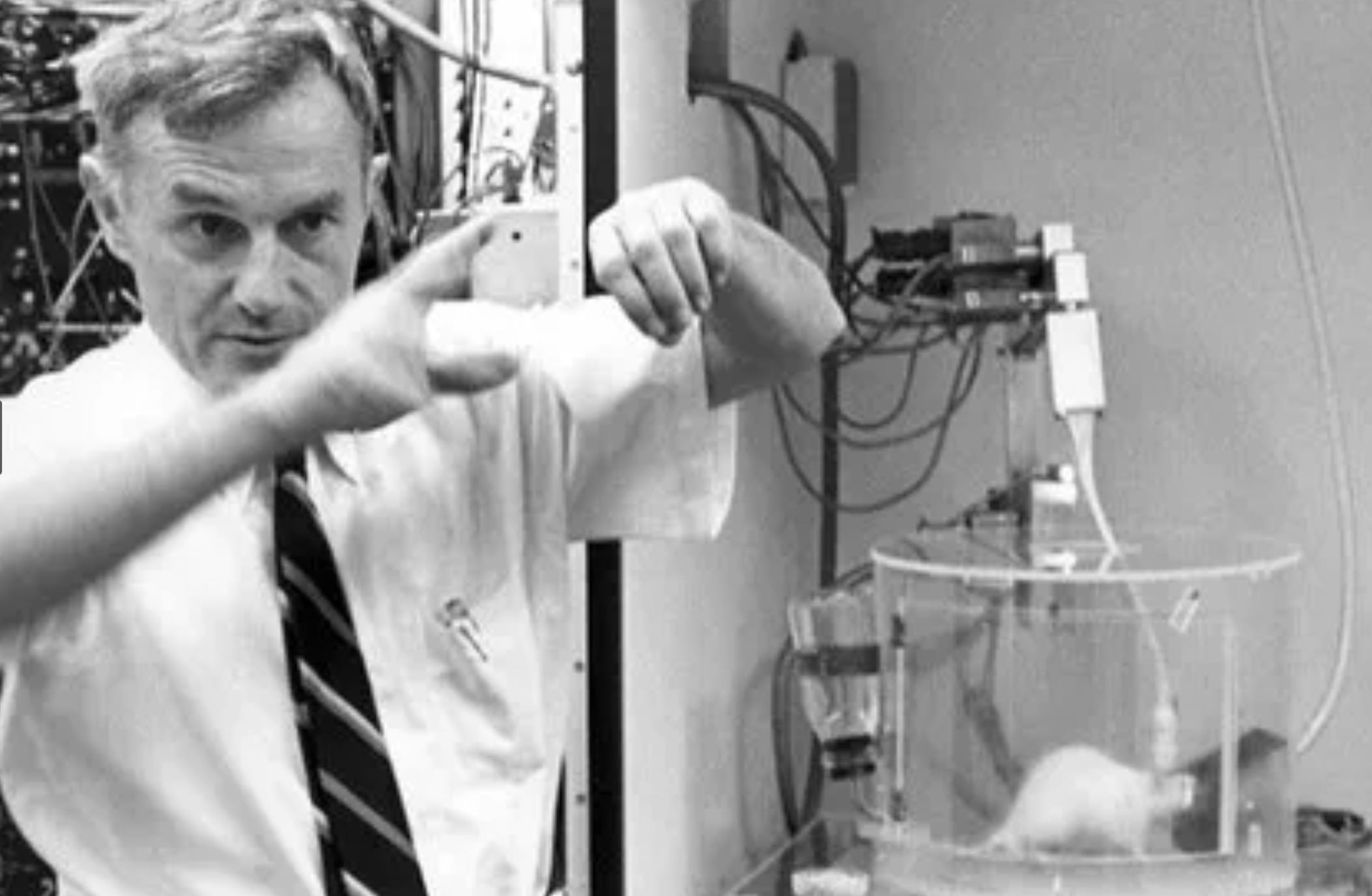
Olds and his colleague Peter Milner set up a proper experiment. They gave rats a lever that, when pressed, would deliver a small pulse of electricity to that same brain region. The rats could stimulate themselves whenever they wanted.
The rats would repeatedly press the lever, up to 2,000 times per hour.
They pressed it instead of eating. They pressed it instead of drinking. In a 48-hour test, rats with hypothalamic electrodes self-stimulated to exhaustion and showed no intrinsic satiation tendencies. They would press the lever until they collapsed.
Olds thought he had discovered the brain’s pleasure center. The press called it exactly that. For decades, the finding was understood as proof that bliss had an address in the brain, and that address could be directly stimulated.
Later research complicated this story. The rats weren’t experiencing pure pleasure. They were experiencing something more like intense wanting, an unquenchable drive to repeat the behavior. The pleasure electrodes may never have caused intense pleasure or ‘liking’ after all, but only a form of ‘wanting’ or motivation to obtain the stimulation.
But the broader finding stood: the brain contains circuitry that, when activated, produces experiences so compelling that an animal will sacrifice food, water, rest, and eventually its own life to keep activating them.
Which raises an uncomfortable question.
If the brain has the capacity to generate overwhelming reward, why does it deploy that capacity so selectively? Why does orgasm feel like what the rats were chasing, while learning calculus feels like chewing cardboard? Why did evolution wire pleasure to reproduction with such intensity while leaving intellectual achievement to run on fumes?
The answer, like most answers about human behavior, is 200,000 years old.
Your ancestors never needed to understand quadratic equations to pass on their genes. They did, however, need to have sex.
This simple fact explains one of the strangest asymmetries in human experience: why certain activities flood your brain with overwhelming bliss while others that objectively matter more to your modern life produce, at best, mild satisfaction.
Before we go further, try something.
Exercise 1: The Pleasure Inventory
Rate the following experiences on a scale of 1 to 10, where 10 is the most intense pleasure you can imagine:
Eating your favorite meal when genuinely hungry
Finally understanding a concept you’ve struggled with for weeks
The moment of sexual climax
Receiving unexpected praise from someone you respect
Solving a difficult puzzle
The first sip of water after intense thirst
Write your numbers down. We’ll return to them.
The Chemistry You’re Running On
Your brain doesn’t experience “pleasure” as a single thing. It runs on a cocktail of chemicals, each doing different jobs. Understanding these chemicals is like understanding the instruments in an orchestra. The music makes more sense when you know who’s playing what.
Dopamine is not actually the “pleasure chemical,” despite what you’ve heard. Dopamine is the wanting chemical. It creates anticipation, craving, motivation. When you smell cookies baking and suddenly need one, that’s dopamine. When you keep scrolling social media even though you’re not enjoying it, that’s dopamine. It drives you toward things. It doesn’t make them feel good once you get them.
Think of dopamine as the friend who convinces you to go to the party. Whether the party is actually fun once you arrive is someone else’s job.
Opioids (your brain makes its own, called endorphins) create the actual feeling of pleasure. The warm glow. The satisfaction. The “ahhhh.” When the cookie hits your tongue and tastes good, that’s your endogenous opioid system. The word “endorphin” literally means “morphine produced within.” Your brain manufactures its own version of the drug.
If dopamine is the friend who drags you to the party, opioids are the moment you realize you’re actually having a great time.
Oxytocin creates bonding and connection. It’s released during physical touch, breastfeeding, and orgasm. It makes you feel close to someone. It transforms a physical sensation into a relational experience. After sex, oxytocin is why you want to cuddle rather than immediately check your email.
Oxytocin is why you remember who you were with at the party, not just that it was fun.
Exercise 2: Separating Wanting from Liking
Think of something you frequently consume or do that you don’t actually enjoy that much anymore. Social media scrolling. A TV show you’re “finishing” out of obligation. A snack you eat automatically.
Notice: you still want it. You still reach for it. But the actual experience has become hollow.
That gap between wanting and liking is the gap between dopamine and opioids. Your dopamine system learned to want it. Your opioid system stopped being impressed.
Now think of something you genuinely enjoy but rarely do. A walk in nature. A conversation with an old friend. Reading fiction.
Why don’t you do it more? Because dopamine drives behavior, and dopamine responds to frequency, immediacy, and unpredictability. The things that are good for you often lack these properties. The things that hijack your attention have them in abundance.
The Orgasm Equation
During sexual climax, something unusual happens. All three systems fire simultaneously at maximum intensity. The dopamine response during orgasm can rival the intensity produced by drugs like heroin.
Most people have never used heroin, so let me translate that comparison into something more accessible.
Heroin binds to the same opioid receptors your brain uses naturally, but it does so with overwhelming force. Users describe it as warmth spreading through every cell, total erasure of anxiety, a feeling that everything is exactly right. It’s so pleasurable that people destroy their lives, relationships, and careers chasing it. Addicts often say that nothing in normal life ever feels as good again.
Your brain, during orgasm, produces a similar neurochemical state using only its own internal pharmacy. No external substances required. Orgasms result from a massive release of opioids into reward regions, combined with dopamine and oxytocin transmission.
Recall: opioids create the actual feeling of pleasure (the ecstatic peak), dopamine creates the wanting and pursuit (the drive that got you there), and oxytocin creates bonding (the closeness you feel afterward). During orgasm, all three fire together at levels your brain rarely achieves otherwise.
The experience is so overwhelming that the prefrontal cortex, your rational decision-making center, essentially goes offline. Brain scans show reduced activity in regions associated with self-control and judgment. For a few seconds, the thinking mind surrenders to the feeling body.
Now consider what happens when you finally understand how compound interest works. A quiet “huh.” Perhaps you tell someone about it at dinner.
Same brain. Same reward circuitry. Radically different outputs.
The Calibration Logic
Evolution is an optimization engine, but it optimizes for one thing only: reproductive success. Everything else is a side effect or a tool.
The pleasure you feel from any activity correlates almost perfectly with how critical that activity was for gene propagation in ancestral environments.
Two factors determine the weighting:
How rare or difficult was the opportunity?
How catastrophic was missing it?
We can express this as:
Pleasure Intensity ≈ (Reproductive Impact × Opportunity Scarcity) / Baseline Frequency
Sex scores maximally on all dimensions. Successful reproduction might happen only a handful of times across an entire lifespan for some ancestral humans. It required finding a willing partner, competing against rivals, avoiding predators during the vulnerable act, and timing it with fertility windows that couldn’t be consciously detected. The costs were high. The opportunities were rare. The stakes were existential.
Intense sexual pleasure can be understood as a primary reinforcer shaped by evolution to reinforce behavior that facilitates reproductive success.
Learning mathematics? Zero reproductive impact in the ancestral environment. Infinite opportunities to skip it. No predators waiting to eat you if you failed to grasp logarithms.
Why Moderation Feels Like Deprivation
Consider eating. Why isn’t restraint pleasurable? Why don’t we feel a rush of satisfaction from pushing away from the table at exactly the right caloric intake?
Because moderation would have killed your ancestors.
Perceiving calorie-rich food as particularly tasty and pleasurable, and bingeing on it whenever it was available, would have conferred a crucial survival advantage by storing up extra energy.
The humans who felt satisfied after a “reasonable portion” died during the next famine. The ones who kept eating when food was available survived to reproduce.
In our modern environment with abundant attractive and energy-dense foods, activation of the same mechanism causes an evolutionary mismatch, resulting in overeating.
Recall: dopamine is the wanting chemical, not the satisfaction chemical. Your dopamine system evolved to keep you wanting more when calorie-dense food was available, because wanting more meant storing more fat, and storing more fat meant surviving the winter. The system was never designed to say “that’s enough.”
Exercise 3: The Ancestor Test
For any behavior you’re trying to change, ask: what would this behavior have produced 100,000 years ago?
Eating everything available when food was present → Survival advantage
Feeling anxious about social rejection → Maintained group membership essential for survival
Seeking novelty and stimulation → Found new resources and opportunities
Difficulty focusing on abstract tasks → Conserved energy for immediate threats
Your “bad habits” and “character flaws” are often ancestral survival strategies running in an environment they weren’t designed for. You’re not fighting weakness. You’re fighting optimization.
Curiosity Gets a Participation Trophy
Learning does activate the reward system. But the activation is modest, conditional, and easily overridden.
When we stumble upon something novel or mysterious, the reward system kicks into gear, releasing dopamine. This release generates a pleasurable sensation and motivates further exploration.
Recall: dopamine motivates pursuit and creates anticipation. When you encounter something new that might be useful, dopamine gives you a small nudge to investigate. But notice the qualifiers in that research finding: novel, mysterious. Your brain rewards information that might immediately help you survive or find resources. A strange sound in the forest. An unfamiliar berry. The behavior of a potential predator or mate.
Evolutionary pressures have made information intrinsically rewarding. The same dopaminergic neurons that respond to food and sex also respond to information.
(”Dopaminergic” just means “related to dopamine.” When researchers say “dopaminergic neurons,” they mean brain cells that use dopamine to communicate. When they say “dopaminergic activity,” they mean the dopamine system is doing something.)
But abstract learning, the kind that requires years of effort before producing any practical benefit, exists outside the optimization window.
Your ancestors who spent their days contemplating geometry instead of hunting and mating did not become your ancestors. The ones who were busy doing………became your ancestors.
In some studies, curiosity is a fundamentally aversive state. Curiosity is seen as a lack of something wanted, namely information, and thus unpleasant. This unpleasantness motivates information-seeking to alleviate it.
Curiosity isn’t joy. It’s discomfort. The relief of satisfying curiosity feels mildly pleasant, but the state of being curious is closer to an itch than an embrace. You scratch it to make the irritation stop, not because scratching feels amazing.
Exercise 4: Mapping Your Curiosity
Think of the last time you learned something that genuinely excited you. Not professionally useful. Not socially impressive. Something that made you want to tell someone immediately, made you feel a small thrill of discovery.
Now think of the last time you studied something because you “should.” How did that feel in your body?
The difference is the difference between dopamine responding to novelty your brain codes as potentially valuable versus effortful processing your brain codes as energy expenditure with uncertain return.
The Eureka Exception
Some people do experience something approaching intellectual bliss. Mathematicians describe moments of sudden insight as transcendent. Scientists chase the rush of discovery. Programmers talk about the satisfaction of elegant code.
The excitement that comes with the moment of insight is produced by an influx of dopamine into the nucleus accumbens, the same region triggered when we receive other rewards.
(The nucleus accumbens is a small structure deep in your brain that acts like a pleasure switchboard. When something feels rewarding, this region lights up. It’s the same area activated by food, sex, drugs, and winning money. The fact that “aha” moments activate it tells us something important about how the brain categorizes insight.)
The Aha! moment refers to the transition from being completely dark about the solution to suddenly “seeing” it. This experience brings a sense of ease, is intrinsically pleasurable, and is accompanied by a feeling of certainty.
Dopamine stimulates goal-driven approach motivation such as curiosity and learning. These findings establish a close link between dopamine, positive mood, and creativity.
But notice the critical distinction: the reward comes from sudden insight, not sustained effort. Your brain rewards the moment of pattern recognition, not the hours of grinding that preceded it. The pleasure spike accompanies the “aha,” not the “still working on it.”
Recall: dopamine responds to prediction errors, moments when reality differs from expectation in a positive direction. The eureka moment is a massive prediction error. You expected confusion; you got clarity. The surprise is what triggers the reward. Gradual understanding produces no such spike because there’s no surprise.
If you have an aha! moment while learning something, it almost doubles your memory. There are few memory effects as powerful as this.
Evolution built a system that rewards discovering answers, not the process of seeking them. This makes sense for ancestral environments where the answer to “is that a predator?” needed to be cached immediately and permanently.
Exercise 5: Engineering Your Own Eureka
Think of something you’re currently trying to learn. Now break it into the smallest possible units that could each produce a moment of “oh, I get it.”
Instead of “learn Spanish,” try “understand why Spanish uses two verbs for ‘to be.’” Instead of “understand investing,” try “figure out why bond prices move opposite to interest rates.”
The insight must be small enough to arrive suddenly. If it requires sustained comprehension, your brain won’t produce the reward spike. You need the penny-drop moment, not the gradual dawn.
The Orgasm Gap: Evolution’s Other Asymmetry
If evolution optimized sexual pleasure to ensure reproduction, why is there such a stark difference between male and female orgasm reliability?
Compared with the male orgasm, female orgasm is extremely difficult to achieve, and nearly 10% of women never have an orgasm in their lifetime. Surveys suggest only one-third of women are regularly fully aroused during intercourse.
This seems like a design flaw. If pleasure motivates behavior, and reproduction requires both sexes to participate, why would evolution make orgasm mandatory for one sex and optional for the other?
The answer lies in plumbing, both literal and evolutionary.
For males, orgasm and reproduction are mechanically coupled. The male cannot transfer gametes without experiencing an orgasm. Ejaculation requires the orgasmic reflex. No pleasure, no sperm transfer. Evolution had no choice but to make male orgasm reliable and easy to achieve.
For females, orgasm and reproduction are completely decoupled. Women can conceive without orgasming. They can orgasm without conceiving. The two events are independent.
The evolutionary explanation of female orgasm has been difficult to come by. The orgasm in women does not obviously contribute to reproductive success and surprisingly unreliably accompanies heterosexual intercourse.
So what’s going on?
Female orgasm seems to be a happy afterthought of our evolutionary past when it helped stimulate ovulation. In many mammal species, females don’t ovulate on a schedule. They release eggs in response to mating itself. The hormonal surge that accompanies what we call “orgasm” was the trigger.
Evolutionary biologists say there is reason to believe that female orgasms used to be necessary because it induced ovulation in our pre-human ancestors.
Humans evolved to ovulate spontaneously, on a hormonal cycle independent of sexual activity. The orgasm mechanism remained but lost its reproductive function. It became, as one researcher put it, like the appendix: present but no longer essential.
In earlier mammals, the clitoris tends to be part of the vagina, guaranteeing that intercourse stimulated this organ and kick-started ovulation. But in later arising species, particularly primates, the clitoris has moved ever farther away from the vagina, even out of reach of an inserted penis.
In humans, there is great variation in clitoris size and location, but the organ steadfastly remains outside of the vaginal canal. This is part of the reason why many women report difficulty having orgasms from intercourse unless there is additional clitoris-specific stimulation.
The clitoris migrated. Intercourse stopped reliably stimulating it. Female orgasm became anatomically optional.
Recall: evolution doesn’t optimize for pleasure or fairness or equality. It optimizes for gene propagation. Male orgasm remained under strong selection pressure because reproduction required it. Female orgasm drifted because reproduction didn’t.
If orgasm had a selective role, it is difficult to understand why females show such variability in their ability to reach a climax. The variability itself is evidence of weak selection pressure. Traits that matter for survival become consistent across a population. Traits that don’t matter show wide variation.
Some researchers propose that female orgasm was repurposed for mate selection: Female orgasm appears to have evolved to increase the probability of fertilization from males whose genes would improve offspring fitness. The logic being that orgasm creates bonding (recall: oxytocin), and women who bonded with attentive, skilled partners may have had offspring with better survival rates.
If your mate is conscientious enough to care whether you have an orgasm, he might also be conscientious enough to make sure you and your mutual offspring have enough food to survive.
Evolution, it turns out, is not an equal opportunity optimizer. It built male orgasm as a requirement and female orgasm as a screening tool. Both serve reproduction, but through entirely different mechanisms.
The Animal Kingdom Runs the Same Software
The pleasure asymmetry isn’t uniquely human. Animals across species show similar weighting.
All mammals have the physiological capacity for orgasm because they all have a penis or clitoris, and evidence suggests they all experience it. Research with female macaques recorded muscle contractions, facial expressions, and vocalizations demonstrating orgasmic response.
Studies confirm that stimulating the dolphin clitoris produces intense pleasure. Female dolphins have well-developed erectile tissue that engorges with blood when stimulated.
Bonobos use sex as a key tool for social cohesion and conflict resolution. Same-sex, opposite-sex, they just love sex play, according to primatologist Frans de Waal.
The dopaminergic reward circuits (recall: dopamine-based systems for motivation and reward) that produce pleasure are ancient, predating mammals entirely. Dopaminergic and mesolimbic neuronal circuits regulating sexual behavior exist in early vertebrates. Fish and amphibians have the neural architecture for pleasure-driven behavior.
But no animal has evolved to experience orgasmic pleasure from abstract reasoning. Even the most intelligent species show curiosity rewards that pale compared to mating rewards. The weighting is consistent across the animal kingdom because the selection pressure was consistent.
The Triple Lock
Return to your Pleasure Inventory from the beginning. Sexual climax likely scored highest for most readers. Why?
Sex activates all three major reward systems simultaneously at maximum intensity:
Dopamine (recall: the wanting chemical) creates the anticipation and pursuit. The “I need this” that drives you toward a partner.
Opioids (recall: the actual pleasure chemicals) create the ecstatic peak. Orgasms result from a massive release of opioids that creates intense pleasure, along with molecular changes that sensitize the system for future experiences.
Oxytocin (recall: the bonding chemical) creates connection afterward. Oxytocin is released during close affectionate and sexual behavior and most importantly during orgasm. It transforms a physical act into a relational one.
Eating engages dopamine moderately and opioids mildly. Social connection engages oxytocin. Learning engages dopamine weakly and intermittently, with occasional opioid spikes during insight moments.
But sex hits all three systems simultaneously at maximum intensity. That neurochemical convergence creates a qualitatively different experience from anything else your body can produce without external chemicals.
Imagine Otherwise
Imagine if evolution had calibrated learning the way it calibrated sex.
Imagine if understanding a new concept produced the same neurochemical cascade as orgasm. Dopamine building during the struggle. Opioids flooding during comprehension. Oxytocin bonding you to the knowledge itself.
Children would beg to stay in school. Adults would sneak away from parties to study. “Learning addiction” would be a clinical diagnosis. Mathematicians would need support groups. Libraries would check IDs at the door. Textbook publishers would be the new drug cartels.
The world would be unrecognizable. Human progress would have accelerated by orders of magnitude. The great challenge of civilization, getting people to learn things that benefit them in the long run, would simply not exist.
But evolution doesn’t optimize for civilizational progress. It optimizes for gene propagation. And in the environments where our brains were shaped, the humans who spent their time thinking deep thoughts instead of eating, mating, and avoiding predators did not reproduce successfully.
We inherited the reward system of the winners. The winners were not philosophers.
Working With Your Wiring
Exercise 6: The Realistic Recalibration
Look at your Pleasure Inventory one more time. Now add a column: “Actual long-term value to my life.”
For most people, the correlation between pleasure intensity and long-term value is weak or negative. The things that feel best often matter least. The things that matter most often feel like work.
This isn’t a flaw in your character. It’s a flaw in the match between ancestral optimization and modern requirements.
Three strategies follow from this understanding:
First, stop expecting learning to feel like pleasure. It won’t. The most you can hope for is mild satisfaction and occasional eureka spikes. Restructure your expectations. The absence of strong pleasure doesn’t mean you’re doing it wrong. It means you’re doing something your brain wasn’t built to reward.
Second, exploit the eureka architecture intentionally. Learning environments that encourage insight boost long-term memory and understanding. Break learning into discrete problems that produce insight moments rather than continuous grinding. Structure for “aha” rather than gradual accumulation.
Third, recognize hijacking when it happens. When something produces pleasure wildly disproportionate to its actual value, your ancient reward system is being exploited by modern stimulus design. Social media, processed food, pornography, gambling. These aren’t pleasures. They’re exploits. The intensity of the feeling is not evidence of the value of the activity.
The Final Exercise
Exercise 7: The Honest Accounting
List three activities that produce strong pleasure but add little long-term value.
List three activities that add significant long-term value but produce little pleasure.
For one week, track how much time you spend on each list.
(You will not find this exercise orgasmic. Your dopamine system will offer no enthusiasm. Your opioid system will remain unimpressed. Manage your expectations accordingly, and persist anyway. This is what discipline feels like from the inside: choosing behavior your reward system didn’t vote for.)
The gap between those numbers is the gap between what evolution optimized you for and what your actual life requires.
Closing that gap won’t feel good. Your dopamine system will protest. Your opioid system won’t reward you.
But your prefrontal cortex, that thin layer of recent evolutionary development sitting atop millions of years of pleasure-seeking machinery, can override the old systems if you understand what you’re fighting.
You’re not fighting laziness. You’re not fighting weakness. You’re fighting the inherited reward structure of every ancestor who survived long enough to reproduce by prioritizing food, sex, and safety over abstract thought.
Everything you learn in spite of that is a small victory against a very old adversary.
If you're the kind of person who keeps reading things that don't produce an immediate neurochemical reward, you might be my audience. Consider subscribing. Evolution didn't optimize for this, but here we are anyway.