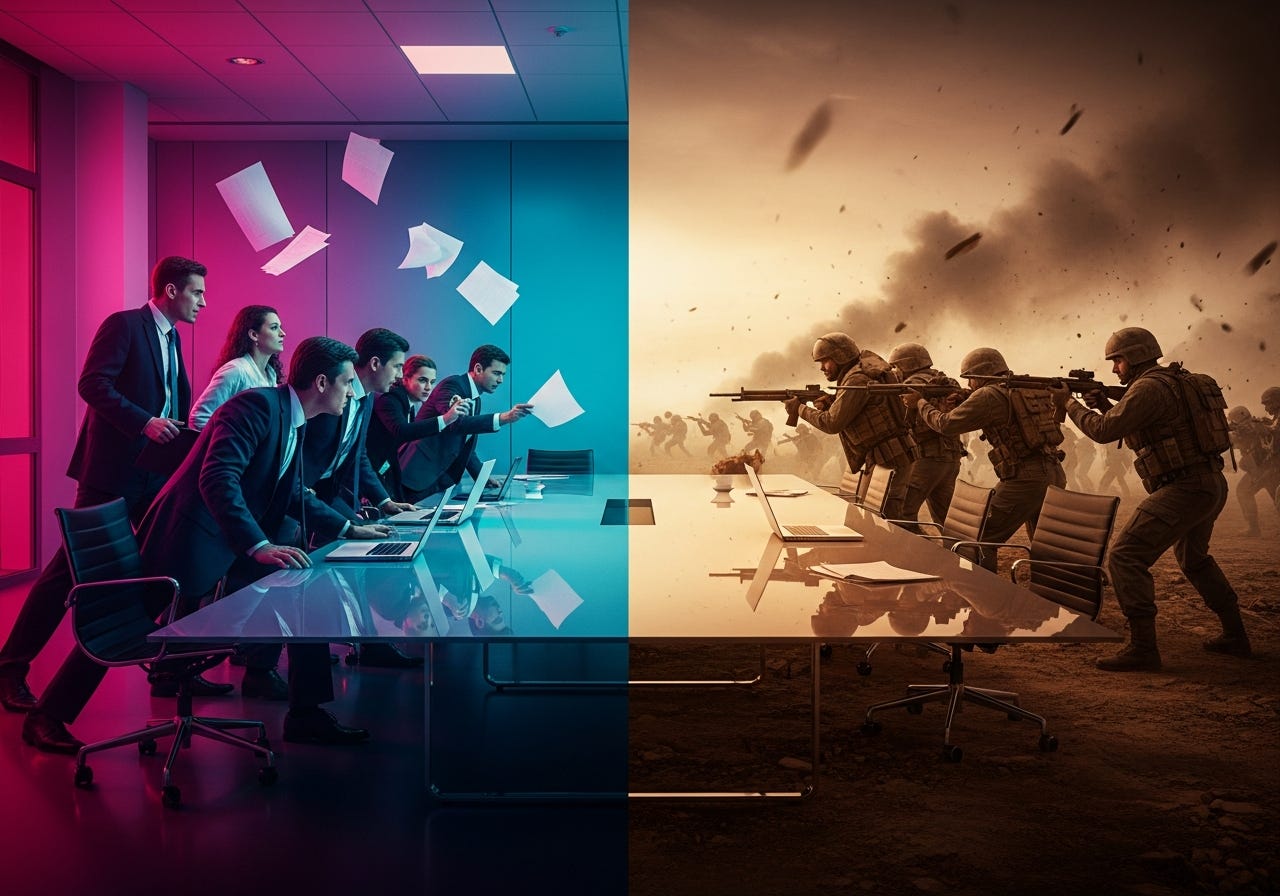
A note on this piece: evolutionary psychology appears frequently in my articles. Not as a trend or a rhetorical device, but because it is the most underleveraged explanatory framework in business writing. Most strategy, leadership, and organizational theory is written as though human behavior begins at the org chart. Evolutionary psychology insists, with considerable evidence, that it begins several hundred thousand years earlier. That is the lens this publication keeps returning to, because the bedrock has to be understood before the building makes sense. A further note: geopolitical conflict operates at a scale and complexity that no single framework can fully account for. History, economics, resource scarcity, ideology, and the specific psychology of individual leaders all shape how nations behave. This piece is not attempting to reduce any of that. It is asking a narrower question: whether the same cognitive instincts that drive conflict between departments also appear, recognizably, at the level of nations. At the level of mechanism, they do.
At some point in my career, I was managing relationships across a company where departments had been in quiet conflict for years. Not the dramatic kind. The procedural kind, where budget approvals arrived late, meetings were called without the relevant people in the room, and credit for shared outcomes settled reliably on one side of the building, in the way that these things do when nobody is willing to name what is actually happening.
What stayed with me was not the conflict itself but a conversation, or several versions of the same conversation repeated over months. The same colleagues embedded in these territorial disputes would turn around and express genuine frustration at governments failing to resolve regional tensions. They meant it sincerely. They had no awareness at all that they were describing themselves.
I found myself sitting with a thought that felt almost absurd: if I were simultaneously the CEO of that company and the political leader of the country those same people lived in, I would be failing in both roles for the same reason. Not because of insufficient vision or wrong policy, but because I would be governing people who arrived already equipped with a tribal operating system that ten pages of company values was never designed to reach. Culture decks get written. All-hands meetings get held. The conflict resumes on Monday.
Whether organizations and nations are separate phenomena, or the same cognitive event running at different scales, whether geopolitical disputes are the macro projection of instincts that play out in a product review meeting, is a question the anthropological record answers with some precision.

The Hardware
Around 300,000 years ago, Homo sapiens occupied a world shared with Neanderthals, Denisovans, and likely other hominid groups competing for the same resources. In that environment, rapid and reliable loyalty to your group was not a personality trait. It was a selection pressure. The individuals who formed strong in-group bonds and treated out-group members with suspicion survived at higher rates than those who did not. Evolution did not build this in as a cognitive option. It built it in as a default.
The amygdala is where this default lives. It processes threat responses faster than the prefrontal cortex processes reason, and it does not distinguish carefully between categories of threat. A border incursion and a deliberately slow-walked budget approval are not the same thing, but the amygdala does not arrive at that distinction before the cortisol does. Social exclusion, resource competition, and the perception of being outmaneuvered by an adjacent group activate the same circuitry that evolved to handle physical danger. The physiological response to a missed CC on an important email and the physiological response to a territorial provocation run on the same biological rail. The scale is different. The chemistry is not.
Henri Tajfel, a Polish-British psychologist who survived the Second World War by concealing his Jewish identity, spent his career investigating how group loyalty forms at the cognitive level. His findings in the early 1970s were more unsettling than most people expect. Tajfel assigned boys to groups using the thinnest possible criteria, preference for one abstract painter over another, or a coin flip, and found that in-group favoritism appeared almost immediately. People began allocating more resources to their own group and fewer to the other, even when doing so gave them no personal material benefit. The loyalty was not strategic. It was reflexive. Group membership generated bias before any shared history could have earned it.
Tajfel called this Social Identity Theory. People derive a measurable portion of their self-worth from the groups they belong to, which means another group’s success is not neutral information. It registers, below the threshold of conscious thought, as a quiet diminishment. You don’t need to dislike the other department. You only need to feel that their win slightly reduces yours. The amygdala handles the rest.
Takeaway: Tribal behavior in organizations is not a culture problem. It is a cognitive default running on hardware that predates organizations by hundreds of thousands of years. Retraining it through communication initiatives is roughly as effective as posting a sign asking employees not to blink.
The Math of Cooperation
William Hamilton formalized the evolutionary logic of this in 1964. His rule for when cooperation emerges is:
rB > C
r is relatedness: how much two parties share, whether genetically or through aligned incentives and mutual exposure. B is the benefit cooperation delivers to the other party. C is the cost it imposes on the cooperating one. Cooperation appears when the left side of that inequality exceeds the right.
You read this as: I help you when what I share with you, multiplied by what my help is worth to you, exceeds what it costs me. A footballer who passes to a better-positioned teammate, sacrificing a personal scoring opportunity, is not being generous. The math is simply clear to them. A goal for the team is a win for everyone on it, including the player who gave up the shot. The r is high enough that cooperation is not altruism. It is self-interest correctly calculated.
The breakdown happens when r becomes abstract. Sales and Product share a company, and in theory share its fate, but the consequence of that shared fate is distant and slow-moving while the competing budget cycle is immediate and personal. The brain weights near-term visible costs far more heavily than long-term ones it cannot see clearly. So the cooperation that should follow from a shared organizational stake fails to appear, not because the math is wrong, but because the incentive architecture makes the shared stake invisible and the competing one impossible to ignore.
Takeaway: The r in Hamilton’s rule is not fixed by human nature. Inside a company, it is set by whoever writes the performance criteria. Zero-sum KPIs are a mathematical instruction to compete. Shared metrics with genuine mutual dependency are a mathematical instruction to cooperate. Most organizations write the first set of instructions and hope for the second set of behaviors.
Too Large to Trust, Too Small to Govern
Robin Dunbar’s research at Oxford placed a cognitive limit on how far natural cooperation can extend. The human neocortex appears calibrated for stable social networks of roughly 150 people. Below that number, trust operates through direct personal knowledge. You know someone’s reliability, their history, how they perform under pressure.
Eight billion people coordinating across languages, currencies, and borders appears to contradict a cognitive ceiling of 150. The resolution is that humanity built workarounds of extraordinary sophistication. Money allows two strangers who share no language and no history to complete a transaction in seconds. Law creates enforceable expectations between people who will never meet. Religion, national identity, and shared mythology extend the sense of in-group membership to millions simultaneously. These are not cognitive upgrades. They are systems erected precisely because the cognitive capacity was insufficient. The civilization works. The wiring underneath it has not changed.
A company sits in an awkward gap between these two systems. At 600 people it is too large for the personal trust network to cover everyone, but too small and too informal to carry the full weight of institutional scaffolding. There is no constitution for the marketing department. There is no currency exchange between Sales and Product. What fills that gap is culture, values documents, and management frameworks, none of which were designed with the same rigor as the systems that hold nations together, and none of which carry equivalent force.
This is where the conflict lives. Not in human nature broadly, but in the specific no-man’s-land where personal familiarity has run out and institutional structure has not yet taken over. The CEO and the prime minister face different versions of the same vacuum, but the prime minister at least has centuries of institutional architecture to work with.
When Cooperation Appears
Muzafer Sherif’s 1954 experiment at Robbers Cave is the most controlled demonstration of what moves this. Two groups of boys, kept separate long enough to develop distinct identities and loyalties, were introduced to each other and descended into raiding, flag-burning, and organized antagonism within days. Sherif tried shared meals. He tried forced proximity. Neither helped. The only intervention that reduced hostility was a crisis that neither group could solve alone: a water supply failure, a truck that wouldn’t start, a film both groups wanted that required pooling resources to afford. Sherif called these superordinate goals.
A CEO can engineer the equivalent, under three conditions.
The first is credibility. Sherif’s boys could not dismiss the broken water supply as a team-building exercise. It was real and they could feel it. A leader who manufactures a competitive threat without grounding it in data will get theater rather than cooperation. The threat has to be made visible enough through specifics that the people closest to it feel the weight. A competitor taking market share, a product cycle falling behind, a customer segment migrating quietly elsewhere: these become superordinate goals when communicated with enough precision that both groups can see what they stand to lose.
The second condition is genuine mutual dependency. The goal has to require something from both groups that the other cannot supply. A shared slide in the all-hands is not mutual dependency. A shared number that appears on both teams’ reviews, with a consequence both can feel, is closer.
The third condition is renewal. Sherif’s boys required new superordinate goals to sustain cooperation once each crisis passed. Cooperation induced by shared threat does not automatically generalize into permanent cultural change. The leader’s job is not to solve the tribal problem once. It is to maintain the conditions under which cooperation remains the rational calculation.
Takeaway: Superordinate goals are the most evidence-backed tool for reducing tribal conflict in organizations, but they require credibility, genuine mutual dependency, and active renewal. The version that works looks like two teams sharing a consequential number, not two teams sharing a mission statement.
The somber part of all this is not that people are selfish. Selfishness is a coherent strategy under conditions of scarcity and uncertain trust, and for most of human history it has been the strategy that worked. The more precise observation is how thin the conditions are under which something better reliably takes over, and how quickly it retreats once those conditions ease.
Nations moved toward arms reduction when mutual destruction became fully credible. Departments cooperate when the shared loss finally outweighs the individual gain from protecting territory. In both cases the cooperation arrives late, under maximum pressure, and does not fully outlast the crisis that produced it.
The person who criticizes their government’s inability to resolve a regional conflict, while slow-walking a cross-departmental request, is not simply a hypocrite. They are caught between two forces they cannot see clearly: the institutional systems that make large-scale civilization possible, and the older, more immediate instincts that those systems were built to work around. The CEO navigating the same dynamic is not failing at leadership. They are running an organization in the gap between those two forces, which is where most organizations actually live.
The war is the same. The room changes.
STRATEX by Naz covers the cognitive and biological foundations of how people, organizations, and markets actually behave. Subscribe below.