
I used to think sleep was for recovery. You work hard, you rest, you reload. Like charging a phone.
This is wrong in a way that costs people their careers, their health, and sometimes their companies.
Sleep is beyond recovery. Sleep is a moment of construction. Your brain isn’t resting while you’re unconscious. It’s building the machinery you’ll use to think tomorrow. Skip the construction, and you’re not tired. You’re cognitively compromised. You’re making decisions with half-built equipment.
The research on this is unambiguous. And almost nobody running a company, a team, or a complex life takes it seriously.
A Note on Percentages
This article contains a lot of percentages. Most people read percentages without truly feeling their magnitude. We see “40% reduction” or “5% efficiency” and register some vague sense of significance, but the number stays abstract. It floats.
So I want to challenge you to make these numbers physical.
Use your fingers. You have ten of them, which makes the math simple. Each finger represents 10%. Since you don’t have half fingers, round up or down as needed.
When you read 50%, close one entire hand into a fist. You now have five fingers available instead of ten. When you read 55%, that’s roughly one hand gone. When you read 5%, that’s half a finger. Essentially nothing.
Now try this. Pick up a heavy book or a laptop with both hands. Feel the weight distributed across all ten fingers. Now try holding it with just one hand. Feel the strain, the instability, the effort required to do what was easy a moment ago. That’s what a 50% reduction feels like when it’s physical.
When this article says your brain’s waste removal system operates at 5% efficiency while you’re awake, that’s half a finger trying to hold the book. When it says sleep deprivation drops insulin sensitivity by 40%, that’s four fingers gone. When it says sleep-restricted dieters lost 55% more lean mass, that’s operating with one hand instead of two.
Your brain is as physical as your hands. The percentages in this article aren’t metaphors. They’re describing real, material changes to a real, material organ. Keep your fingers in mind as you read.
The Architecture of a Night
Most people think of sleep as a single state. You’re either awake or you’re not. But sleep is actually a sequence of distinct phases, each with a specific biological function. Miss any of them, and you pay a specific price.
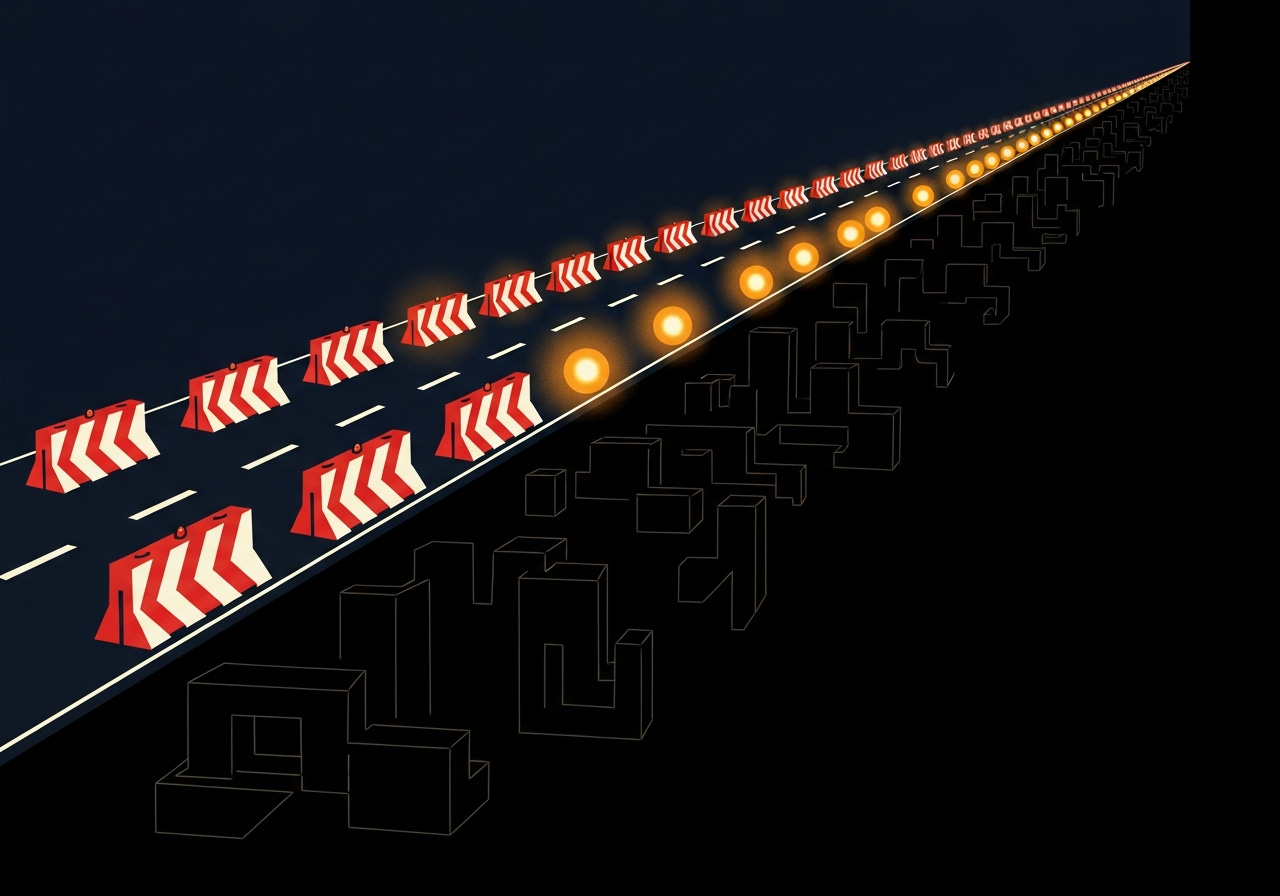
Think of it like city maintenance crews arriving to repair a major road at night. The work can’t happen while traffic is flowing. There’s a sequence. First the road closure signs go up. Then the amber hazard lights start flashing. Then, only when the area is fully secured, do they shut the power so the crew can do the real work. Each step prepares for the next. Skip a step and the repairs don’t happen safely.
Your brain runs the same protocol every night.
Non-REM Stage 1 (N1): Imagine the maintenance crew arriving at the site. The first thing they do is set up road closure signs and cones. Traffic is being redirected. The road isn’t closed yet, but everyone is being told that it’s about to be. This is what N1 looks like in your brain. You’re drifting. Brain waves slow from the rapid beta waves of wakefulness to the gentler alpha and theta rhythms. This stage lasts maybe five to ten minutes. You’re not asleep yet, but you’re no longer fully awake. The signs are up. The closure is coming.
Non-REM Stage 2 (N2): Now picture the amber hazard lights clicking on, one by one, down the length of the road. The barriers are in place. The occasional car might still drift past, but the zone is increasingly protected. This is the bulk of your night. About 50% of total sleep time happens here. Your body temperature drops. Heart rate slows. The brain produces sleep spindles, brief bursts of electrical activity that function like those amber lights, warding off external disruptions before they can penetrate the work zone. This stage also consolidates motor learning. If you’ve ever practiced a new exercise at the gym or rehearsed a presentation and woken up slightly better at it, this protected zone is where that encoding happened. The skill was transferred while you were unconscious.
Non-REM Stage 3 (N3): Now the power goes off. The entire block is dark. The maintenance crew finally has what it needs: complete control of the environment. No traffic. No lights. No interruptions. The heavy machinery comes out. This is slow-wave sleep, named for the long, rolling delta waves that dominate the EEG. An EEG, or electroencephalogram, is essentially a way to eavesdrop on your brain’s electrical conversation with itself. Electrodes on the scalp pick up the collective chatter of millions of neurons. During N3, that chatter slows into long, synchronized waves, like a stadium crowd shifting from chaotic shouting to a single rhythmic chant.
N3 is where the real restoration happens. Growth hormone floods the bloodstream. You’ve probably heard this term before. Fitness magazines mention it. Anti-aging clinics sell it. But what is it actually doing?
Think of growth hormone as the foreman showing up to the construction site with the work orders. The crew is there. The materials are available. But nothing gets built until someone arrives with the authorization and the blueprints. Growth hormone is that authorization. It tells your cells to start repairing damaged tissue, to synthesize new proteins, to break down fat stores for energy, to actually do the construction work that keeps your body functioning. Without adequate growth hormone, the crew just stands around. The materials sit unused. The repairs don’t happen.
This is why N3 matters so much. The foreman only shows up when the power is off and the site is secure. Disrupt deep sleep, and the work orders never get issued.
Tissue repair accelerates. The immune system does its maintenance. But something else happens here that matters enormously for decision-makers.
N3 is when the brain cleans itself.
The glymphatic system, discovered only in 2012 by Maiken Nedergaard’s lab at the University of Rochester, is essentially a waste removal network that activates during deep sleep. It works by pumping cerebrospinal fluid through brain tissue. Cerebrospinal fluid is the clear liquid that surrounds and cushions your brain, functioning like the hydraulic fluid in a machine, except this fluid also carries away debris. During N3, this fluid flushes through the spaces between neurons, clearing out metabolic waste including beta-amyloid. Beta-amyloid is a sticky protein fragment that accumulates in the brain over time, clumping together like soap scum in a pipe. In small amounts it’s harmless, but when it builds up, it’s associated with Alzheimer’s disease and cognitive decline.
During wakefulness, this cleaning system runs at about 5% efficiency. Remember your fingers. That’s half a finger trying to do the work of ten. During N3, it runs closer to 100%. All ten fingers. The difference between barely functioning and fully operational.
(If you’re reading this and wondering how on earth a finger discussion showed up, it’s probably because you’ve skimmed the article and missed the percentages guide at the start. If this is you, it will help to start at the top. If you have read it, carry on.)
You’re not resting during deep sleep. You’re taking out the neurological trash.
This is also why being jolted awake during N3 feels so disorienting. Imagine a stray car somehow getting past the barriers at 3 AM, headlights blazing into the dark work zone, startling the entire crew mid-repair. The power wasn’t supposed to come back on yet. The workers scatter. Tools are dropped. The job is half-finished. That’s what a N3 interruption feels like. You wake up groggy, disoriented, and unrested because the maintenance got cut short.
REM Sleep: The final stage, characterized by rapid eye movements and vivid dreaming. This is where emotional processing and complex memory consolidation occur. But that’s another article.
The cycle repeats roughly every 90 minutes. Early in the night, N3 dominates. Toward morning, REM takes over. This matters because people who cut sleep short usually sacrifice late-night REM. People who struggle to fall asleep or wake frequently sacrifice N3.
Different failures. Different costs.
But what determines when you feel the pull toward sleep in the first place? What builds the pressure that eventually becomes irresistible?

The Adenosine Clock
The answer is a molecule called adenosine.
Adenosine accumulates in your brain every moment you’re awake. Think of it as a biological hourglass. Each hour of consciousness adds another grain of sand. By evening, the chamber is full enough to trigger sleep pressure. You feel tired because you’re supposed to.
The equation is roughly linear:
Sleep Pressure = Adenosine Concentration × Time Awake
After 16 hours of wakefulness, most people hit the threshold. After 24 hours, the pressure becomes nearly irresistible.
Caffeine interrupts this system in a specific way. It doesn’t give you energy. It blocks adenosine receptors. The adenosine is still accumulating. You just can’t feel it. The molecule sits in your bloodstream, waiting, while you push through your afternoon meetings chemically blind to how depleted you actually are.
Caffeine has a half-life of roughly five to six hours. For example, if you drink a cup at 3 PM, half that caffeine is still active at 9 PM. You may fall asleep on schedule, but the caffeine interference degrades the quality of that sleep. Specifically, it reduces N3. The deep restorative phase gets truncated.
You wake up having slept but not having restored. The adenosine you masked yesterday is partially still there. So you drink more coffee. The cycle compounds.
This is why some people can “function” on five hours of sleep for years and then collapse catastrophically. The debt doesn’t announce itself. It accumulates silently until the system fails.
But adenosine only explains half the equation. It creates the pressure to sleep. A second system creates the pressure to stay awake.

The Cortisol Curve
Cortisol is often called the “stress hormone,” which is misleading. It’s more accurate to call it the mobilization hormone. Cortisol tells your body to release glucose, increase alertness, and prepare for action. It’s the counterweight to adenosine, the force that keeps you functional even as sleep pressure builds.
In a healthy system, cortisol follows a predictable daily curve:
6 AM: Cortisol spikes sharply. This is the cortisol awakening response (CAR). It’s your body’s natural alarm clock, flooding your system with energy to transition from sleep to wakefulness.
Morning to midday: Cortisol remains elevated, supporting focus and executive function.
Afternoon: Gradual decline begins.
Evening: Cortisol drops to its lowest point, removing one of the barriers to sleep onset.
First half of the night: Cortisol stays suppressed, allowing N3 to dominate.
Pre-dawn: Cortisol begins rising again, preparing you for the next awakening.
The mathematics of optimal performance depend on this curve staying intact.
Now consider what chronic stress does.
When you’re running a team through a crisis, managing a difficult board, or navigating a reorganization, cortisol doesn’t politely decline at 6 PM. It stays elevated. The emergency signal never shuts off.
Elevated evening cortisol directly suppresses N3. You fall asleep, but you don’t drop into deep sleep efficiently. The glymphatic cleaning cycle runs poorly. Growth hormone release diminishes. You wake up having completed sleep cycles but without the restoration those cycles should have delivered.
This is why people under sustained pressure often say they’re sleeping but not feeling rested. They’re telling the truth. The architecture of their sleep is intact. The content is degraded.
So adenosine builds the pressure to sleep. Cortisol provides the opposing pressure to stay alert. But neither system actually initiates sleep. That job belongs to a third molecule, one governed not by time or stress but by light.
The Melatonin Switch
Melatonin is produced by the pineal gland, a tiny structure deep in the brain. Its release is governed by light exposure to the retina, specifically the absence of blue-spectrum light.
The mechanism works like this: specialized photoreceptor cells in your eyes (distinct from the rods and cones that handle vision) detect ambient light levels and send signals to the suprachiasmatic nucleus, or SCN. The SCN is a tiny cluster of about 20,000 neurons sitting just above where your optic nerves cross. Think of it as the brain’s master clock, the central dispatcher that keeps all of your body’s daily rhythms synchronized. When light decreases, the SCN tells the pineal gland to begin melatonin synthesis.
The process takes about two hours. Melatonin levels begin rising around 9 PM in most adults and peak between 2 and 4 AM.
Melatonin doesn’t make you sleep. This is a common misconception. It signals to your body that darkness has arrived and sleep is now biologically appropriate. It lowers core body temperature slightly, reduces alertness, and opens the gate for sleep initiation. Think of it less as a sedative and more as a permission slip.
The problem is obvious: we’ve engineered an environment that defeats this system entirely.
Most people in industrialized countries spend their evenings staring at screens emitting precisely the wavelength of light (460-480 nanometers, peak blue) that suppresses melatonin production most effectively. Studies from Harvard and elsewhere have shown that two hours of evening screen exposure can delay melatonin onset by 90 minutes and reduce total melatonin production by 50%. That’s five fingers gone. Half your melatonin never arrives.
You’re not failing to fall asleep because of willpower. You’ve chemically disabled the permission slip.
These three systems, adenosine, cortisol, and melatonin, work together to govern when you sleep, how deeply you sleep, and how restored you wake. Disrupt any one of them and you pay a price. Disrupt all three, which modern life makes remarkably easy to do, and the costs extend far beyond feeling tired.
The Metabolic Consequences
Matthew Walker’s lab at UC Berkeley and others have documented what happens to glucose regulation after sleep restriction.
Take healthy adults. Limit them to four hours of sleep for six nights. Their glucose metabolism degrades to the point where they’d be classified as pre-diabetic. Insulin sensitivity drops by 40%. That’s four fingers gone, four fingers trying to do the work of ten. Leptin (the hormone that signals satiety) falls. Ghrelin (the hormone that signals hunger) rises.
But the metabolic damage goes deeper than appetite. Sleep deprivation fundamentally alters your hormonal environment in ways that sabotage body composition even when you’re doing everything else right.
Growth hormone, critical for muscle protein synthesis and fat metabolism, is released primarily during N3. Truncate deep sleep, and you truncate the signal that tells your body to build muscle and mobilize fat stores. Testosterone, which plays a key role in metabolic function for both men and women, follows a similar pattern. Studies show that men sleeping five hours per night have testosterone levels equivalent to someone ten to fifteen years older.
This creates a brutal math problem for anyone over forty.
For example, consider a man in his mid-forties who eats clean, lifts weights three times a week, and still can’t shift the visceral fat around his midsection. He’s doing the behavioral inputs correctly. But his hormonal environment is working against him. Chronically elevated cortisol (from stress and poor sleep) signals the body to store fat, particularly in the abdominal region. Suppressed growth hormone means reduced fat mobilization during rest. Lowered testosterone means diminished muscle protein synthesis, which lowers basal metabolic rate.
The math looks like this:
Body Composition = (Caloric Balance) × (Hormonal Environment)
You can control the first variable perfectly and still lose the equation if the second variable is degraded. This is why some people hit the gym religiously, track their macros, and plateau indefinitely. The limiting factor isn’t discipline. It’s sleep.
A study published in the Annals of Internal Medicine demonstrated this directly. Researchers put dieters on identical caloric deficits with different sleep allowances. The sleep-restricted group lost the same amount of weight but 55% more of that weight came from lean mass rather than fat. Close one hand. That’s the difference. They were cannibalizing muscle while preserving fat. Same diet. Same exercise. Different sleep. Opposite metabolic outcomes.
If you’re optimizing your nutrition while neglecting sleep, you’re fighting your own endocrine system. And your endocrine system will win.
The metabolic damage is measurable. But for anyone whose job depends on thinking clearly, the cognitive damage is worse.
The Cognitive Tax
Sleep deprivation impairs the prefrontal cortex before anything else. This is the region responsible for working memory, logical reasoning, impulse control, emotional regulation, and complex decision-making. In other words: everything an executive is paid to do.
David Dinges at the University of Pennsylvania ran a study tracking cognitive performance across different sleep conditions. After two weeks of six hours of sleep per night (which many high performers would consider adequate), subjects showed cognitive impairment equivalent to someone who had been awake for 24 hours straight.
The cruel twist: the subjects didn’t feel that impaired. Their subjective sense of their own function remained relatively stable while their actual performance cratered.
This is the trap. Sleep deprivation erodes the very cognitive capacity you’d need to recognize that you’re sleep-deprived. You feel fine. You’re not fine. You’re making decisions with a brain running on degraded hardware, and the degradation has disabled the warning light.
For example, I’ve watched executives make bet-the-company decisions at the end of weeks where they averaged five hours a night. They weren’t being heroic. They were being neurologically reckless. If they were making those decisions after five drinks, we’d intervene. When they make them after five nights of insufficient sleep, we call it dedication.
The Practical Framework
So what does this mean for someone running a demanding life?
First, stop thinking about sleep as time lost. Think about it as cognitive capacity. Seven hours of sleep followed by sixteen hours of high executive function outperforms five hours of sleep followed by nineteen hours of degraded performance. The math isn’t close.
Second, protect N3. This means finishing eating three hours before sleep, since digestion elevates core body temperature and suppresses deep sleep. It means cutting caffeine by early afternoon, since the half-life guarantees interference otherwise. It means managing evening cortisol through whatever works for you: exercise earlier in the day, a wind-down routine, dealing with stressful communications before 6 PM rather than in bed.
Third, protect the melatonin onset window. Reduce screen brightness after sunset. Consider blue-light filtering. Better yet, shift to non-screen activities for the last hour. Your pineal gland evolved for firelight, not LED backlighting.
Fourth, recognize that sleep debt is real but non-linear. You can’t bank sleep, but you can partially recover. One night of good sleep won’t erase a week of deprivation, but it will restore some function. For example, if you have a board presentation on Thursday, protecting your sleep Tuesday and Wednesday night matters more than any last-minute preparation you’d do at midnight.
The Bottom Line
There’s a machismo in business culture around sleep deprivation. The executive who sleeps four hours is admired. The one who protects eight hours is suspected of lacking commitment.
This is backwards in a way that should be embarrassing.
Sleep is not a luxury that the serious person sacrifices for results. Sleep is the biological process that makes results possible. The person who chronically undersleeps isn’t outworking you. They’re compromising the very organ that generates their judgment, their creativity, and their capacity to lead.
You would never brag about making major decisions after five beers. You should feel the same way about five hours of sleep.
The brain you’re using to run your company, your team, your life, is built during the hours you’re unconscious. Shortchange those hours, and you’re not optimizing. You’re degrading.
The most productive thing many leaders could do tomorrow is nothing.
Just sleep.