
Before you start reading this article, try something.
Think of a particular outcome in your life. A decision you made. A job you took or left. A relationship you ended. A risk you accepted. Something with weight.
Now remember it as best you can. The event itself. What happened. How it resolved.
Got it?
Good. Now try to remember your thought process. The reasoning that led you there. The doubts you entertained. The options you weighed and discarded. The moment the conclusion formed.
Which was easier to recall? The outcome or the thought process?
If you are like most people, the outcome came quickly. The thought process came in fragments, if at all. Maybe a vague impression. Maybe nothing.
We walk around with fogged impressions of our past cognition. We remember that we thought, rarely how. And this has profound implications for how we judge ourselves across time.
Scaffolding and Storage
The brain is not a recording device. It is a storytelling machine. When an experience enters long-term memory, the brain does something counterintuitive. It strips away most of the contextual scaffolding. The intermediate reasoning. The alternative paths considered and rejected. What remains is a compressed summary: the event, the emotional valence, the outcome.
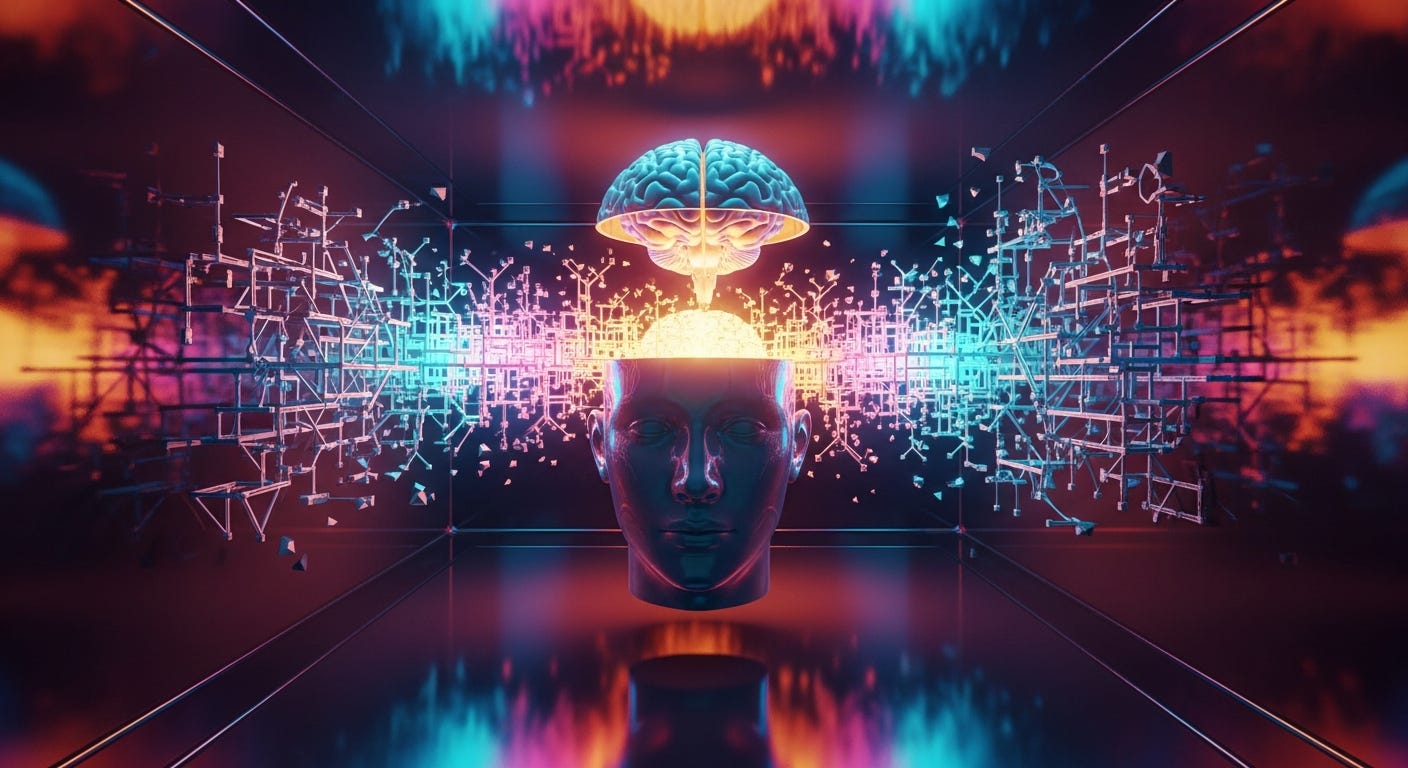
Think of it in computational terms. Your thought process operates in something like cache memory. Fast, volatile, high-bandwidth. It serves its function in the moment: weighing options, running simulations, producing a conclusion. Once the conclusion is reached and acted upon, the cache clears. The outcome writes to persistent storage. The scaffolding does not survive the transfer.
Why would it? The scaffold’s job was to build the structure. Once the structure stands, the scaffold is debris. Metabolically expensive debris. The brain accounts for roughly 2% of body weight but consumes about 20% of daily energy. Reasoning is costly. Storing the full trace of every decision tree would be astronomically wasteful. The brain solves this by keeping outputs and discarding process.
When we try to recall the past, we do not retrieve a stored file. We rebuild. The brain keeps fragments and fills the rest with inference, current beliefs, plausible guesses. What feels like remembering is closer to improvisation with a few constraints.
We can express this as a storage ratio:
Memory Fidelity = Outcome Retention / Process Retention
Say you made a decision to accept a job. A year later, you try to recall it.
Outcome retention: you remember that you accepted, the salary, the title, your start date. Call it 90% intact, or 0.9.
Process retention: you vaguely recall there were other options. You think you made a spreadsheet. The actual weighing of tradeoffs is gone. Call it 10% intact, or 0.1.
Memory Fidelity = 0.9 / 0.1 = 9
You retained nine times more outcome than process.
Or consider ending a relationship. Five years later, you remember that you broke up, roughly when, maybe where. Outcome retention: 0.85.
But the weeks of internal debate? The moment you realized it was over? The specific accumulation of disappointments that crossed some threshold? You have a vague sense that you were unhappy. The granular reasoning is gone. Process retention: 0.05.
Memory Fidelity = 0.85 / 0.05 = 17
The what survived. The why did not.
For most episodic memories, this ratio is heavily skewed. Outcomes approach 1. Process approaches 0. The decision persists. The deliberation evaporates.
Why We Repeat Ourselves
People repeat mistakes. Organizations repeat failures. Societies repeat cycles. “History repeats itself” is treated as a proverb, but it may be closer to a diagnosis.
Fritz Oser and Maria Spychiger, educational psychologists at the University of Fribourg, developed a concept they call “negative knowledge.” This is knowledge about what NOT to do, how things DON’T work, which strategies DON’T lead to solutions. Their research shows that avoiding the repetition of errors requires building this kind of knowledge. You need to retain not just the outcome, but the procedural understanding of why something failed.
The problem is that procedural understanding lives in the scaffolding. And the scaffolding gets cleared.
When you remember only that a decision led to a bad result, you have an outcome without a map. You know the destination was wrong. You do not know which turns led you there. The next time you face a similar fork, you have no negative knowledge to draw on. You cannot avoid the bad path because you never encoded why it was bad.
This is why someone can fail at the same type of relationship repeatedly. Or make the same strategic error across multiple jobs. Or fall for the same rhetorical trick in successive political cycles. The outcome is stored. The reasoning that produced it is gone. And without that reasoning, there is nothing to prevent the same sequence from running again.
Organizations face an amplified version of this problem. Institutional memory compresses even more aggressively than individual memory. The people who lived through the original failure leave. What remains are policies, procedures, outcomes. The negative knowledge that would have explained why those policies exist is lost. A new generation arrives, sees the policies as arbitrary constraints, removes them, and recreates the original failure.
We call this “not learning from history.” It may be more accurate to call it “not storing the scaffolding.”
Locked States
There is a second mechanism at work. Thought processes are not free-floating abstractions. They are coupled to internal states. Hormones. Stress levels. Sleep quality. Social context. Perceived power. Even the time of day shapes cognition in measurable ways.
Researchers call this state-dependent memory. Information encoded in one physiological configuration is best retrieved in that same configuration.

Think of it like a lock and key. The mental state you inhabited while making a decision is part of the key that accesses the memory of that decision. Change states, and the key no longer fits. The information may still be stored somewhere in the neural architecture, but the access path is blocked.
The you who was panicked during a crisis cannot fully reconstruct the reasoning of that moment when you are calm at your desk a week later. The you who was sleep-deprived and anxious during a negotiation cannot access those thoughts from a rested Sunday morning. The you who was 24 and uncertain cannot be re-entered by the you who is 40 and established.
The state is gone. And with it, the thought process it produced.
Reconstruction Errors
When we try to remember how we thought, we do not retrieve a stored recording. We reconstruct.
Each recall is a fresh assembly. Current beliefs, current models, current self-concept serve as the raw materials. We fill gaps with inference. We smooth inconsistencies with narrative logic.
Kahneman documented this in his research on hindsight bias. Asked to reconstruct their former beliefs, people retrieve their current ones instead. It is an instance of substitution. And most cannot believe they ever felt differently.
When you look back at your past self and think “I was so naive” or “I was making obvious mistakes,” you may be suffering from a reconstruction error. You are re-simulating old decisions using newer mental models. The simulation naturally looks inefficient. You have changed the software and are judging the outputs of an older version.
The past collapses into a straight line. But lived reality was branching, probabilistic, uncertain. You just no longer remember the forks.
Feeling Stupid in Hindsight
This brings us to a common experience.
You look back at decisions made two, five, ten years ago. They seem crude. Maybe even embarrassing. The conclusion feels obvious: I was stupider then.
Not necessarily.
What you are observing is model mismatch, not intelligence differential.
Past you was reasoning inside constraints that current you has forgotten. Missing information. Different incentives. Less exposure to certain problems. More urgency. Different social costs. The conclusions appear naive because the variables are no longer visible.
It is like judging someone’s chess move without seeing the board they were playing on.
Future Hindsight
There is a logical consequence to all of this that most people avoid confronting.
If past you is subject to retrospective distortion, current you will be too. The present is simply future hindsight.
You believe your current reasoning is more rigorous. It includes meta-cognition. Awareness of biases. Social models. Incentive literacy. This is likely true. You have accumulated better error correction, better priors, better compression schemes.
But it is still bounded. There are blind spots you cannot currently detect, precisely because detecting them requires standing outside your present frame.
We can express this as a simple model. Let t represent any point in time in your life:
Intelligence(t) = Models(t) + Accumulated Experience(t) − Unknown Unknowns(t)
You read this as: your effective intelligence at any moment equals the mental models you have built, plus the experience you have accumulated, minus the blind spots you cannot see.
At t = 25, you have fewer models but also fewer blind spots operating beneath your awareness. At t = 40, you have more models but also more ways to be wrong that you cannot yet detect. The unknown unknowns grow alongside the known knowns.
Each phase feels smarter because it is locally optimal. Each future phase will see its limits because perspective always outruns memory.
Earlier versions of you were limited by lack of models. You made mistakes because you did not yet have frameworks for understanding what was happening.
Current you is limited by the models themselves. You have so many that you risk seeing everything through them. Pattern-matching replaces fresh observation. Confidence in your frameworks creates blind spots your frameworks cannot reveal. The tools that help you think also constrain how you think.
For example: five years ago, you missed that a project was doomed because you had no model for how organizational politics kills initiatives. Now, you see politics in everything, including situations that are just poor communication. The model that once corrected your naivety now overcorrects.
Or: you once took feedback at face value and missed that it was territorial. Now you interpret genuine feedback as territorial and dismiss it. You have more explanations than you need, and they compete to explain things that may not require them.
Evidence Everywhere
If this theory is correct, we should see repetition everywhere. We do.
Individuals repeating relationship failures, career mistakes, self-sabotage cycles. The entrepreneur who burns out the same way at every company. The executive who creates the same political enemies in every organization. They remember the outcomes. They do not remember the reasoning that led them there. So the sequence runs again.
Financial systems repeating speculative bubbles. Tulip Mania in 1637. The South Sea Bubble in 1720. The crash of 1929. The dot-com bubble in 2000. The housing collapse in 2008. Each generation believes it has learned from the last. Each generation stored the outcome but not the procedural understanding of how intelligent people convince themselves that this time is different.
Nations repeating geopolitical errors. Overextension. Wealth inequality breeding internal conflict. Military overconfidence after prolonged success. Rome. Spain. The British Empire. Ray Dalio studied five hundred years of empire cycles and found the same sequence. The outcomes are meticulously recorded. The reasoning of the people who lived through it is gone.
Treaties repeating the mistakes of previous treaties. Versailles imposed such harsh terms on Germany that it created the conditions for World War II. The negotiators in 1919 had access to the history of punitive peace agreements. The scaffolding of why those had failed was not available in a form they could use.
History does not repeat itself. But the scaffolding keeps getting cleared. And without it, the same sequences run again.
Most people avoid this thought. But if you have read this far, you have probably already entertained it: future you will look back at current you and find blind spots. Sitting with that possibility without flinching means something has shifted. You are no longer defending the idea that present you has it figured out. You have stopped conflating who you are with what you currently believe.
You have recognized that intelligence decays into context. That thought is transient. That wisdom lies not in preserving past reasoning, but in maintaining the capacity to revise it without humiliation.
Most people never notice this. They confuse memory with truth and confidence with correctness. They treat the feeling of knowing as proof of knowledge.
The present you is a draft, not a final version. The past you was doing their best with what they had. The future you will look back at this moment the same way you now look back at moments that feel distant and vaguely embarrassing.
You were not as stupid as you think you were. You are not as smart as you think you are. Neither was anyone else.