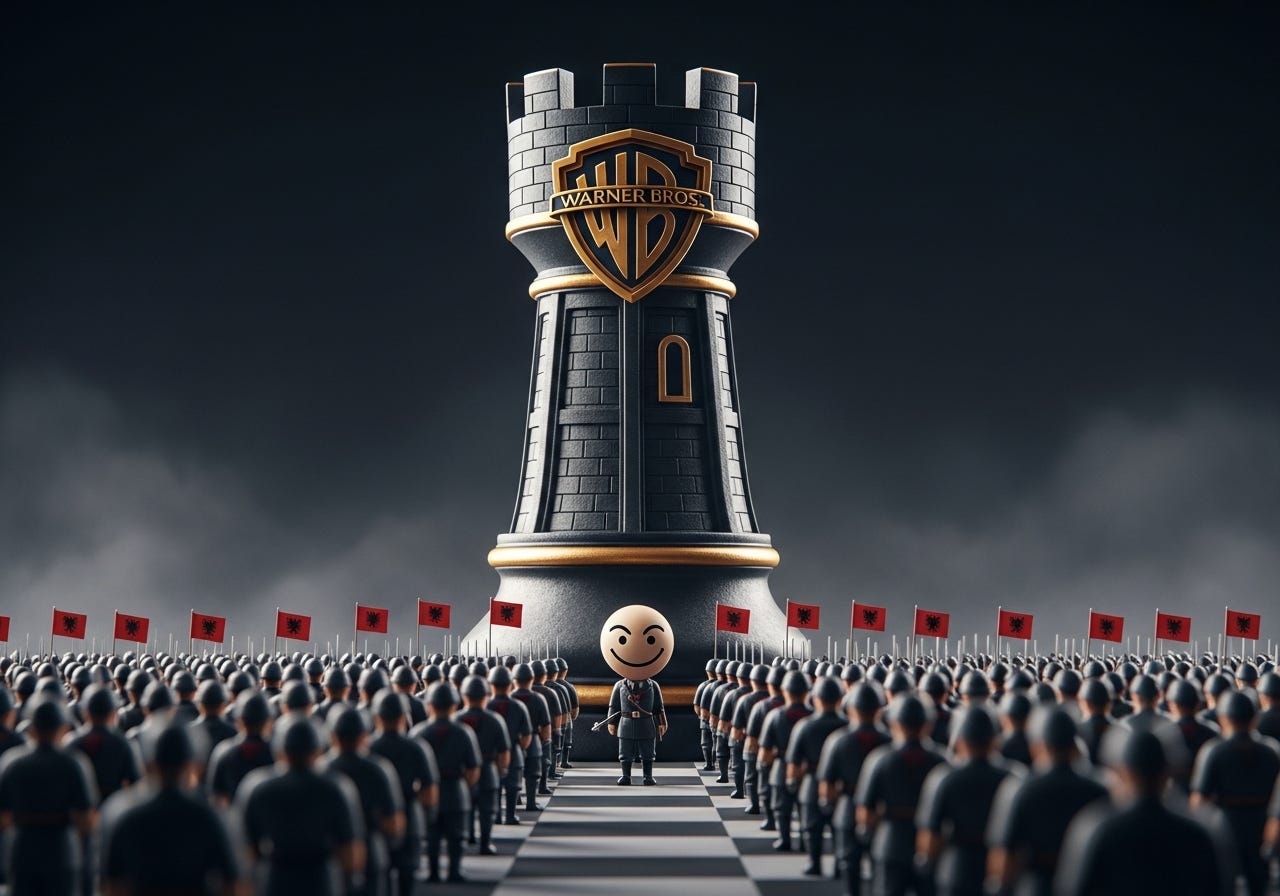
In 2011, Jeff Bewkes, then-CEO of Time Warner, was asked about Netflix’s growing influence in the entertainment industry. He compared them to “the Albanian army.”
“Is the Albanian army going to take over the world?” he smirked.
Last Friday, Netflix announced an $83 billion deal to acquire Warner Bros.
The Albanian army now owns the throne.
Yes, another Netflix-Warner Bros. article. I know. But most of what I have read this week either assumes you have an MBA or skips the parts that actually matter. This one tries to do neither.
The Bouquet Problem
For three years, Warner Bros. Discovery has been a confused asset. Call it a “bouquet” where half the flowers were blooming and half were wilting.
The blooms: HBO, Max, the Warner studio, the Batman IP.
The weeds: CNN, Discovery Channel, TNT, the entire linear cable portfolio.
Netflix wanted the blooms. They had zero interest in inheriting a dying cable business that would drag down their value and force them to apologize to investors for declining revenues every quarter.
So they forced a separation.
The Plate
Here is the simplest way to understand what just happened.
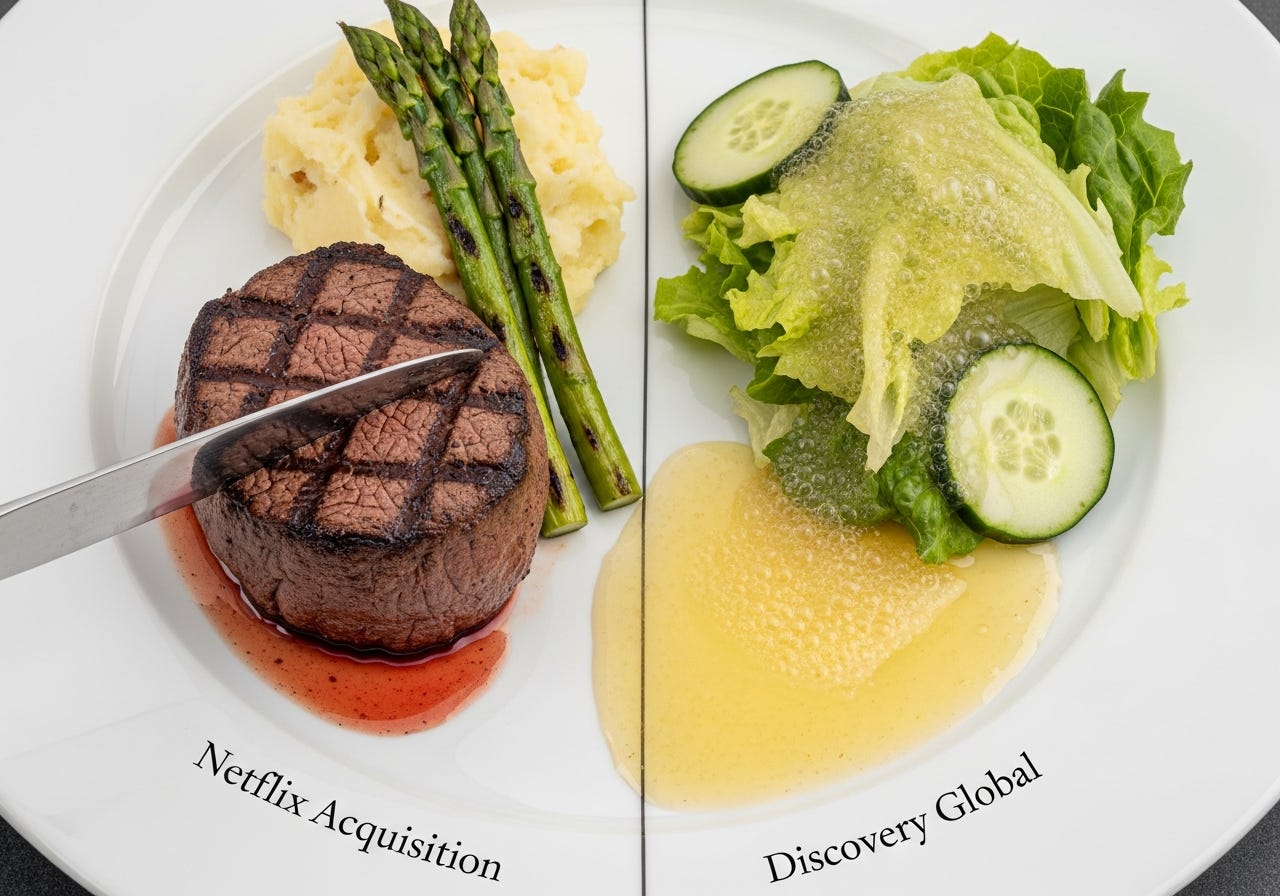
Imagine Warner Bros. Discovery as a dinner plate.
On one side, you have a prime filet mignon. The Warner movie studio. HBO. The DC Universe. Harry Potter. Game of Thrones.
On the other side, you have a wilting side salad. CNN. TNT Sports. Discovery Channel. HGTV.
And pooled across the entire plate is a thick layer of congealed fat. Thirty-four billion dollars of debt, cold and stuck to everything.
Netflix looked at the plate and said: “I’ll take the steak. You keep the salad.”
But here is the trick. The part the talking heads keep missing.
Netflix did not just refuse the salad. They made the salad absorb the grease.
Picture it: the lawyers and bankers slide a knife under the steak, lift it off the plate, and let all the fat drain down into the salad bowl. The steak comes out clean. The salad sits there, soaking in $24 billion of someone else’s problem.
That is what happened.
The Arithmetic of the Scrape
Before the deal, Warner Bros. Discovery owed $34 billion to banks and bondholders. The streaming and studio business generated cash. The linear cable business was bleeding. But the debt was stuck to the whole company like grease on a cold plate.
Netflix refused to eat the grease.
So the bankers restructured. They split the company in two and assigned roughly 70% of the debt to the spinoff company, Discovery Global. That is $24 billion in IOUs handed to a shrinking cable portfolio.
Netflix takes the remaining $10 billion.
The final math looks like:
Netflix pays $72 billion to buy the company outright. Add the $10 billion in debt they are taking on, and the total price comes to $82.7 billion. Think of it like buying a house: the purchase price is $72 billion, but there is a $10 billion mortgage attached that Netflix agrees to keep paying.
For that, Netflix gets HBO, Max, Warner Bros. Pictures, DC Studios, Warner Bros. Games, and a content library spanning a century. They also get 128 million HBO Max subscribers, though most of them already subscribe to Netflix. The real prize is not the subscriber count. It is the content.
Discovery Global gets CNN, TNT, Discovery Channel, and $24 billion in debt payments funded by a subscriber base that shrinks every quarter.
One company is built to grow. The other is built to die slowly while writing checks.
The Zombie Math
Discovery Global is what happens when you create a company designed not to expand but to wind down gracefully.
Think of it like a landlord who owns an old apartment building. The tenants are moving out. The neighborhood is declining. But the landlord still has a mortgage. So they collect rent from whoever is left, pay the bank every month, and wait for the building to empty. They are not trying to attract new tenants. They are just trying to survive long enough to pay off the loan.
That is Discovery Global.
Linear cable revenue dropped 9% last year. Operating profit dropped 25%. The trajectory is clear. Every quarter, fewer households pay for cable. Every quarter, the cash available to service that $24 billion shrinks.
Netflix looked at that trajectory and decided: not our problem.
They paid a 121% premium over what Warner Bros. Discovery stock was worth in September. They offered a $5.8 billion penalty fee if regulators kill the deal. They are spending real money to ensure they never have to explain cable decline on an earnings call.
Is it fair to the shareholders left holding Discovery Global? Not really.
Is it brilliant? Absolutely.
The Cost of the Knife
Netflix did not pay $83 billion in cash. Nobody pays $83 billion in cash. They borrowed.
Think of it like buying a house. You do not show up with a suitcase full of money. You get a loan.
Netflix got a very specific kind of loan called a “bridge loan.” The name tells you what it does. It bridges the gap between today and the day the deal closes. It is short-term, expensive money meant to get you through the door. You take it because you need cash now, but you never plan to keep it. The moment the deal closes, you replace it with cheaper, longer-term debt.
Wells Fargo, BNP Paribas, and HSBC put together a $59 billion bridge loan for Netflix. This is the largest loan of its kind ever extended to a single company. Wells Fargo alone committed $29.5 billion, the biggest single-bank bet in acquisition history.
The interest rate on the bridge is roughly 5.25%. Here is how that breaks down:
Banks have a “wholesale” interest rate they charge each other for overnight loans. It is called SOFR (Secured Overnight Financing Rate). Right now it sits around 4.5%. When Netflix borrows, they do not get the wholesale price. They pay wholesale plus a markup. Netflix’s markup is 0.75%. So: 4.5% plus 0.75% equals 5.25%.
Once the deal closes, Netflix will refinance. They will replace the expensive bridge loan with a mix of cheaper options: $25 billion in bonds sold to pension funds and insurance companies, $20 billion in medium-term bank loans, and a $5 billion line of credit they can tap if needed.
Call it 5.5% blended interest once the dust settles. On $59 billion, that is roughly $3.25 billion per year in interest payments.
Three and a quarter billion dollars. Every year. Just to service the loan.
The Subscriber Math
Now lets unpack what this could mean…
Netflix has 302 million subscribers. HBO Max has 128 million. But you cannot just add them together.
On the investor call, Netflix co-CEO Greg Peters admitted there is “high overlap” between the two subscriber bases. Research backs this up: over 80% of people who subscribe to one streaming service also subscribe to Netflix. The average American household already pays for four streaming services.
In the US, where HBO Max has 57 million subscribers, assume 80% of them already have Netflix. That is 45 million people who pay for both. Internationally, where HBO Max has 71 million subscribers and only recently launched in many markets, assume 50% overlap. That is another 35 million people who pay for both.
Total overlap: roughly 80 million subscribers who already pay for Netflix and HBO Max.
Unique HBO Max subscribers Netflix is actually gaining: 128 million minus 80 million equals 48 million net new customers.
Combined unique subscriber base: 302 million plus 48 million equals 350 million.
Now do the math that matters.
Netflix needs to pay $3.25 billion per year in interest. Divide that by 350 million subscribers:
$3.25 billion ÷ 350 million = $9.29 per subscriber per year
That is $0.77 per subscriber per month.
Netflix needs to extract an additional seventy-seven cents per month from each subscriber just to cover the interest on the debt. Not to pay off the principal. Just to keep the banks happy.
Seventy-seven cents. The price of a single song on iTunes in 2009. If you notice a Netflix price increase soon, congrats - you are helping clear the fat off the salad.
The Price Increase Math
Now look at what Netflix currently charges.
In North America, Netflix averages $17.26 per month per subscriber. Globally, that number drops to $11.70 because poorer countries pay less.
A single dollar increase across 350 million subscribers generates $350 million per month. That is $4.2 billion per year. More than enough to cover the $3.25 billion interest bill and leave $1 billion on the table.
But Netflix may not even need to raise prices.
They have already announced $2 to $3 billion in expected annual cost savings by year three. When two companies merge, you do not need two headquarters. You do not need two legal teams. You do not need two sets of content licensing executives negotiating the same deals. You fire the duplicates and keep the savings.
The savings alone cover the interest. Any price increase is pure profit.
This is why Netflix was willing to pay a 121% premium. They are not betting on subscriber growth. There are only so many humans on earth, and most of the ones who want streaming already have it.
They are betting on price extraction. The entire deal is underwritten by the assumption that 350 million subscribers can absorb seventy-seven cents a month without canceling.
And they are probably right.
When was the last time you canceled a streaming service over a dollar?
The Albanian Army
The talking heads are pulling up charts from the AOL-Time Warner merger in 2000. They are invoking the AT&T-WarnerMedia disaster from 2018. They are screaming “value destruction” and calling this another entry in a twenty-year lineage of disasters.
They are right that value was destroyed over the last two decades.
But Netflix did not destroy it. They just made sure they were not the ones left holding the bill.
They ate the steak. They left the check with the salad.
And Jeff Bewkes is somewhere, watching the Albanian army raise their flag over Burbank.