
This article is a product of broad curiosity into the African ecosystem and its potential in the business process outsourcing (BPO) and information technology-enabled services (ITES) sectors. It draws on a 100-page research report produced by Caribou Digital and Genesis Analytics, in partnership with the Mastercard Foundation. You may read the full report in a link at the end of this article.
Norah handles customer service tickets from 3 p.m. to midnight in Kampala, Uganda. When she started, she resolved 20 queries per shift. Then her employer introduced an AI assistant that suggests four response options for every incoming message. Now she resolves 30. Response time dropped from 10 minutes to 2. Her quota went up, her cognitive load dropped for the repetitive tickets, and her pay stayed flat.
She knows this. She also knows that first-tier support, scripted resolutions, transactional queries, should probably be automated. She isn’t afraid of that conclusion. What she told researchers from Caribou Digital is more precise than fear: “If it was fully automated, I could move on to tier two support, where we could get paid more.”
Norah has diagnosed her own situation with more accuracy than most labor economists apply to hers. The question is whether the systems around her, the governments, the BPO operators, the training institutions, the investors circling the continent’s outsourcing sector, will build what she needs to climb before the floor she is standing on disappears.
A Labor Advantage With an Expiration Date
Africa’s BPO and information technology-enabled services market is projected to reach $35 billion by 2028, growing at a compound annual rate of 14.2%. Structurally, this is a race against a faster clock.
Think of labor arbitrage the way you think about a dam holding water. The water is global outsourcing demand, currently flowing toward wherever the unit cost is lowest. Africa’s dam is tall because wages are competitive, English and French fluency is widespread, time zones align with European clients, and attrition rates are lower than in much of Asia. But AI is not competing with African wages. It is competing with the task itself. Over 40% of current tasks in Africa’s BPO sector are susceptible to automation within five years. When those tasks go, the dam does not collapse. It becomes irrelevant.
If you model the sector’s exposure, it maps roughly to:
Risk(job) = T(auto) × W(junior) × (1 − G(growth))
T(auto) is the proportion of tasks automatable in a role, W(junior) is the employment weight of that role across the sector, and G(growth) is the rate at which new higher-complexity roles are being created to absorb displaced workers. You read this as: the gap between jobs eliminated and jobs created is widening, and the people most exposed are the ones the sector currently leans on most heavily. T(auto) is rising fast, W(junior) sits at 68% of all employment, and G(growth) is moving slowly.
Junior roles carry over half of all automatable tasks, with only 3% of their work deemed resilient. That concentration is where the risk lives.
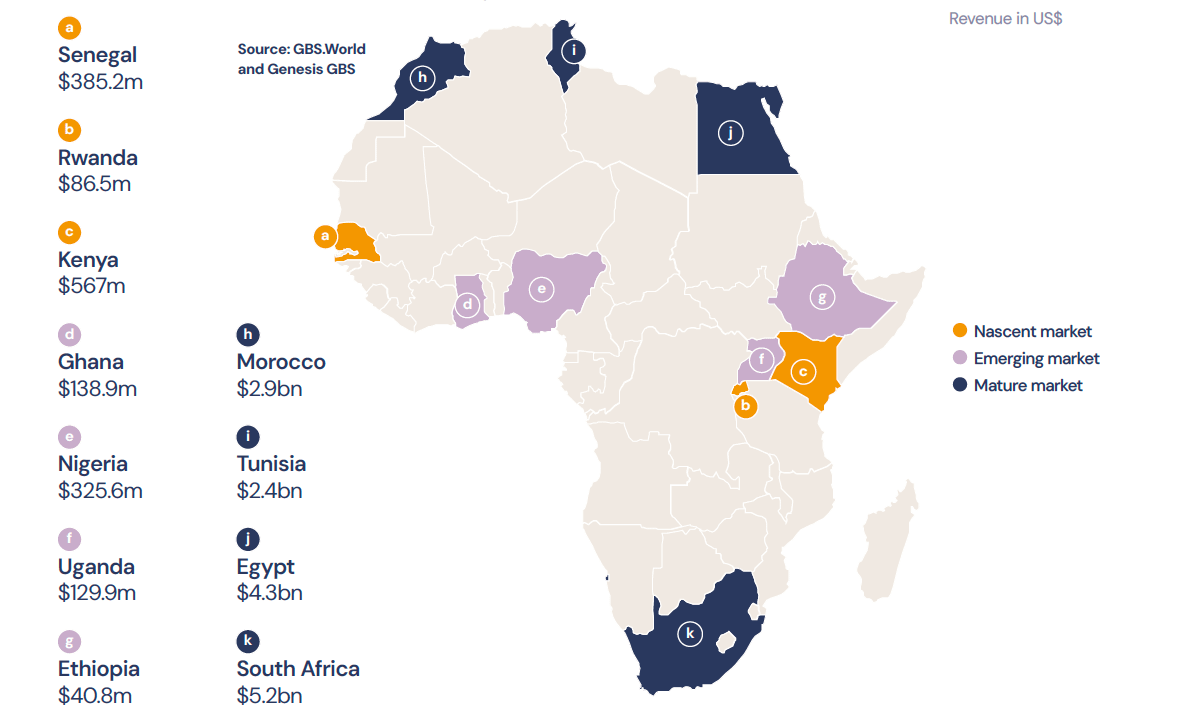
To understand the scale of what is at stake, it helps to see where the sector actually sits today. The market is heavily concentrated at the top, with three countries accounting for the vast majority of mature revenue, and most of the continent still in early stages.
Africa’s BPO/ITES market by country (2022 revenue)
Source: GBS.World and Genesis Analytics
South Africa and Egypt together account for roughly 87% of the continent’s mature market revenue. Everything below them is emerging or nascent. That concentration matters for how you read the automation risk, because the countries with the most to lose are also the ones with the most existing capacity to adapt, and the countries with the most young workers entering the sector are the ones with the least runway to do so.
The 30 Percent
One role alone, junior-level customer experience agents, comprises 30% of Africa’s total BPO workforce. In a sector of 1.1 million people, roughly 330,000 individuals whose primary daily work involves text-based inquiry handling, basic complaint resolution, and scripted troubleshooting. All three are automatable. All three are already being automated.
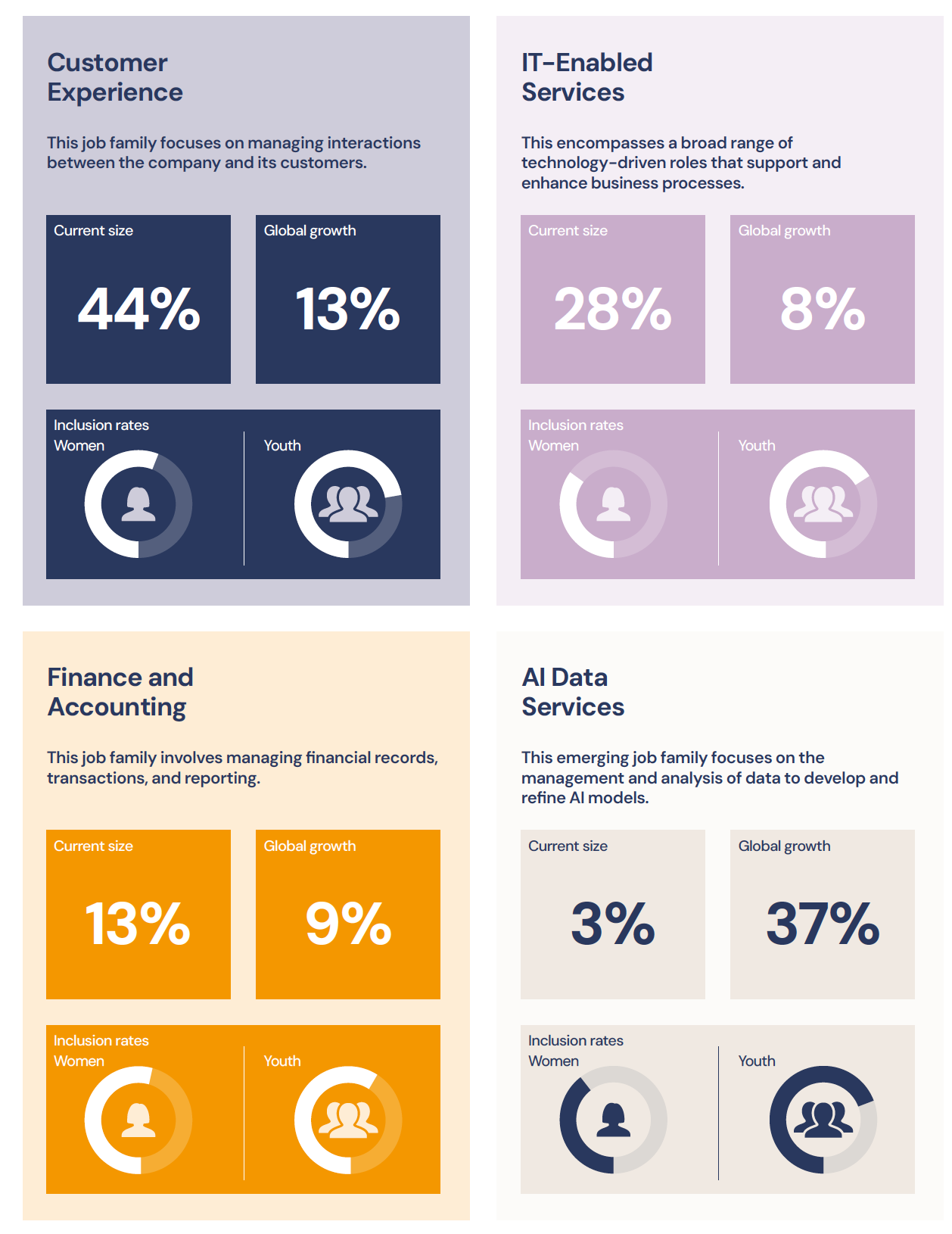
Customer experience accounts for 44% of current employment, with 72% of those roles held by youth and 56% by women. Work done by women in Africa’s BPO sector is on average 10% more susceptible to automation than work done by men, and women’s resilience score sits at 8% compared to 12% for men. Not because of any difference in capability, but because women are concentrated in the roles that automation was built to handle first.
A policy response that misses this distributional reality will miss the people most at risk.
What the ATM Actually Taught Us
In the early 1980s, economists and bank tellers watched ATMs roll out across the United States and made what seemed like an obvious prediction: teller jobs would disappear. They were wrong. ATMs reduced the number of tellers per branch. They also reduced the cost of operating a branch, which led banks to open more branches. The number of bank tellers in the United States grew between 1980 and 2010.
ATMs absorbed cash deposits, withdrawals, and balance inquiries. Human tellers absorbed cross-selling, loan consultations, dispute resolution, and judgment that a cash machine cannot exercise. The job transformed. The headcount survived. Then grew.
The BPO sector can follow the same logic, but only if it makes the same bet the banks made: invest in upgrading the human role at the same pace as the automation is deployed. The banks did not wait to see how ATM rollout played out and then respond. They redesigned the teller role in parallel.
In Africa’s customer experience sector, nearly half of all tasks are positioned for augmentation rather than replacement over the next five years. Augmentation means the job survives and becomes more complex, not that the person gets to keep doing the same thing.
The Empathy Argument Has a Problem
The standard defense of human workers in customer-facing BPO roles goes something like this: AI cannot replicate genuine empathy, so roles requiring emotional intelligence are safe. Researchers, operators, and workers themselves repeat it. Ibrahim, a customer experience worker in South Africa, told Caribou Digital researchers that customers often start with a product query and end up venting about something personal. AI, he argued, won’t relate the way a human would.
He is not wrong about what is happening in the interaction. He may be wrong about how much it matters.
AI has not built empathy. It has built something that functions as a statistically optimized proxy for empathy at scale, and for a majority of service interactions, that proxy is sufficient. When a customer is frustrated about a delayed delivery, they do not need to be understood in any deep psychological sense. They need the delay acknowledged, a resolution offered, and the tone calibrated to match their emotional register. Current generative AI does all three, at 30 queries per hour rather than 20, with no shift fatigue and no variance in tone at 11 p.m.
The interactions where human emotional judgment genuinely outperforms AI are real but narrow. Complex disputes, culturally layered conversations, situations where context shifts mid-call and the resolution requires improvisation beyond a decision tree. These exist. They are also not the dominant task composition of a junior customer experience role. The gap between the empathy argument as typically stated and the actual task distribution of the jobs it is meant to protect is large enough to matter.
This does not mean human workers have no advantage. It means the advantage is not primarily emotional. Africa’s real differentiator is cognitive range combined with linguistic depth, the ability to navigate between registers, cultures, and client expectations in ways that require accumulated social knowledge, not just warmth. That is harder to automate than tone-matching. It is also harder to sell without being specific about where it applies. The sector has not been specific yet.
Four Predictions for 2030
Finance and Accounting will contract first and hardest. The job family carries one of the sector’s highest automation risks, with 44% of current tasks automatable and junior roles facing 60% exposure. Bookkeeping, invoice processing, reconciliation, and routine financial reporting are exactly what AI-powered accounting software now handles faster, cheaper, and with fewer errors than a junior accountant. The operators who built capacity here assuming stable demand are going to be surprised by the speed of the contraction.
AI Data Services will be the sector’s growth engine, but it will employ far fewer people than Customer Experience ever did. It is the fastest-growing job family, at a projected five-year compound annual growth rate of 37%. But it currently employs 3% of the sector. Even aggressive growth from that base does not absorb the displacement coming from elsewhere. The new jobs will be better paid, more technically demanding, and substantially fewer in number.
Rural youth will be the sector’s largest missed opportunity. Around 57% of sub-Saharan Africa’s population lives in rural areas. Reliable electricity, high-speed internet, and digitally skilled workers are concentrated in cities. AI does not fix this geography. It intensifies it. The skills required to work alongside AI tools, prompt literacy, model evaluation, output quality assessment, require training infrastructure that simply does not exist in rural areas. Unless governments and donors build it deliberately and quickly, the sector’s growth will deepen the urban-rural divide rather than bridge it.
The countries that treat BPO as an AI training ground will pull ahead of those that treat it as a cost arbitrage play. The Philippines understood this before the conversation became urgent. The IT Business Process Association of the Philippines has been reskilling workers in data analytics, cloud computing, AI, and cybersecurity through coordinated industry partnerships. The continent that uses BPO employment as a pathway to AI literacy, rather than treating AI literacy as a threat to BPO employment, will capture the next wave of global outsourcing demand. Those are two different strategic orientations, and most African BPO policy currently reads like the second one.
The Reskilling Calculus
Increasing Africa’s share of global BPO demand by 10 percentage points could generate 5 million direct and 7 million indirect jobs. That outcome depends on one thing above everything else: a workforce capable of doing what the clients who generate that demand actually need. Those clients are moving up the value chain. Data analytics. AI supervision. Complex customer interactions. Strategic finance. Cybersecurity. Workers who reach those capabilities will have jobs. Workers who do not will watch the sector grow around them while their specific role shrinks.
Norah already has the right instinct. She wants to learn Python. She wants to move into data analytics. She took a short course in AI after her company introduced the tools. What she does not have is a structured pathway to get there on a salary that does not require choosing between training and rent.
That is a solvable problem. It requires employers to invest in training workers rather than simply replacing them, governments to fund pathway programs that connect current workers to future roles, and development partners to stop treating reskilling as an optional add-on to BPO investment.
Based on the current trajectory of AI capability adoption, the window for doing this before automation outpaces transition infrastructure is probably five to seven years. After that, the gap between what displaced workers can do and what the sector needs closes from the wrong direction.
What Norah Knows
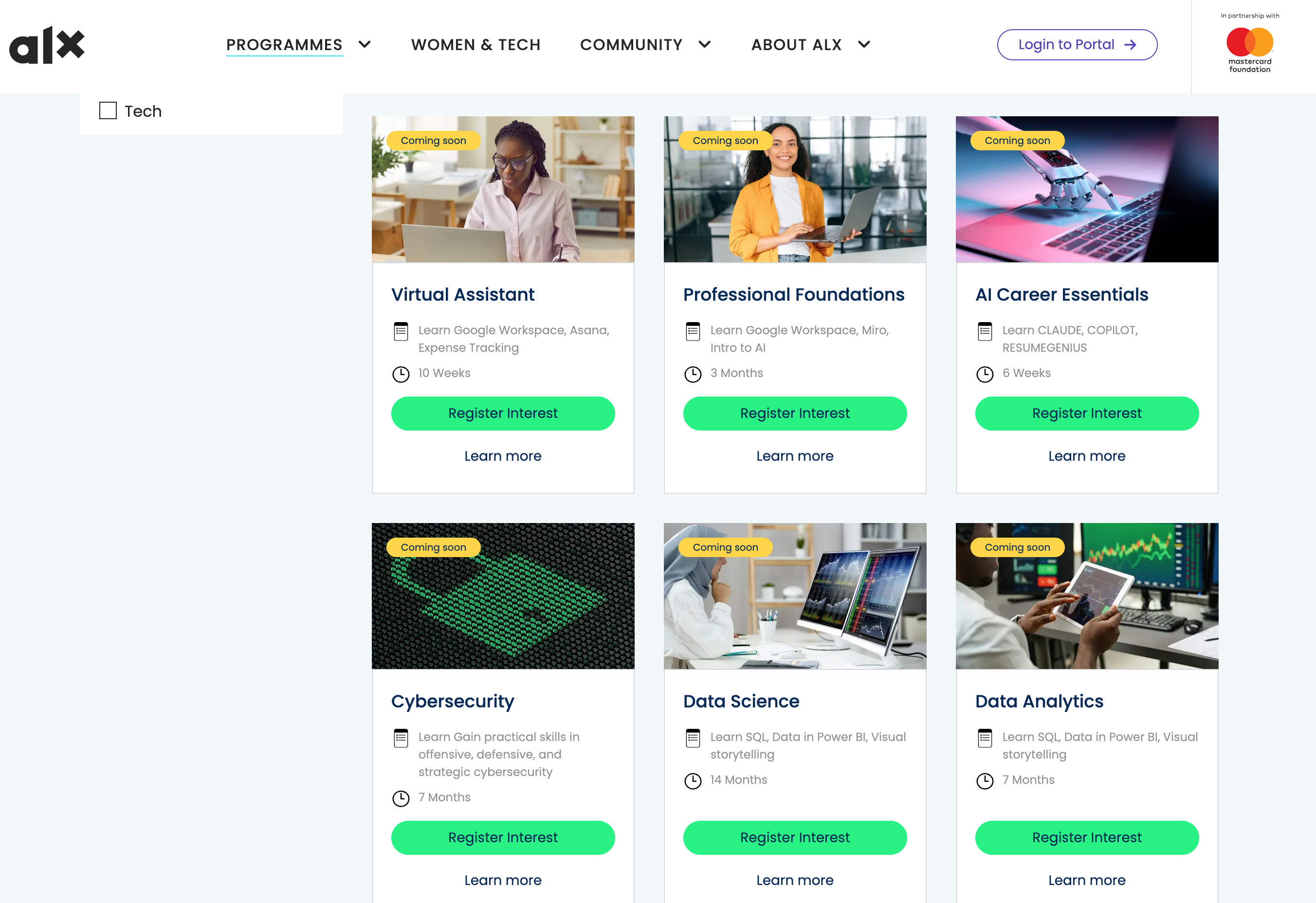
Norah is not waiting for anyone to solve this for her. She is taking courses such as those provided by ALX Africa, building skills, mapping a path from tier one support to developer to data analyst with the same clarity that someone with a management consulting background would apply to a career transition. She is doing this with fewer resources, fewer mentors, and less margin for error than anyone who will ever write a white paper about her situation.
The continent is full of Norahs. Workers who have already begun the cognitive shift from task-executor to AI-collaborator, who understand what is coming and are trying to position themselves for it, without the systemic support that would make the transition faster, cheaper, and more certain.
As with past technological revolutions, job transformation rather than wholesale displacement remains the more likely outcome. That is the honest read of the historical evidence. But transformation is not automatic. It requires decisions, investments, and structures built before the pressure arrives, not in response to it.
Africa’s BPO sector has the demographics, the linguistic range, the time zone alignment, the cost structure, and the appetite. What it needs now is the deliberate architecture to convert a labor arbitrage story into a capability story before the arbitrage expires.
Key Takeaways
Over 40% of current BPO tasks in Africa are automatable within five years, with junior roles carrying 52% exposure. Women face a 10% higher automation risk than men due to concentration in front-line roles.
Finance and Accounting carries the sector’s highest automation exposure at 44% of tasks, with junior levels reaching 60%. Contraction here will move faster than most operators are planning for.
AI Data Services is growing at 37% annually but currently employs only 3% of the sector. The growth is real; the absorption capacity for displaced workers is not.
Rural youth face structural exclusion from the sector’s next chapter unless connectivity, training infrastructure, and device access are treated as prerequisites rather than aspirations.
The empathy defense of human labor is weaker than it sounds. AI has compressed emotional calibration into a statistical function that is good enough for most service interactions. The real human advantage is cultural and cognitive range, and the sector has not yet learned to price it.
Operators that reposition from cost-per-ticket to outcome-quality-per-interaction will access a different buyer market with different margin profiles. That repositioning requires deliberate investment in human capability now, not after automation has already compressed the workforce.
Preparing For AI In The BPO And ITES Sector In Africa
Nazstack publishes research-backed essays on human behavior, cognitive psychology, marketing science, and the systems that shape how people and organizations actually work. Subscribe below.